
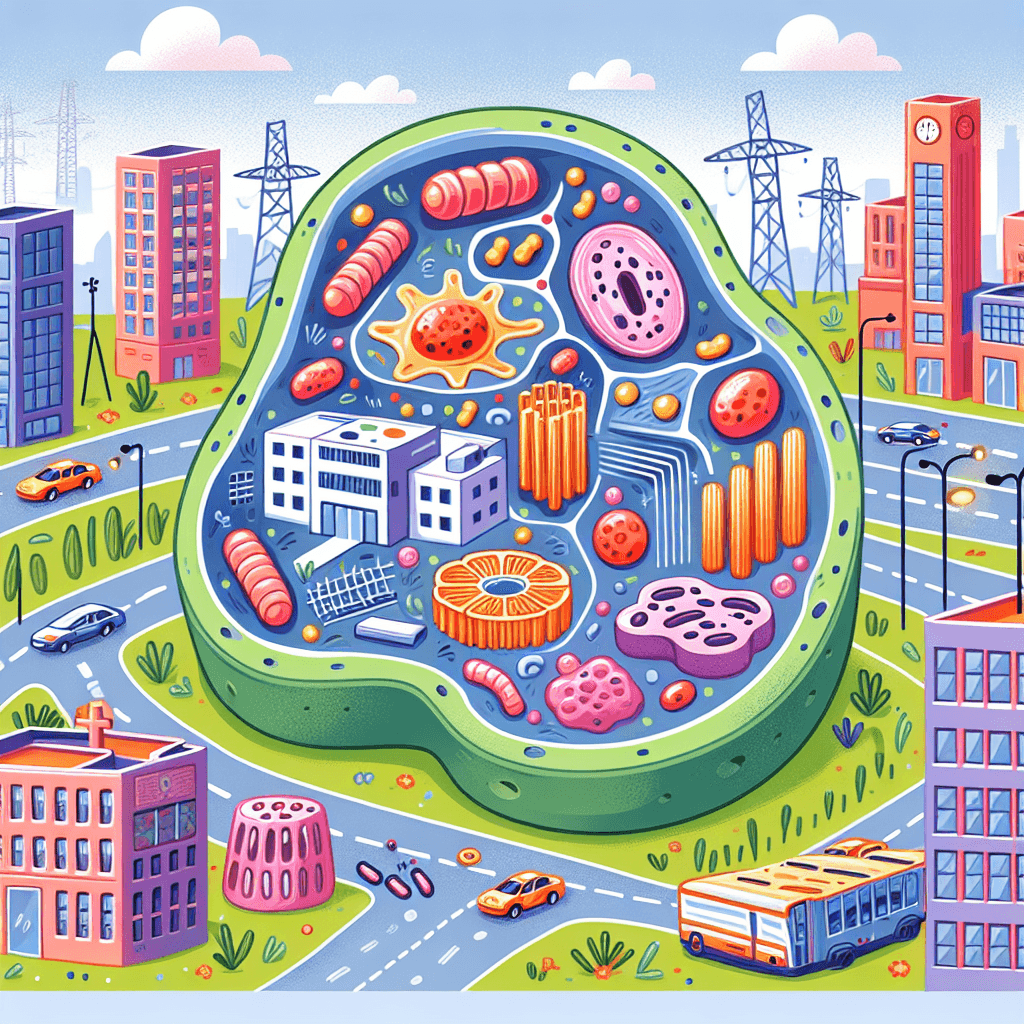
Cell City: A Microscopic Metropolis
Inquiry Framework
Question Framework
Driving Question
The overarching question that guides the entire project.How can we design a 'Cell City' that models the functions of a cell and promotes understanding of cellular processes, waste management, energy production, and overall health, drawing parallels between urban planning and cellular biology?Essential Questions
Supporting questions that break down major concepts.- How do the different parts of a cell work together to keep it alive and healthy?
- In what ways is a cell like a city, and what can we learn from this comparison?
- How do cells get what they need to survive, like food and water?
- What happens to waste inside a cell, and how does it get rid of it?
- How do cells get energy to do all their important jobs?
- What are the main differences between plant and animal cells, and why are these differences important?
- How do different types of cells work together in our bodies to keep us healthy?
- What can we do to keep our cells healthy and strong?
Standards & Learning Goals
Learning Goals
By the end of this project, students will be able to:- Students will be able to describe the basic structure and function of cells, including the roles of key organelles.
- Students will be able to develop a model of a 'Cell City' that effectively demonstrates the functions of cellular components and their interactions.
- Students will be able to explain how cells obtain nutrients, dispose of waste, and produce energy.
- Students will be able to compare and contrast plant and animal cells.
- Students will be able to construct an argument, supported by evidence, that relates cell functions to the overall health and well-being of a multicellular organism.
- Students will be able to make connections between cellular processes and urban planning, recognizing parallels in resource management, waste disposal, and energy production.
Teacher-specified Standards
Entry Events
Events that will be used to introduce the project to studentsCellville Crisis: An Urban Planning Emergency
A local news report announces a crisis in Cellville: essential services are failing, and the city is on the brink of collapse. Students, as newly appointed urban planners, must investigate the malfunctioning organelles (buildings) and propose solutions to restore the city's health and functionality.The Missing Blueprints: Engineering a Sustainable Cell City
Students receive a mysterious package containing blueprints for a new cell city but crucial parts are missing. They must reverse-engineer the existing designs, research organelle functions, and complete the blueprints to ensure the city's survival and sustainability.Portfolio Activities
Portfolio Activities
These activities progressively build towards your learning goals, with each submission contributing to the student's final portfolio.Cell City Blueprints: Designing Our Microscopic Metropolis
Students design their own 'Cell City' blueprint, assigning each organelle a role as a building or service within the city. This activity requires them to demonstrate how organelles work together to maintain the cell's life processes.Steps
Here is some basic scaffolding to help students complete the activity.Final Product
What students will submit as the final product of the activityA detailed blueprint of the Cell City, showing the layout of organelles (buildings), their assigned functions, and connecting pathways that represent the flow of resources and waste.Alignment
How this activity aligns with the learning objectives & standardsCovers 6.MS-LS 1.2 by tasking students with modeling how organelles contribute to cellular functions.Cell City Operations: Resource Management & Sustainability
Students create a detailed infographic explaining how their Cell City obtains resources, disposes of waste, and generates energy, connecting each process to specific organelles and their functions.Steps
Here is some basic scaffolding to help students complete the activity.Final Product
What students will submit as the final product of the activityAn infographic that visually explains the processes of resource acquisition, waste management, and energy production in the Cell City, with clear labels, diagrams, and concise descriptions.Alignment
How this activity aligns with the learning objectives & standardsAddresses 6.MS-LS 1.2 by focusing on the processes of obtaining resources, waste disposal and energy production within the cell.Cell City's Impact: A Healthy Metropolis, A Healthy Organism
Students write a persuasive essay arguing how the efficient functioning of their Cell City (and its organelles) is essential for the health and sustainability of a larger organism.Steps
Here is some basic scaffolding to help students complete the activity.Final Product
What students will submit as the final product of the activityA well-written essay that persuasively argues the importance of efficient cellular function for the overall health and sustainability of a multicellular organism, using the Cell City analogy to illustrate key points.Alignment
How this activity aligns with the learning objectives & standardsConnects to 6.MS-LS 1.3 by prompting students to consider how cellular functions contribute to the overall health and well-being of a multicellular organism, and touches upon sustainability and health.Organelle ID: Meet the Cell City Residents
Students create a 'Cell Organelle ID Card' for each major organelle, detailing its structure and function. This activity introduces organelles as the building blocks of the cell city.Steps
Here is some basic scaffolding to help students complete the activity.Final Product
What students will submit as the final product of the activityA set of illustrated ID cards, each profiling a different cell organelle with labeled diagrams and function descriptions.Alignment
How this activity aligns with the learning objectives & standardsAddresses 6.MS-LS 1.1 by establishing the foundational understanding that all living things are made of cells.Rubric & Reflection
Portfolio Rubric
Grading criteria for assessing the overall project portfolioCell City Project Assessment Rubric
Conceptual Understanding
Assess students' understanding of cellular structure and function as demonstrated through the cell city analogy.Organelle Function Allocations
Accuracy in assigning functions to organelles and analogies to city structures.
Exemplary
4 PointsAll organelle functions accurately and creatively assigned and analogized; comprehensive understanding evident.
Proficient
3 PointsMost organelle functions accurately assigned with logical analogies; clear understanding demonstrated.
Developing
2 PointsSome organelle functions are correctly assigned; analogies may be simplistic or partially inaccurate.
Beginning
1 PointsMultiple organelle functions incorrectly assigned or poorly analogized; limited understanding evident.
Cellular Processes
Understanding of how cellular processes are modeled and linked to cell components.
Exemplary
4 PointsAll cellular processes clearly mapped to appropriate organelles; high degree of clarity and insight.
Proficient
3 PointsMost cellular processes accurately connected to their organelles with clear descriptions.
Developing
2 PointsSome processes are correctly linked; explanations may lack detail or accuracy.
Beginning
1 PointsFew processes correctly linked; explanations are incomplete or inaccurate.
Critical Thinking and Application
Evaluate critical thinking demonstrated in constructing and analyzing the 'Cell City' model.Model Design and Innovation
Creativity and logic in the design and layout of the Cell City.
Exemplary
4 PointsHighly original and logical city layout with innovative design choices linked to organelle functions.
Proficient
3 PointsLogical city layout with creative elements and clear links to organelle functions.
Developing
2 PointsBasic logic in layout; creativity is minimal or inconsistent with some function links unclear.
Beginning
1 PointsDisorganized layout with limited creativity and ineffective links between structure and function.
Communication and Presentation
Assess how effectively students communicate their understanding and argumentation in various formats.Clarity of Explanation
Effectiveness in explaining cellular functions and processes through verbal, written, and visual means.
Exemplary
4 PointsExplanations are exceptionally clear and precise across all formats, with strong logical flow and detail.
Proficient
3 PointsExplanations are clear and detailed, with logical coherence in multiple formats.
Developing
2 PointsExplanations are somewhat clear, with occasional errors or gaps in coherence.
Beginning
1 PointsExplanations lack clarity and coherence, with minimal detail.
Research and Argumentation
Assess ability to research and construct a persuasive argument relating to cellular health.Argument Development
Strength of argument linking cellular function to organismal health, supported by evidence.
Exemplary
4 PointsPersuasive argument with comprehensive evidence and strong links between cellular functions and health.
Proficient
3 PointsConvincing argument with relevant evidence linking cellular functions to health.
Developing
2 PointsArgument is basic with some supporting evidence; links may be unclear or underdeveloped.
Beginning
1 PointsArgument is poorly constructed with minimal evidence or unclear links.