
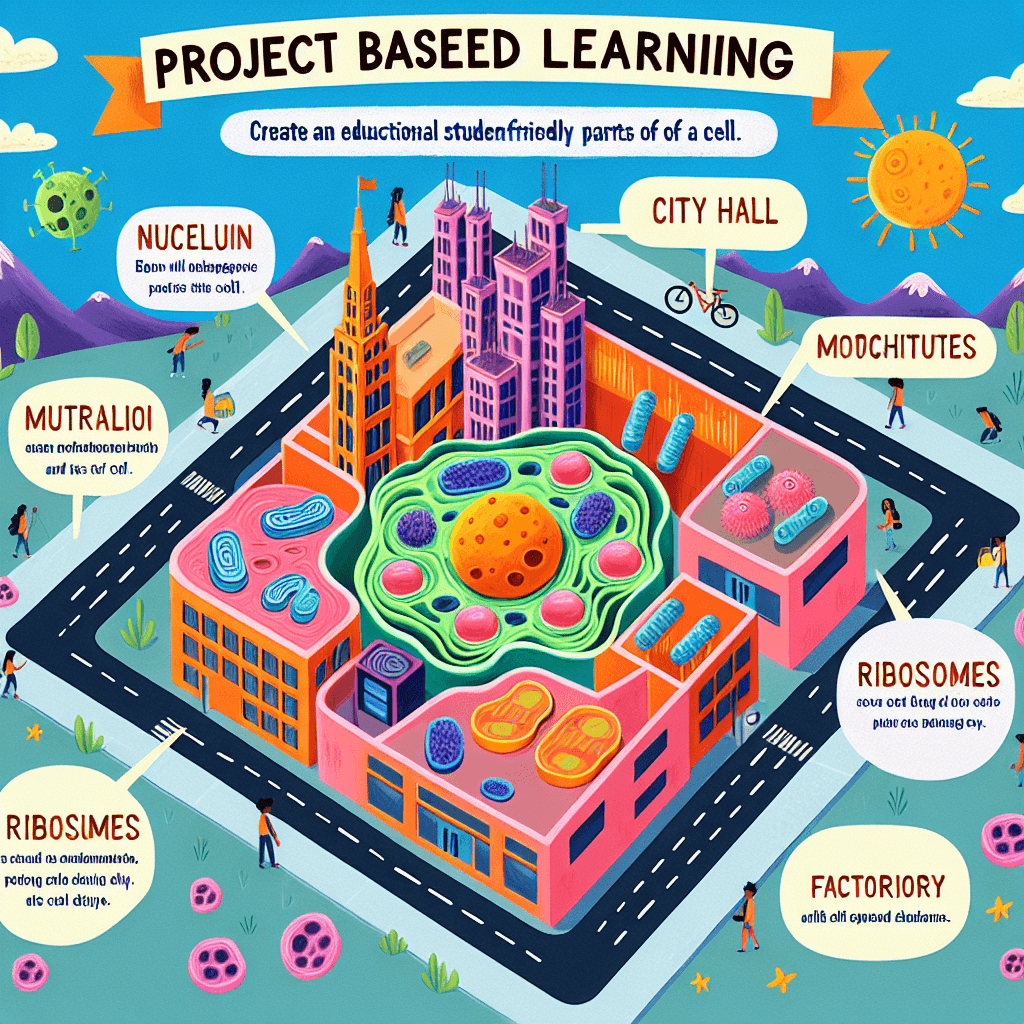
Cell City: Building a Functional Metropolis
Inquiry Framework
Question Framework
Driving Question
The overarching question that guides the entire project.How can we design a thrivingEssential Questions
Supporting questions that break down major concepts.- How do the different parts of a cell work together to keep it alive?
- How can we compare the structures and functions of cell organelles to the different parts of a city?
- What are the main differences between plant and animal cells, and how would that change our city design?
- How does the cell membrane control what enters and exits the cell, and how can we represent this in our city?
- If one part of our cell city breaks down, how does that affect the entire cell?
Standards & Learning Goals
Learning Goals
By the end of this project, students will be able to:- Students will be able to describe the function of major cell organelles.
- Students will be able to compare and contrast cell organelles to parts of a city.
- Students will be able to explain how organelles work together to maintain cell function.
- Students will be able to design a model of a cell city that accurately represents cell structure and function.
- Students will be able to identify the differences between plant and animal cells.
Entry Events
Events that will be used to introduce the project to studentsCell City of the Future
**Cell City Time Capsule:** Unearth a 'time capsule' from a fictional Cell City of the future. Inside are artifacts representing different organelles, but they're damaged or mutated. Students must analyze the artifacts to determine what went wrong in the city and how it impacted the cell's overall function. This blends science with creative storytelling.Portfolio Activities
Portfolio Activities
These activities progressively build towards your learning goals, with each submission contributing to the student's final portfolio.Organelle Fact Sheet: Cell City Planner's Guide
Students will take on the role of 'Cell City Planners,' researching and creating an 'Organelle Fact Sheet' detailing the structure, function, and city equivalent of each major cell organelle. Students can choose roles that focus on different aspects of the cell, such as power generation, waste management, communication, or defense. This activity introduces the basic components of the cell and their roles.Steps
Here is some basic scaffolding to help students complete the activity.Final Product
What students will submit as the final product of the activityA detailed fact sheet covering the structure, function, and city analogy for each major cell organelle (e.g., Nucleus, Mitochondria, Ribosomes, etc.). Each fact sheet will be tailored to the student's chosen 'Cell City Planner' role.Alignment
How this activity aligns with the learning objectives & standardsLearning Goal: Students will be able to describe the function of major cell organelles. NGSS MS-LS1-2Cell City Blueprint: Mapping Out the Metropolis
Students develop a 'Cell City Blueprint' where they visually represent their cell city, labeling each organelle and its city equivalent. This activity reinforces the analogy between cell organelles and city departments, emphasizing how they work together.Steps
Here is some basic scaffolding to help students complete the activity.Final Product
What students will submit as the final product of the activityA detailed blueprint of the Cell City, including labeled organelles (and their city equivalents), a legend explaining each component's function, and a brief paragraph describing how the different parts of the city work together.Alignment
How this activity aligns with the learning objectives & standardsLearning Goals: Students will be able to compare and contrast cell organelles to parts of a city. Students will be able to explain how organelles work together to maintain cell function.Cell City 3D Model: Building Our Biodome
Students construct a 3D model of their Cell City using various materials. They will also write a brief description of how the cell works.Steps
Here is some basic scaffolding to help students complete the activity.Final Product
What students will submit as the final product of the activityA physical or digital 3D model of the Cell City, accompanied by a written explanation of how the city (cell) functions.Alignment
How this activity aligns with the learning objectives & standardsLearning Goals: Students will be able to design a model of a cell city that accurately represents cell structure and function. Students will be able to explain how organelles work together to maintain cell function. NGSS MS-LS1-2Plant vs. Animal Cell City Tour: A Comparative Analysis
Students will take a tour of other groups' Cell Cities (either physically or virtually) and identify key differences between plant and animal cell cities. They will record their observations and discuss how these differences relate to the unique functions of plant and animal cells.Steps
Here is some basic scaffolding to help students complete the activity.Final Product
What students will submit as the final product of the activityA written or oral presentation summarizing the key differences observed between plant and animal cell cities, with explanations of how these differences relate to the functions of plant and animal cells.Alignment
How this activity aligns with the learning objectives & standardsLearning Goals: Students will be able to identify the differences between plant and animal cells. Students will be able to design a model of a cell city that accurately represents cell structure and function.Rubric & Reflection
Portfolio Rubric
Grading criteria for assessing the overall project portfolioCell City Portfolio Rubric
Organelle Fact Sheet
Assessment of the Organelle Fact Sheet, focusing on the accuracy of information, effectiveness of city analogies, and overall presentation quality.Organelle Knowledge
Accuracy of organelle structure and function descriptions.
Proficient
3 PointsDemonstrates a thorough and accurate understanding of the structure and function of all assigned organelles.
Developing
2 PointsShows a basic understanding of the structure and function of most assigned organelles, but with some inaccuracies or omissions.
Beginning
1 PointsShows limited understanding of the structure and function of assigned organelles, with significant inaccuracies and omissions.
City Analogy
Effectiveness of the city analogy in representing organelle function.
Proficient
3 PointsCreates effective and relevant city analogies that clearly represent organelle function.
Developing
2 PointsCreates city analogies that are somewhat relevant to organelle function, but with some inconsistencies or lack of clarity.
Beginning
1 PointsCreates city analogies that are not relevant or do not accurately represent organelle function.
Presentation Quality
Clarity and organization of the fact sheet.
Exemplary
4 PointsPresents information in a highly organized, clear, and engaging manner, with sophisticated use of visuals and formatting.
Proficient
3 PointsPresents information in a clear and organized manner, with effective use of visuals and formatting.
Developing
2 PointsPresents information in a somewhat organized manner, but with some lack of clarity or inconsistent formatting.
Beginning
1 PointsPresents information in a disorganized and unclear manner, with minimal use of visuals and poor formatting.
Cell City Blueprint
Assessment of the Cell City Blueprint, focusing on the accuracy and completeness of the blueprint, clarity of labels, and quality of the explanatory paragraph.Blueprint Accuracy
Accuracy and completeness of the Cell City blueprint.
Proficient
3 PointsBlueprint is detailed, accurate, and comprehensive, demonstrating a thorough understanding of spatial relationships and functional integration.
Developing
2 PointsBlueprint is somewhat detailed and accurate, but with some omissions or inaccuracies in spatial relationships or functional integration.
Beginning
1 PointsBlueprint is incomplete, inaccurate, and lacks detail, demonstrating a limited understanding of spatial relationships and functional integration.
Clarity and Labeling
Clarity and effectiveness of the labels and legend.
Proficient
3 PointsLabels and legend are clear, concise, and informative, effectively explaining the Cell City's components and functions.
Developing
2 PointsLabels and legend are somewhat clear, but with some ambiguity or lack of detail in explaining the Cell City's components and functions.
Beginning
1 PointsLabels and legend are unclear, incomplete, and fail to adequately explain the Cell City's components and functions.
Explanation of City Function
Quality of the paragraph explaining how the city works.
Proficient
3 PointsParagraph provides a clear and thorough explanation of how the different parts of the Cell City work together.
Developing
2 PointsParagraph provides a basic explanation of how the different parts of the Cell City work together, but with some gaps in understanding or lack of detail.
Beginning
1 PointsParagraph provides a limited and incomplete explanation of how the different parts of the Cell City work together.
Cell City 3D Model
Assessment of the Cell City 3D Model, focusing on the accuracy of organelle representation, craftsmanship, and the quality of the written explanation.Craftsmanship
Craftsmanship and attention to detail in the 3D model.
Exemplary
3 PointsThe 3D model demonstrates exceptional craftsmanship and meticulous attention to detail, enhancing its overall aesthetic appeal and educational value.
Developing
2 PointsThe 3D model demonstrates basic craftsmanship, but with some lack of attention to detail.
Beginning
1 PointsThe 3D model demonstrates poor craftsmanship and a lack of attention to detail.
Explanation of City Function
Clarity and completeness of the written explanation of city function.
Proficient
3 PointsThe written explanation clearly and completely describes how the Cell City functions.
Developing
2 PointsThe written explanation provides a basic description of how the Cell City functions, but with some omissions or lack of detail.
Beginning
1 PointsThe written explanation is incomplete and provides a limited understanding of how the Cell City functions.
Plant vs. Animal Cell City Tour
Assessment of the Plant vs. Animal Cell City Tour, focusing on the identification of key differences, accuracy of explanations, and overall presentation quality.Difference Identification
Identification of key differences between plant and animal cell cities.
Exemplary
3 PointsIdentifies all key differences between plant and animal cell cities with insightful explanations of their functional significance.
Developing
2 PointsIdentifies some key differences between plant and animal cell cities, but with limited explanations.
Beginning
1 PointsStruggles to identify key differences between plant and animal cell cities and provides minimal explanations.