
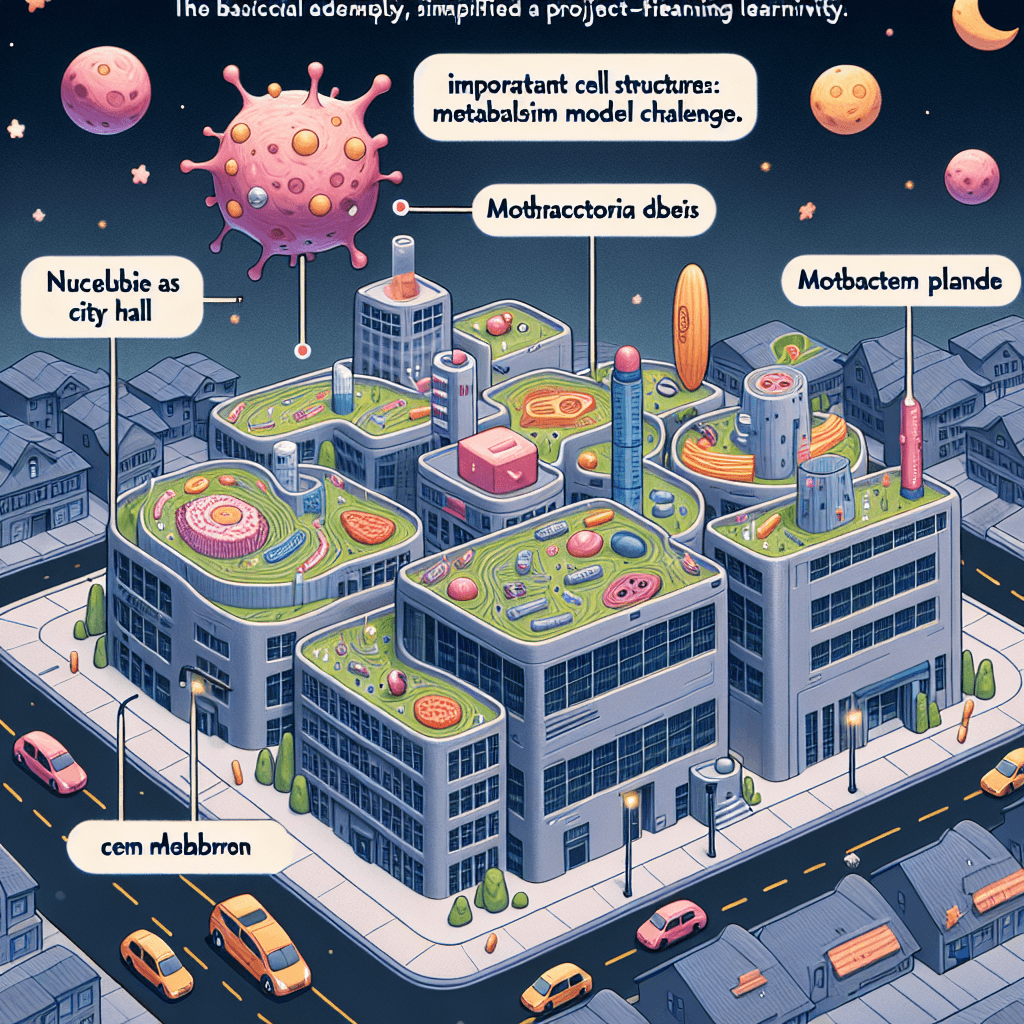
Cell City: Metabolism Model Challenge
Inquiry Framework
Question Framework
Driving Question
The overarching question that guides the entire project.How can we build a city model that shows how a cell works, like how it uses energy and gets rid of waste, similar to parts of a city?Essential Questions
Supporting questions that break down major concepts.- What does a cell do, especially when using energy (metabolism)?
- What parts of a cell work together, just like parts of a city?
- What is cellular respiration and why do cells need it to live?
- How can we say that cell parts are like city parts such as power plants or trash bins?
- How do cells change energy so they can do important things?
- How does knowing how cells work help us keep our body and our world healthy?
Standards & Learning Goals
Learning Goals
By the end of this project, students will be able to:- Understand the main functions of a cell, particularly in the context of metabolism and cellular respiration.
- Demonstrate the ability to create models that accurately represent biological concepts.
- Draw parallels between cellular organelles and city elements to understand cell functions.
- Explain the process and importance of cellular respiration in organisms.
- Develop critical thinking by comparing and contrasting cell and city element functions.
- Present a comprehensive model that reflects the parallels between city infrastructure and cell functions.
Next Generation Science Standards
Common Core State Standards
Entry Events
Events that will be used to introduce the project to studentsEnergy Crisis Simulation
An urgent broadcast kicks off the event, calling students to address the impending energy crisis affecting their 'city.' They must apply their understanding of cellular respiration to propose innovative solutions for sustainable energy usage, integrating the function of cellular components in their models.Portfolio Activities
Portfolio Activities
These activities progressively build towards your learning goals, with each submission contributing to the student's final portfolio.City-Cell Conceptualizer
Students begin by exploring the basic functions and structures of cells. They map cell organelles to city elements, laying the groundwork for their city model project.Steps
Here is some basic scaffolding to help students complete the activity.Final Product
What students will submit as the final product of the activityA completed worksheet and preliminary concept map connecting cell organelles to city features.Alignment
How this activity aligns with the learning objectives & standardsAligns with MS-LS1-5 and MS-LS1-2 by helping students understand cell functions and their parallels to city components.Modeling Metabolism
Students delve deeper into cellular respiration, using diagrams to illustrate how energy transfer in cells can be mirrored by energy flows in a city.Steps
Here is some basic scaffolding to help students complete the activity.Final Product
What students will submit as the final product of the activityAn annotated cellular respiration diagram highlighting city analogies.Alignment
How this activity aligns with the learning objectives & standardsAligns with MS-LS1-7 and MS-LS1-2 by developing an understanding of energy transfers through cellular respiration and city parallels.3D Model Creator
Students bring their blueprints to life by building a 3D city model that functions like a living cell, incorporating lessons from metabolism and respiration.Steps
Here is some basic scaffolding to help students complete the activity.Final Product
What students will submit as the final product of the activityA physical or digital 3D city model that demonstrates the dynamic processes of a cell.Alignment
How this activity aligns with the learning objectives & standardsSupports MS-LS1-2 and MS-LS1-7, emphasizing understanding through the creation of a functional model mirroring cellular processes.Organism Energy Presenters
Students conclude by presenting their city models, explaining the parallels to cellular respiration and energy use within cells, practicing clear communication strategies.Steps
Here is some basic scaffolding to help students complete the activity.Final Product
What students will submit as the final product of the activityA class presentation of the city model, complete with explanations of cellular parallels.Alignment
How this activity aligns with the learning objectives & standardsAligns with CCSS.ELA-LITERACY.SL.6.4, reinforcing communication skills and MS-LS1-2 by explaining and justifying their model dynamics.Rubric & Reflection
Portfolio Rubric
Grading criteria for assessing the overall project portfolioCell City Project Rubric
Understanding and Application of Cell Functions
Assesses students' comprehension and application of cell functions, metabolism, and respiration.Cell Function Mapping
Ability to accurately map cell organelles to city functions, demonstrating understanding of cellular structures and processes.
Exemplary
4 PointsAccurately and innovatively maps all major cell organelles to city functions with detailed explanations of their roles in cellular metabolism and respiration.
Proficient
3 PointsCorrectly maps most cell organelles to city functions with clear explanations of their involvement in cellular metabolism and respiration.
Developing
2 PointsMaps some cell organelles to city functions, provides partial explanations of their roles in cellular processes.
Beginning
1 PointsStruggles to map cell organelles to city functions and provides incomplete explanations of cellular processes.
Energy Flow Representation
Demonstrates understanding of cellular respiration and energy flow within cells through creative analogies and diagrams.
Exemplary
4 PointsPresents a nuanced and comprehensive diagram that accurately represents energy flow in cell metabolism, using creative and scientifically sound analogies.
Proficient
3 PointsDevelops a clear and accurate diagram representing energy flow, with sound analogies connecting cellular and city structures.
Developing
2 PointsAttempts to create a diagram with some representation of energy flow, using basic analogies.
Beginning
1 PointsProduces an incomplete or incorrect diagram, struggling to use analogies effectively.
Model Construction and Dynamics
Evaluates the construction of the city model to ensure it accurately reflects cellular processes and dynamics.3D Model Design
Quality and accuracy of the 3D city model in reflecting cell functions and mechanics.
Exemplary
4 PointsConstructs a highly detailed and functional 3D model, effectively integrating dynamic components to represent cellular processes.
Proficient
3 PointsBuilds a complete 3D model that accurately reflects key cellular functions, with minor dynamic elements.
Developing
2 PointsCreates a basic 3D model showing some cellular functions with limited accuracy or detail.
Beginning
1 PointsProduces an incomplete model that poorly reflects cellular functions or dynamics.
Communication and Presentation Skills
Assesses ability to present scientific information clearly and effectively, using appropriate communication techniques.Presentation Clarity
Effectiveness in clearly and logically presenting the model, its components, and cellular parallels.
Exemplary
4 PointsDelivers a highly engaging presentation with clear, logical explanations of the model's components and cellular parallels, exhibiting strong communication skills.
Proficient
3 PointsProvides a clear presentation with logical explanations and effective communication of the model and cellular parallels.
Developing
2 PointsGives a presentation with some logical order, but lacks depth in explaining the model and cellular parallels.
Beginning
1 PointsStruggles to deliver a coherent presentation, with unclear explanations and weak communication of the model's relevance.