
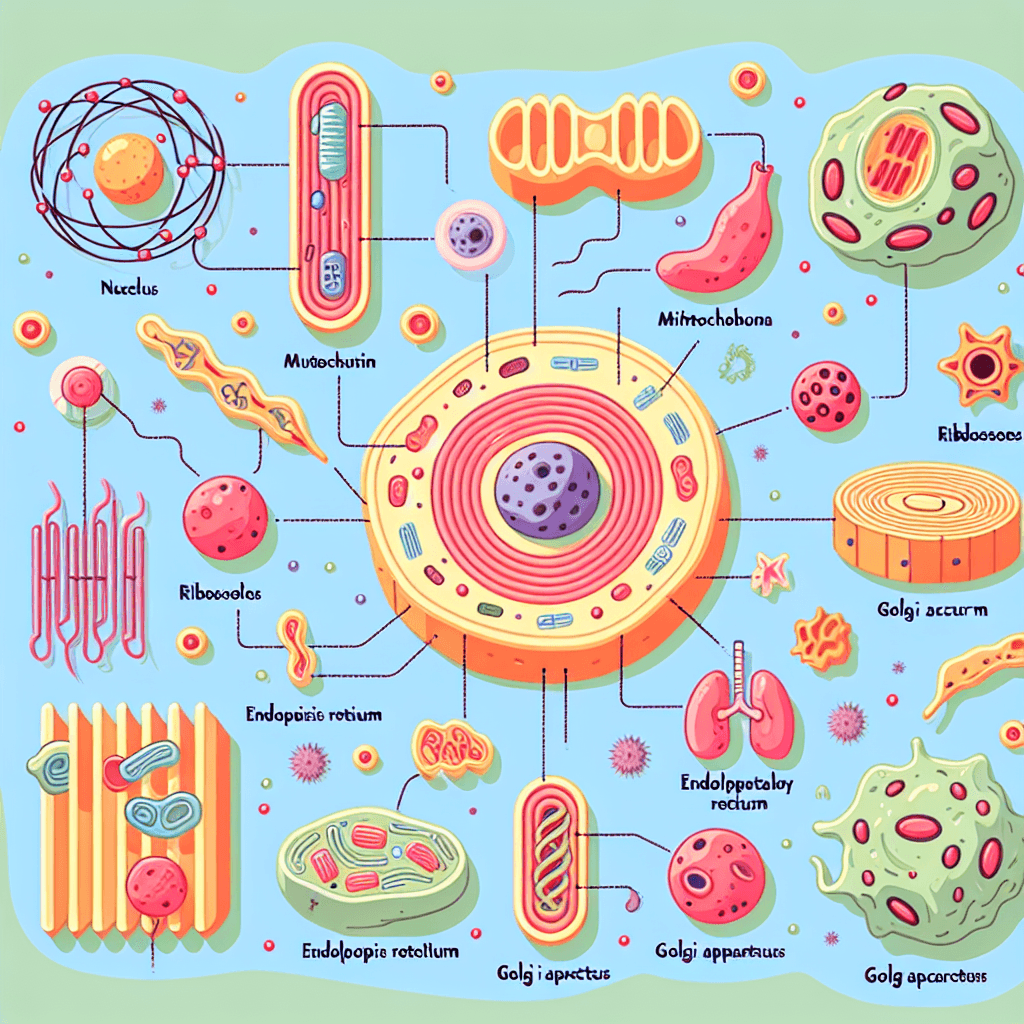
Cell Structure and Function: A Biological Exploration
Inquiry Framework
Question Framework
Driving Question
The overarching question that guides the entire project.How can we design a comprehensive model that elucidates the intricate relationship between cellular structures, functions, communication pathways, and the resulting implications for both cellular health and disease states?Essential Questions
Supporting questions that break down major concepts.- What are the key structural components of prokaryotic and eukaryotic cells, and how do these components differ?
- How do different cellular organelles contribute to the overall function of the cell?
- What are the mechanisms of transport across the cell membrane, and how do they maintain cellular homeostasis?
- How do cells communicate with each other, and what are the different signaling pathways involved?
- How do disruptions in cellular structure and function lead to disease, and what are the implications for treatment?
Standards & Learning Goals
Learning Goals
By the end of this project, students will be able to:- Students will be able to describe the key structural components of prokaryotic and eukaryotic cells, and compare their differences.
- Students will be able to explain how different cellular organelles contribute to the overall function of the cell.
- Students will be able to explain the mechanisms of transport across the cell membrane, and how they maintain cellular homeostasis.
- Students will be able to describe how cells communicate with each other, including the different signaling pathways involved.
- Students will be able to analyze how disruptions in cellular structure and function can lead to disease, and discuss the implications for treatment.
Entry Events
Events that will be used to introduce the project to studentsThe Case of the Malfunctioning Mitochondria
Students receive a mock medical report detailing a patient with a mysterious illness linked to mitochondrial dysfunction. They must work in teams to diagnose the patient, explaining the cellular processes affected and proposing potential treatments, sparking inquiry into organelle function and cellular respiration.Cellular Communication Breakdown: A Role-Playing Game
Students participate in a role-playing game where they simulate different cell types attempting to communicate under various stress conditions (e.g., viral infection, toxin exposure). This illustrates the importance of signaling pathways and the consequences of communication disruptions.Create a Cellular 'Art Gallery': Visualizing Disease
Students create visual representations (e.g., digital art, 3D models) of cells affected by specific diseases, focusing on how structural changes at the cellular level contribute to the pathology. This blends creativity with scientific understanding and connects cell biology to real-world health issues.Portfolio Activities
Portfolio Activities
These activities progressively build towards your learning goals, with each submission contributing to the student's final portfolio.Cell Structure Unveiled: Comparative Analysis
Students will begin by exploring and comparing the structural components of both prokaryotic and eukaryotic cells. This activity sets the foundation for understanding cellular function and lays the groundwork for more complex topics.Steps
Here is some basic scaffolding to help students complete the activity.Final Product
What students will submit as the final product of the activityA comprehensive Venn diagram and comparative essay detailing the structural differences between prokaryotic and eukaryotic cells.Alignment
How this activity aligns with the learning objectives & standardsAddresses Learning Goal 1: Students will be able to describe the key structural components of prokaryotic and eukaryotic cells, and compare their differences.Organelle Function Factory: Role Assignment
In this activity, students will dive deep into the functions of various cellular organelles. Each student or group will become an 'expert' on a specific organelle, explaining its role and contribution to the overall function of the cell.Steps
Here is some basic scaffolding to help students complete the activity.Final Product
What students will submit as the final product of the activityA series of presentations or infographics detailing the function of each major cellular organelle.Alignment
How this activity aligns with the learning objectives & standardsAddresses Learning Goal 2: Students will be able to explain how different cellular organelles contribute to the overall function of the cell.Membrane Transport Mania: Homeostasis Heroes
This activity focuses on the mechanisms of transport across the cell membrane and how these processes maintain cellular homeostasis. Students will explore different types of transport (e.g., diffusion, osmosis, active transport) and their roles in regulating the cellular environment.Steps
Here is some basic scaffolding to help students complete the activity.Final Product
What students will submit as the final product of the activityA model and explanatory report detailing the mechanisms of transport across the cell membrane and their role in maintaining cellular homeostasis.Alignment
How this activity aligns with the learning objectives & standardsAddresses Learning Goal 3: Students will be able to explain the mechanisms of transport across the cell membrane, and how they maintain cellular homeostasis.Cellular Communication Network: Signal Relay
Students will investigate how cells communicate with each other, including the different signaling pathways involved. This activity will help students understand the complexity of cellular interactions and their importance in coordinating cellular activities.Steps
Here is some basic scaffolding to help students complete the activity.Final Product
What students will submit as the final product of the activityA diagram or flowchart and presentation explaining a specific cell signaling pathway.Alignment
How this activity aligns with the learning objectives & standardsAddresses Learning Goal 4: Students will be able to describe how cells communicate with each other, including the different signaling pathways involved.Disease Detective: Cellular Dysfunction Analysis
In the final activity, students will analyze how disruptions in cellular structure and function can lead to disease. They will choose a specific disease and investigate the cellular mechanisms involved, discussing the implications for treatment.Steps
Here is some basic scaffolding to help students complete the activity.Final Product
What students will submit as the final product of the activityA report or presentation analyzing the cellular basis of a specific disease and discussing potential treatment strategies.Alignment
How this activity aligns with the learning objectives & standardsAddresses Learning Goal 5: Students will be able to analyze how disruptions in cellular structure and function can lead to disease, and discuss the implications for treatment.Rubric & Reflection
Portfolio Rubric
Grading criteria for assessing the overall project portfolioCell Structure and Function Portfolio Rubric
Cell Structure and Function Knowledge
Demonstrates understanding of cell structure, organelle functions, and the differences between prokaryotic and eukaryotic cells.Accuracy of Information
Presents accurate and detailed information about cell structures and functions.
Exemplary
4 PointsProvides comprehensive and accurate information, demonstrating a deep understanding of cell structures and functions with no misconceptions.
Proficient
3 PointsPresents mostly accurate information with minor omissions or inaccuracies; demonstrates a good understanding of cell structures and functions.
Developing
2 PointsPresents some accurate information, but with significant omissions or inaccuracies; demonstrates a basic understanding of cell structures and functions.
Beginning
1 PointsPresents limited and inaccurate information; demonstrates a minimal understanding of cell structures and functions.
Depth of Understanding
Demonstrates a thorough understanding of the complexities of cell structure and function.
Exemplary
4 PointsDemonstrates a sophisticated understanding of the complexities of cell structure and function, including nuanced relationships and underlying principles.
Proficient
3 PointsDemonstrates a thorough understanding of the complexities of cell structure and function, explaining key concepts clearly and accurately.
Developing
2 PointsDemonstrates an emerging understanding of the complexities of cell structure and function, but may struggle with more challenging concepts.
Beginning
1 PointsDemonstrates a limited understanding of the complexities of cell structure and function, requiring significant guidance and support.
Cell Communication and Signaling Pathways
Explains cell communication processes and signaling pathways clearly and accurately.Clarity of Explanation
Presents clear and coherent explanations of cell communication and signaling pathways.
Exemplary
4 PointsPresents exceptionally clear and coherent explanations of cell communication and signaling pathways, using precise language and illustrative examples.
Proficient
3 PointsPresents clear and coherent explanations of cell communication and signaling pathways, using appropriate language and relevant examples.
Developing
2 PointsPresents explanations of cell communication and signaling pathways that are sometimes unclear or difficult to follow; language may be imprecise.
Beginning
1 PointsPresents unclear and incoherent explanations of cell communication and signaling pathways; language is vague and examples are lacking.
Accuracy of Pathway Details
Provides accurate details of the molecules, receptors, and steps involved in cell signaling pathways.
Exemplary
4 PointsProvides comprehensive and accurate details of the molecules, receptors, and steps involved in cell signaling pathways, demonstrating a deep understanding of the underlying mechanisms.
Proficient
3 PointsProvides accurate details of the molecules, receptors, and steps involved in cell signaling pathways, with only minor omissions or inaccuracies.
Developing
2 PointsProvides some accurate details of the molecules, receptors, and steps involved in cell signaling pathways, but with significant omissions or inaccuracies.
Beginning
1 PointsProvides limited and inaccurate details of the molecules, receptors, and steps involved in cell signaling pathways; demonstrates a minimal understanding of the processes.
Cellular Dysfunction and Disease
Analyzes how disruptions in cellular structure and function lead to disease, and discusses potential treatment strategies.Connection to Disease
Clearly connects cellular dysfunction to specific diseases.
Exemplary
4 PointsEstablishes a clear and compelling connection between cellular dysfunction and specific diseases, providing detailed examples and insightful analysis.
Proficient
3 PointsClearly connects cellular dysfunction to specific diseases, providing relevant examples and logical reasoning.
Developing
2 PointsConnects cellular dysfunction to specific diseases, but the connection may be weak or lack supporting evidence.
Beginning
1 PointsFails to clearly connect cellular dysfunction to specific diseases; connection is vague or missing.
Treatment Strategies
Discusses potential treatment strategies based on targeting affected cellular processes.
Exemplary
4 PointsDiscusses innovative and well-reasoned treatment strategies based on targeting affected cellular processes, demonstrating a sophisticated understanding of therapeutic interventions.
Proficient
3 PointsDiscusses potential treatment strategies based on targeting affected cellular processes, providing clear explanations and logical justifications.
Developing
2 PointsDiscusses potential treatment strategies, but the strategies may be poorly justified or lack a clear connection to the affected cellular processes.
Beginning
1 PointsFails to adequately discuss potential treatment strategies or connect them to the affected cellular processes.
Presentation and Communication
Effectively presents information in a clear, organized, and visually appealing manner.Clarity and Organization
Presents information in a clear and logically organized manner.
Exemplary
4 PointsPresents information in an exceptionally clear, concise, and logically organized manner, making it easy for the audience to understand complex concepts.
Proficient
3 PointsPresents information in a clear and logically organized manner, facilitating audience understanding.
Developing
2 PointsPresents information in a somewhat disorganized manner, making it difficult for the audience to follow the main points.
Beginning
1 PointsPresents information in a disorganized and confusing manner, hindering audience understanding.
Visual Appeal
Uses visuals (diagrams, models, etc.) effectively to enhance understanding.
Exemplary
4 PointsUses visuals (diagrams, models, etc.) creatively and effectively to enhance understanding, demonstrating a strong command of visual communication principles.
Proficient
3 PointsUses visuals (diagrams, models, etc.) effectively to enhance understanding, supporting the presentation of information.
Developing
2 PointsUses visuals, but they may be poorly designed, irrelevant, or distracting.
Beginning
1 PointsUses few or no visuals, or the visuals are ineffective and detract from understanding.