
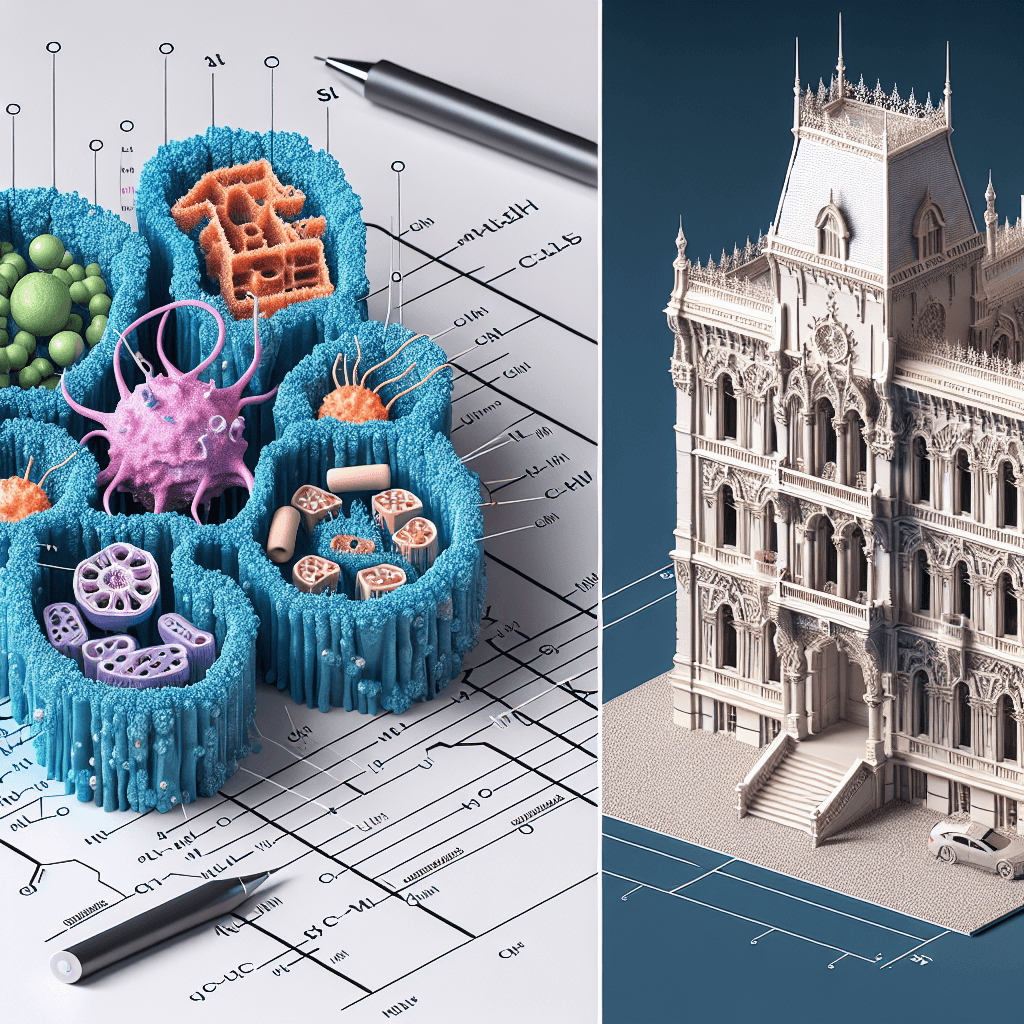
Cellular Structures: Building Models of Famous Architectural Designs
Inquiry Framework
Question Framework
Driving Question
The overarching question that guides the entire project.How can we design architectural models to represent the structures and functions of cells in living organisms, and what famous structures can be used to illustrate these cellular functions?Essential Questions
Supporting questions that break down major concepts.- What are the basic structures and functions of cells in living organisms?
- How can different cellular structures be represented through architectural models?
- What are some famous architectural structures that can represent cell functions and designs effectively?
Standards & Learning Goals
Learning Goals
By the end of this project, students will be able to:- Students will understand the basic structures and functions of cells in living organisms.
- Students will develop skills in creating architectural models that represent cellular functions.
- Students will learn to identify famous architectural structures and their applicability in representing cell functions.
- Students will engage in scientific investigations to explore cellular compositions of living organisms.
- Students will articulate how cells work together to form systems within living organisms.
NGSS
Entry Events
Events that will be used to introduce the project to studentsMystery Micrograph Challenge
Present students with a series of mystery micrographs, or magnified images of cell types, without providing the identity of the cells. Challenge them to investigate and draw parallels between these cells and architectural designs in the real world, initiating a project that merges biology with architectural creativity.Design a Bio-Skyscraper
Invite students to conceptualize and draw a 'bio-skyscraper' inspired by cellular structure and function. This project kick-off combines their interest in design and biology, sparking curiosity about how the cellular world can influence human architectural innovation.Cellular Architecture Case Study
Introduce a case study of a famous building designed with 'cells in mind', such as the Eden Project's biomes or the Gherkin in London. Students will research how biological cell functions inspired these designs, setting the context for their own bio-architecture projects.Portfolio Activities
Portfolio Activities
These activities progressively build towards your learning goals, with each submission contributing to the student's final portfolio.Micrograph Detective Notebook
Students will start their investigation into cellular components by analyzing mystery micrographs to draw connections between cells and architectural designs.Steps
Here is some basic scaffolding to help students complete the activity.Final Product
What students will submit as the final product of the activityA science notebook entry documenting the observations, hypotheses, and group discussions about the micrographs.Alignment
How this activity aligns with the learning objectives & standardsAligns with NGSS MS-LS1-1 as students investigate cell composition and MS-LS1-3 as they begin forming arguments about cellular roles.Bio-Skyscraper Blueprint
Students will design a bio-skyscraper inspired by the functions and structures of cells to deepen their understanding of cellular design principles.Steps
Here is some basic scaffolding to help students complete the activity.Final Product
What students will submit as the final product of the activityA comprehensive blueprint representing a skyscraper designed with inspirations from specific cell parts, complete with function descriptions.Alignment
How this activity aligns with the learning objectives & standardsMeets NGSS MS-LS1-2 as students develop models describing cell functions and MS-LS1-3 in illustrating how cells systems can inspire modern design.Architectural Cell Models
Students will create three-dimensional models of cells, akin to famous architectural structures, to synthesize their understanding of cellular functions and interworking systems.Steps
Here is some basic scaffolding to help students complete the activity.Final Product
What students will submit as the final product of the activityA 3D architectural model of a cell, complete with explanations and justifications for design choices linked to cell functions.Alignment
How this activity aligns with the learning objectives & standardsSupports NGSS MS-LS1-2 in using models to describe cells and MS-LS1-3 by providing evidence for cell structures as systems.Rubric & Reflection
Portfolio Rubric
Grading criteria for assessing the overall project portfolioCellular Architecture Project Rubric
Scientific Investigation
Evaluates the student's ability to conduct thorough investigations into cellular biology, draw scientific conclusions, and make connections to architectural models.Observation and Documentation
Assess the detail and accuracy in observing and documenting scientific inquiries, particularly in the analysis of micrographs.
Exemplary
4 PointsProvides detailed and accurate observations with insightful connections to architectural designs, demonstrating a strong grasp of cellular structures.
Proficient
3 PointsOffers clear and accurate observations with appropriate connections to architectural models, showing good understanding of cellular structures.
Developing
2 PointsPresents observations with some detail and limited connections to architectural models, indicating basic understanding of cellular structures.
Beginning
1 PointsDisplays minimal observations with few connections to architectural models, showing limited understanding of cellular structures.
Hypotheses Formation
Evaluates the ability to form well-thought-out hypotheses regarding cell types and functions based on scientific observation.
Exemplary
4 PointsForms insightful hypotheses supported by strong evidence relating cellular functions to architectural designs.
Proficient
3 PointsForms logical hypotheses with reasonable evidence connecting cellular functions to architectural designs.
Developing
2 PointsForms basic hypotheses with minimal evidence relating to cellular functions and architectural designs.
Beginning
1 PointsStruggles to form coherent hypotheses with insufficient evidence linking to cellular functions.
Creative Representation
Assesses students' ability to translate cellular functions and structures into innovative architectural designs.Design Creativity and Innovation
Measures creativity in design and originality in representing cellular structures through architectural models.
Exemplary
4 PointsDemonstrates exceptional creativity and innovation, with unique and original architectural designs clearly linked to cellular functions.
Proficient
3 PointsDisplays creativity and originality, with clear links between architectural designs and cellular functions.
Developing
2 PointsShows some creativity and basic connections between architectural designs and cellular functions.
Beginning
1 PointsLacks creativity with vague or insufficient connections to cellular functions.
Accuracy and Detail in Models
Assesses the accuracy and level of detail in the architectural models constructed to represent cellular structures.
Exemplary
4 PointsModels are highly accurate and detailed, reflecting an outstanding understanding of cellular structures and functions.
Proficient
3 PointsModels are accurate and detailed, showing a solid understanding of cellular structures and functions.
Developing
2 PointsModels show basic accuracy and detail, indicating developing understanding of cellular structures.
Beginning
1 PointsModels lack accuracy and detail, showing limited understanding of cellular structures.
Collaboration and Communication
Evaluates teamwork and communication throughout the project, focusing on group discussions and feedback exchanges.Contribution to Group Work
Assesses how effectively the student contributes to group discussions and works collaboratively to develop ideas.
Exemplary
4 PointsDisplays leadership in group discussions, consistently contributes valuable ideas, and effectively collaborates with peers.
Proficient
3 PointsActively participates in group discussions, contributes good ideas, and collaborates well with peers.
Developing
2 PointsParticipates in group discussions occasionally, contributes some ideas, and collaborates with some support.
Beginning
1 PointsRarely participates in group discussions, with limited contribution to ideas and requires support to collaborate.
Presentation and Explanation
Assesses the clarity and effectiveness of presenting and explaining architectural models and associated scientific concepts.
Exemplary
4 PointsPresents models with exceptional clarity and effectiveness, demonstrating thorough understanding of scientific concepts and design rationale.
Proficient
3 PointsPresents models clearly and effectively, showing good understanding of scientific concepts and design rationale.
Developing
2 PointsPresents models with basic clarity, showing some understanding of scientific concepts and design rationale.
Beginning
1 PointsPresents models with limited clarity, showing minimal understanding of scientific concepts.