
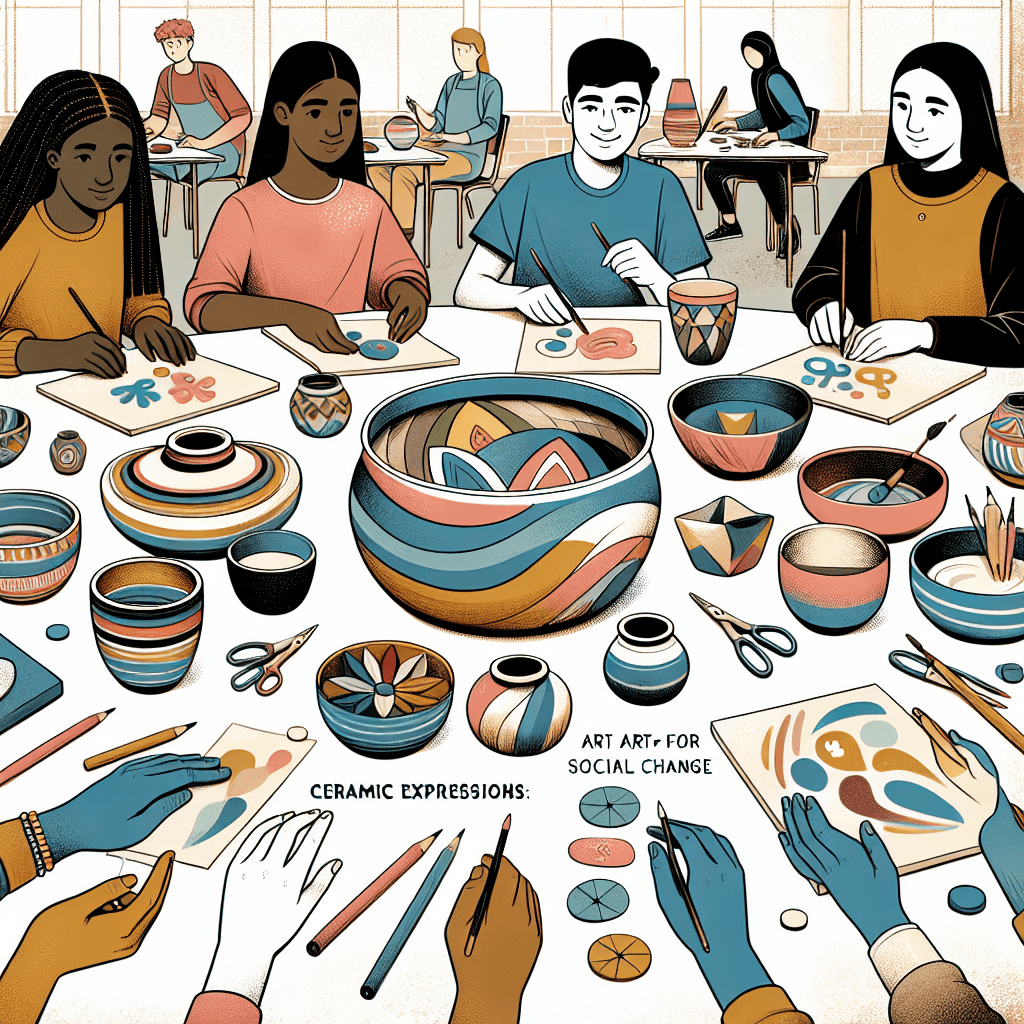
Inquiry Framework
Question Framework
Driving Question
The overarching question that guides the entire project.How can artists create ceramic artworks that effectively express and communicate our experiences, provoke change, and invite various interpretations?Essential Questions
Supporting questions that break down major concepts.- What makes an artwork compelling?
- How can artists use ceramics to express their ideas about social issues?
- What techniques are used to create ceramics that effectively communicate a message?
- In what ways can art provoke change or communicate an important message?
- What role does interpretation play in understanding art?
Standards & Learning Goals
Learning Goals
By the end of this project, students will be able to:- Students will analyze social issues and select one to represent through ceramic art.
- Students will apply artistic techniques to create ceramic artworks that convey messages about their chosen social issue.
- Students will evaluate and provide constructive feedback on peers' ceramic artworks, focusing on technique and message efficacy.
- Students will explore and discuss the impact of ceramic art on societal awareness and change.
- Students will reflect on their artistic process and revise their artwork based on peer and self-feedback.
National Core Arts Standards
Entry Events
Events that will be used to introduce the project to studentsArt in Activism Gallery Tour
Start with a virtual or in-person tour of a renowned art gallery that features works focusing on social issues. Students can see firsthand how artists tackle these issues through various art forms, sparking curiosity and setting the stage for their ceramic artwork project.Interactive Social Media Campaign
Facilitate a class project where students create a social media campaign that highlights a social issue, incorporating ceramic art as the central visual component. This modern and relatable approach connects directly to students’ experiences and interests, encouraging creativity and advocacy.‘Power of Porcelain’ Documentary Screening
Show a documentary focusing on the use of ceramics in history, particularly reflecting social and political themes. This unconventional use of ceramics can broaden students' perspectives on the art form and prime them for thinking about how they can channel their passions into ceramic artwork.Portfolio Activities
Portfolio Activities
These activities progressively build towards your learning goals, with each submission contributing to the student's final portfolio.Concept and Design Sketching
Students will develop their initial ideas into detailed design sketches. This process involves applying their research to create a plan for their ceramic artwork that effectively communicates their chosen social theme.Steps
Here is some basic scaffolding to help students complete the activity.Final Product
What students will submit as the final product of the activityA series of refined design sketches for the ceramic artwork.Alignment
How this activity aligns with the learning objectives & standardsVA:Cr3.1.Ia (Apply relevant criteria to plan revisions for a work of art).Ceramic Technique Workshop
In this hands-on workshop, students will learn essential ceramic techniques that will enable them to bring their design sketches to life. This activity focuses on skill-building and practical application, ensuring that students are prepared to execute their projects.Steps
Here is some basic scaffolding to help students complete the activity.Final Product
What students will submit as the final product of the activityA small sample ceramic piece demonstrating various learned techniques.Alignment
How this activity aligns with the learning objectives & standardsVA:Cr3.1.Ia (Refine artistic processes and techniques).Sculpt and Reflect
Students will create their ceramic artworks based on their design sketches, incorporating feedback and refining their techniques as needed. Reflection on both the process and the evolving piece is key to this stage.Steps
Here is some basic scaffolding to help students complete the activity.Final Product
What students will submit as the final product of the activityA completed ceramic artwork that reflects a chosen social issue.Alignment
How this activity aligns with the learning objectives & standardsVA:Cr3.1.Ia (Plan revisions and refine artwork).Exhibition Curation
Students will learn how to present and curate their ceramic pieces, focusing on how the display can influence viewers' understanding of the social issue. This activity enhances students’ skills in artistic communication and public engagement.Steps
Here is some basic scaffolding to help students complete the activity.Final Product
What students will submit as the final product of the activityA curated exhibition of ceramic artworks with informational plaques.Alignment
How this activity aligns with the learning objectives & standardsVA:Pr6.1.Ia (Analyzing the impact of exhibition on understanding).Critique and Reflection Panels
This activity involves students evaluating both their own and their peers' ceramic artworks, focusing on technique, message communication, and personal artistic growth. Engaging in critique enhances understanding and encourages reflective practices.Steps
Here is some basic scaffolding to help students complete the activity.Final Product
What students will submit as the final product of the activityA reflective panel discussion and a written critique log for personal learning.Alignment
How this activity aligns with the learning objectives & standardsVA:Re.7.1.Ia (Hypothesize ways art influences human experiences) and VA:Re.7.2.Ia (Analyze visual imagery's impact).Rubric & Reflection
Portfolio Rubric
Grading criteria for assessing the overall project portfolioCeramic Art for Social Change Evaluation Rubric
Concept and Design Development
Evaluation of the student's ability to research and develop compelling design sketches that effectively incorporate symbolic elements to communicate a chosen social issue.Research and Development
Assess how well students researched social issues and developed design sketches that incorporate symbolic elements.
Exemplary
4 PointsDemonstrates extensive research and innovative development of design sketches with sophisticated symbolic elements effectively communicating the social issue.
Proficient
3 PointsShows thorough research and clear development of design sketches with well-chosen symbolic elements effectively communicating the social issue.
Developing
2 PointsDisplays some research and development of design sketches with limited symbolic elements that somewhat communicate the social issue.
Beginning
1 PointsExhibits limited research and incoherent development of design sketches with minimal symbolic elements, struggling to communicate the social issue.
Peer Feedback Integration
Evaluate how effectively students use peer feedback to refine and improve their design sketches.
Exemplary
4 PointsConsistently integrates peer feedback effectively to enhance design quality and message clarity, demonstrating leadership in collaborative refinement.
Proficient
3 PointsEffectively uses peer feedback to improve design quality and message clarity, contributing to collaborative refinement.
Developing
2 PointsInconsistently applies peer feedback with some improvement in design and message clarity, showing emerging collaboration skills.
Beginning
1 PointsRarely uses peer feedback, with little to no improvement in design or message clarity, requiring support in collaboration.
Ceramic Technique and Skill Application
Assessment of the student's acquisition and application of ceramic techniques like molding, shaping, and glazing to create a sample piece that demonstrates skill proficiency.Technique Mastery
Measurement of proficiency in mastering and applying ceramic techniques learned.
Exemplary
4 PointsDemonstrates exceptional mastery and innovative application of ceramic techniques to create a precisely crafted sample piece.
Proficient
3 PointsShows thorough mastery and effective application of ceramic techniques to create a well-crafted sample piece.
Developing
2 PointsDisplays basic understanding and inconsistent application of ceramic techniques with a sample piece of varying quality.
Beginning
1 PointsExhibits initial understanding and struggles with applying ceramic techniques, resulting in an incomplete sample piece.
Artistic Expression and Reflection
Evaluation of the final ceramic artwork for its expression of social issues and the reflective practices in documenting artistic decisions and challenges.Social Issue Expression
Assessment of the effectiveness of the final ceramic artwork in expressing the chosen social issue through artistic means.
Exemplary
4 PointsCreates a compelling and insightful artwork with profound expression and clarity in communicating the social issue.
Proficient
3 PointsProduces an insightful artwork with clear expression and communication of the social issue.
Developing
2 PointsDevelops an artwork with basic expression and partial communication of the social issue.
Beginning
1 PointsGenerates an artwork with minimal expression and struggles to communicate the social issue.
Exhibition Curation and Presentation
Assessment of the student's ability to curate and present their ceramic artwork in a gallery setting to effectively communicate the social issue to an audience.Curation and Display
Measure of the students’ skills in organizing and presenting artworks in a coherent and impactful exhibition.
Exemplary
4 PointsDemonstrates exceptional skills in curating and presenting artworks, ensuring a compelling and coherent exhibition that enhances audience understanding.
Proficient
3 PointsShows effective skills in curating and presenting artworks, resulting in a coherent exhibition that contributes to audience understanding.
Developing
2 PointsDisplays basic skills in curating and presenting artworks with a somewhat coherent exhibition that somewhat contributes to audience understanding.
Beginning
1 PointsExhibits limited skills in curating and presenting artworks, struggling to create a coherent exhibition that enhances audience understanding.