
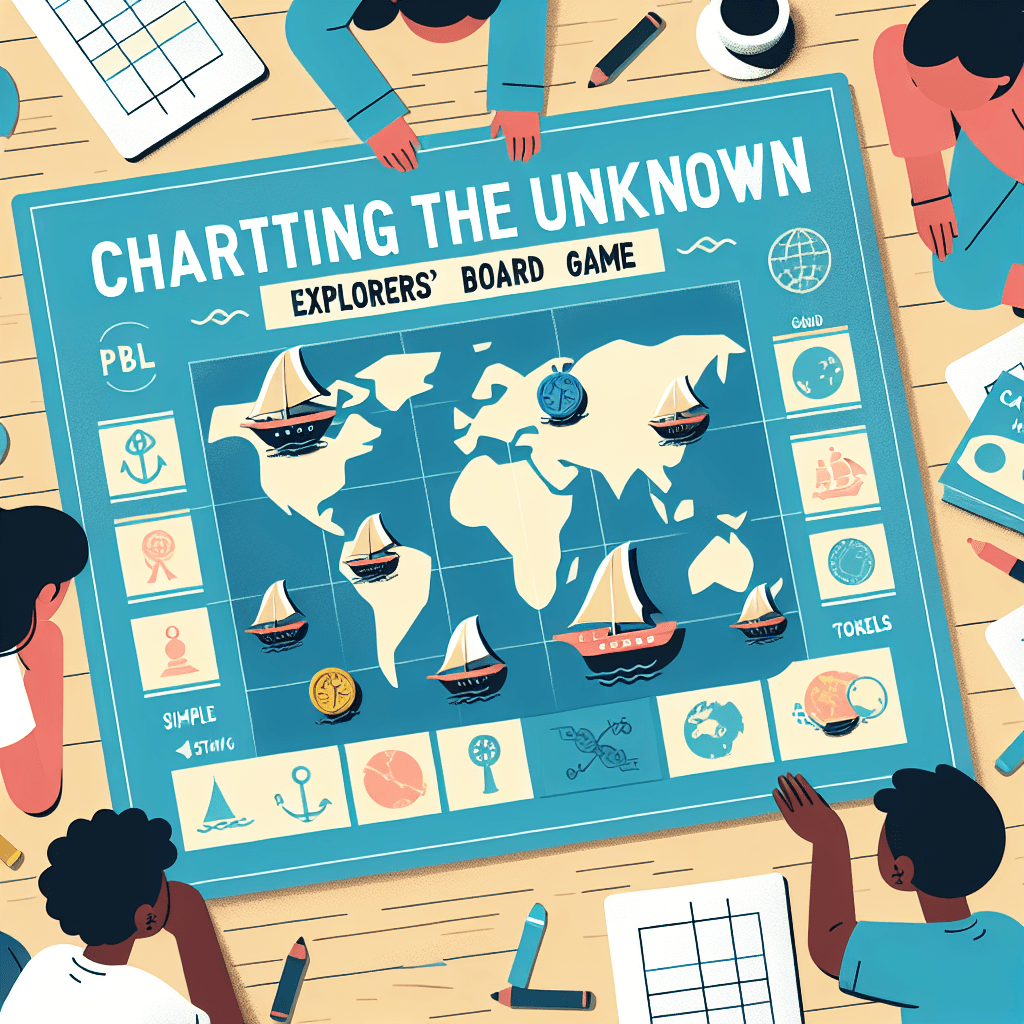
Charting the Unknown: Explorers' Board Game
Inquiry Framework
Question Framework
Driving Question
The overarching question that guides the entire project.How can we design a board game to explore the motivations, challenges, accomplishments, and effects of European exploration and colonization on Indigenous peoples in North America, while simulating historical events and understanding exploration dynamics?Essential Questions
Supporting questions that break down major concepts.- What were the primary motivations behind European exploration and colonization in North America?
- What obstacles did European explorers face during their voyages and how did they overcome them?
- What were the major accomplishments of the Dutch, English, French, Portuguese, and Spanish explorers?
- How did European exploration and colonization impact Indigenous peoples in terms of culture and economy?
- What were the key routes taken by European explorers, and how did geography influence their journeys?
- In what ways did cooperation and conflict arise between Indigenous peoples and European explorers, and what were the long-term effects?
- How can we use board games to simulate historical events and understand exploration dynamics of the past?
Standards & Learning Goals
Learning Goals
By the end of this project, students will be able to:- Students will identify and describe the primary motivations behind European exploration and colonization in North America.
- Students will analyze the major obstacles faced by European explorers and how they overcame these challenges during their voyages.
- Students will evaluate the accomplishments of Dutch, English, French, Portuguese, and Spanish explorers in North America.
- Students will explain the cultural and economic impacts of European exploration on Indigenous peoples, including both cooperation and conflict.
- Students will map the key routes taken by European explorers and analyze how geography influenced their journeys.
- Students will design a board game that simulates historical events and dynamics of European exploration, using their understanding of history, geography, and cultural interactions.
Virginia Standards of Learning
Entry Events
Events that will be used to introduce the project to studentsTime Traveler's Message
A mysterious letter from the past is delivered to the classroom, purportedly from a famous explorer of the 15th century. It challenges the students to unravel hidden truths and motivations behind the famous exploration journeys using clues in their board game design.Portfolio Activities
Portfolio Activities
These activities progressively build towards your learning goals, with each submission contributing to the student's final portfolio.Voyage Obstacle Course
Students will create an obstacle course simulation that represents the challenges faced by explorers during their voyages.Steps
Here is some basic scaffolding to help students complete the activity.Final Product
What students will submit as the final product of the activityA physically interactive obstacle course representing exploration challenges.Alignment
How this activity aligns with the learning objectives & standardsAligns with VUS.2 by exploring the obstacles faced by European explorers and their methods to overcome them.Accomplishment Chronicle Card Game
Students will develop a card game featuring the major accomplishments of the Dutch, English, French, Portuguese, and Spanish explorers. The goal is to use these cards strategically within a game format that highlights exploration achievements and their historical significance.Steps
Here is some basic scaffolding to help students complete the activity.Final Product
What students will submit as the final product of the activityA card game consisting of 10-20 illustrated cards detailing exploration accomplishments, complete with rules and mechanics for gameplay.Alignment
How this activity aligns with the learning objectives & standardsAligns with VUS.2 by evaluating the accomplishments of European explorers through interactive gameplay.Board Game Design Challenge
Students will collaboratively design a board game that incorporates elements of exploration motivations, obstacles, accomplishments, and cultural interactions.Steps
Here is some basic scaffolding to help students complete the activity.Final Product
What students will submit as the final product of the activityA completed board game simulating historical exploration events.Alignment
How this activity aligns with the learning objectives & standardsAligns with VUS.2 by synthesizing knowledge on European exploration and colonization through game design.Rubric & Reflection
Portfolio Rubric
Grading criteria for assessing the overall project portfolioExplorer's Board Game Project Rubric
Historical Understanding
Assessment of students' grasp of historical motivations, challenges, and accomplishments of explorers.Motivations and Challenges
Understanding and description of the motivations behind exploration and the challenges faced by explorers.
Exemplary
4 PointsThoroughly and accurately describes complex motivations and challenges with insightful details.
Proficient
3 PointsClearly describes main motivations and challenges with relevant details.
Developing
2 PointsProvides basic descriptions with limited details; some inaccuracies present.
Beginning
1 PointsMinimal description with inaccuracies; struggles to connect motivations and challenges.
Accomplishments of Explorers
Evaluation of students' comprehension of significant accomplishments of selected European explorers.
Exemplary
4 PointsInsightfully evaluates and integrates explorers' accomplishments into the game mechanics.
Proficient
3 PointsAccurately incorporates and evaluates explorers' accomplishments with effective mechanisms.
Developing
2 PointsIncorporates basic accomplishments with limited evaluation; minor inaccuracies.
Beginning
1 PointsIncludes few accomplishments with significant inaccuracies; lacks depth.
Cultural and Economic Interactions
Assessment of understanding cultural and economic interactions between Indigenous peoples and Europeans.
Exemplary
4 PointsComprehensively explains interaction dynamics and integrates them creatively into the game.
Proficient
3 PointsAdequately explains interactions and effectively integrates them into the game.
Developing
2 PointsProvides basic explanations with limited integration; lacks clarity in portrayal.
Beginning
1 PointsInadequately explains interactions with limited or inaccurate integration.
Design and Creativity
Evaluation of students' creativity and design in developing a historically accurate and engaging board game.Game Mechanics
Innovativeness and logic of the game rules and mechanics, reflecting historical events.
Exemplary
4 PointsInnovatively designs comprehensive mechanics that accurately reflect historical events.
Proficient
3 PointsDesigns logical mechanics that reflect historical events pertinently.
Developing
2 PointsDevelops basic mechanics with limited reflection of history; some inconsistencies.
Beginning
1 PointsDisplays rudimentary mechanics with inaccuracies; lacks historical alignment.
Component Design
Quality and creativity in the design of game components (board, cards, tokens).
Exemplary
4 PointsDesigns components with exceptional creativity, detail, and historical relevance.
Proficient
3 PointsProduces components with creativity and relevance, supporting engagement.
Developing
2 PointsCreates basic components with limited creativity and relevance.
Beginning
1 PointsDesigns components with minimal creativity and relevance to history.
Collaboration and Communication
Evaluation of students' ability to work together and communicate ideas effectively in the design process.Team Collaboration
Ability to effectively collaborate with peers during the design process.
Exemplary
4 PointsLeads team effectively, fostering a collaborative and inclusive environment.
Proficient
3 PointsContributes positively and consistently to team discussions and tasks.
Developing
2 PointsParticipates inconsistently; needs occasional prompts to engage.
Beginning
1 PointsParticipates minimally; relies heavily on partner support.
Idea Communication
Clarity and effectiveness in communicating design ideas.
Exemplary
4 PointsCommunicates ideas with exceptional clarity and persuasiveness, adapting to audience needs.
Proficient
3 PointsCommunicates ideas clearly and effectively to peers and teachers.
Developing
2 PointsCommunicates basic ideas with some clarity; occasionally unclear or incomplete.
Beginning
1 PointsStruggles to communicate ideas clearly; often unclear or incomplete.