
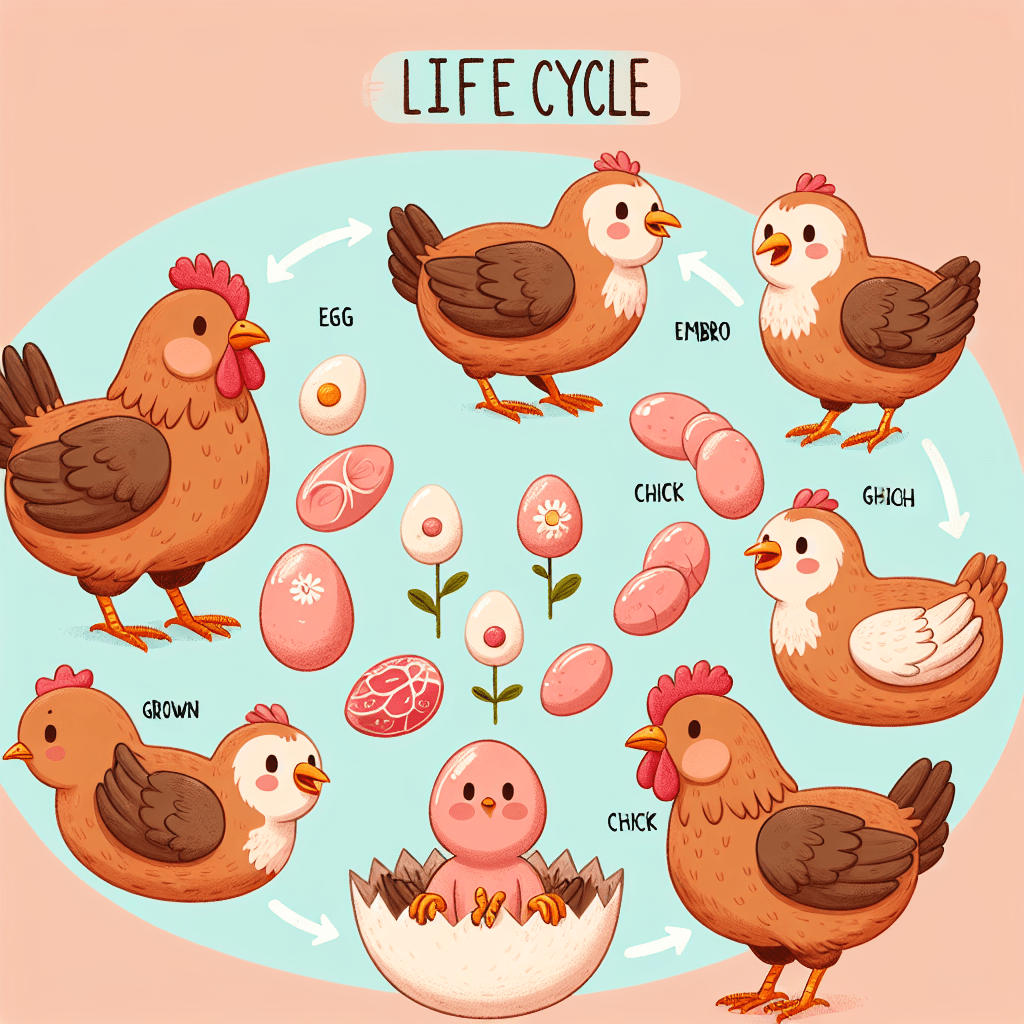
Chickens: Life Cycle & Traits Exploration
Inquiry Framework
Question Framework
Driving Question
The overarching question that guides the entire project.How can we creatively demonstrate our understanding of a chicken's life cycle, and the inheritance of traits?Essential Questions
Supporting questions that break down major concepts.- What is the life cycle of a chicken and what are the key stages in this cycle?
- How do chickens inherit traits from their parents?
- Why is understanding the life cycle of chickens important in science?
Standards & Learning Goals
Learning Goals
By the end of this project, students will be able to:- Students will understand and describe the life cycle of a chicken, identifying key stages including birth, growth, reproduction, and death.
- Students will analyze and interpret data on inherited traits in chickens, understanding how variation in traits occurs.
- Students will creatively demonstrate their understanding of the topic through a choice board presentation.
NGSS
Entry Events
Events that will be used to introduce the project to studentsFarm-to-Classroom Egg Hatching
Bring a set of fertilized chicken eggs into the classroom and set up an incubator. Tell the students they'll be part of a team that will care for and eventually hatch these eggs, allowing them to observe and document each stage of development firsthand, connecting directly with the life cycle and inheritance traits they are about to study.Virtual Reality Chicken Life Cycle Tour
Use VR headsets to give students an immersive experience inside a chicken coop, following the life cycle of chickens from egg to adulthood. This simulated experience sets the stage for students to explore aspects of a chicken's life in a new and engaging way, prompting questions about development and traits.Portfolio Activities
Portfolio Activities
These activities progressively build towards your learning goals, with each submission contributing to the student's final portfolio.Egg-to-Chick Observation Journal
Students will maintain a detailed observation journal documenting the development stages of the eggs in the incubator. They will sketch, note changes, and hypothesize about the stages observed, aligning their observations with scientific concepts of life cycles.Steps
Here is some basic scaffolding to help students complete the activity.Final Product
What students will submit as the final product of the activityAn illustrated and annotated journal documenting the chicken's stages from egg to chick, showcasing understanding of growth stages.Alignment
How this activity aligns with the learning objectives & standardsAligns with NGSS 3-LS1-1 by developing models to describe the diverse stages of organisms' life cycles.Trait Detective: Chicken Genetics
Students explore chicken genetics by analyzing and interpreting traits they observe in the newly hatched chicks, focusing on heredity and variations.Steps
Here is some basic scaffolding to help students complete the activity.Final Product
What students will submit as the final product of the activityA genetics report categorizing observed traits and their inheritance patterns based on student data collected from the chicks.Alignment
How this activity aligns with the learning objectives & standardsAligns with NGSS 3-LS3-1 by analyzing and interpreting data on inherited traits.Survival Features Exploration
Students investigate how specific traits provide advantages to chickens in their environment, constructing explanations with evidence.Steps
Here is some basic scaffolding to help students complete the activity.Final Product
What students will submit as the final product of the activityA presentation poster detailing survival advantages of specific chicken traits and how these contribute to their life cycle success.Alignment
How this activity aligns with the learning objectives & standardsAligns with NGSS 3-LS4-2 by using evidence to explain trait variations and survival advantages.Creative Choice Board Presentation
Utilize a choice board for students to creatively present their learnings on chicken life cycles and trait inheritance, linking back to their previous investigations.Steps
Here is some basic scaffolding to help students complete the activity.Final Product
What students will submit as the final product of the activityA selected creative project from the choice board that demonstrates comprehensive understanding of chicken life cycles and genetic traits.Alignment
How this activity aligns with the learning objectives & standardsSupports learning goals involving demonstration of understanding and creativity in presentation as outlined in the project overview.Rubric & Reflection
Portfolio Rubric
Grading criteria for assessing the overall project portfolioLife Cycle and Genetics of Chickens Assessment Rubric
Understanding of Life Cycle
Assessment of students' comprehension and articulation of the chicken's life cycle, including key stages of birth, growth, reproduction, and death.Life Cycle Stages
Identifies and describes the key stages of the chicken life cycle through observation and representation.
Exemplary
4 PointsProvides a comprehensive and accurate depiction of all key stages in the chicken life cycle, supported by detailed observations and creative illustrations.
Proficient
3 PointsAccurately identifies and describes most stages of the chicken life cycle, supported by clear observations and illustrations.
Developing
2 PointsIdentifies and describes some stages of the chicken life cycle, though some details may be missing or inaccurate.
Beginning
1 PointsStruggles to identify and describe the stages of the chicken life cycle, with significant inaccuracies or omissions.
Observation Skills
Demonstrates thoroughness and accuracy in documenting observations during the incubation period, including sketches and notes.
Exemplary
4 PointsUses detailed sketches and notes to thoroughly document observations, reflecting deep engagement and understanding.
Proficient
3 PointsUses clear sketches and notes to document most observations, showing consistent engagement.
Developing
2 PointsDocumentation reflects partial observations or lacks detail, indicating inconsistent engagement.
Beginning
1 PointsDocumentation is minimal or inaccurate, showing limited engagement with observations.
Genetics and Inherited Traits
Evaluation of students’ understanding of chicken genetics, including the ability to analyze and document inherited traits and their variations.Identification of Traits
Ability to observe and identify inherited traits in chickens, including similarities and variations.
Exemplary
4 PointsObserves and identifies a comprehensive range of inherited traits, clearly documenting similarities and differences.
Proficient
3 PointsObserves and identifies most inherited traits, documenting similarities and differences accurately.
Developing
2 PointsIdentifies some inherited traits, with limited documentation of similarities and differences.
Beginning
1 PointsStruggles to identify or document inherited traits, with minimal or inaccurate observations.
Data Analysis Skills
Ability to analyze and interpret genetic data to explain traits inheritance and variation.
Exemplary
4 PointsProvides nuanced analysis of genetic data, demonstrating clear understanding of trait inheritance and variation.
Proficient
3 PointsAnalyzes genetic data to explain trait inheritance and variation, demonstrating solid understanding.
Developing
2 PointsExplains trait inheritance with partial analysis of genetic data, indicating emerging understanding.
Beginning
1 PointsMinimal analysis or inaccurate explanation of genetic data related to trait inheritance.
Creative Presentation
Assessment of students’ ability to creatively compile and present information on chicken life cycles and genetics, using a variety of formats from the choice board.Creativity and Innovation
Ability to utilize creative formats to showcase understanding and analysis using the choice board options.
Exemplary
4 PointsEmploys highly creative and effective formats, showcasing a comprehensive understanding through innovative presentation.
Proficient
3 PointsUtilizes creative formats to effectively showcase understanding and analysis.
Developing
2 PointsEmploys somewhat creative formats, though presentation may lack depth or clarity.
Beginning
1 PointsStruggles to use creative formats effectively, with minimal evidence of understanding.
Content Accuracy
Ensures that all information presented is scientifically accurate and relevant to chicken life cycles and genetics.
Exemplary
4 PointsAll content presented is scientifically accurate and fully relevant, showcasing a strong grasp of topics.
Proficient
3 PointsMost content presented is scientifically accurate and relevant, with minor errors.
Developing
2 PointsSome content is accurate and relevant, but includes noticeable errors or omissions.
Beginning
1 PointsContent is largely inaccurate or irrelevant, showing misunderstanding of the topics.