
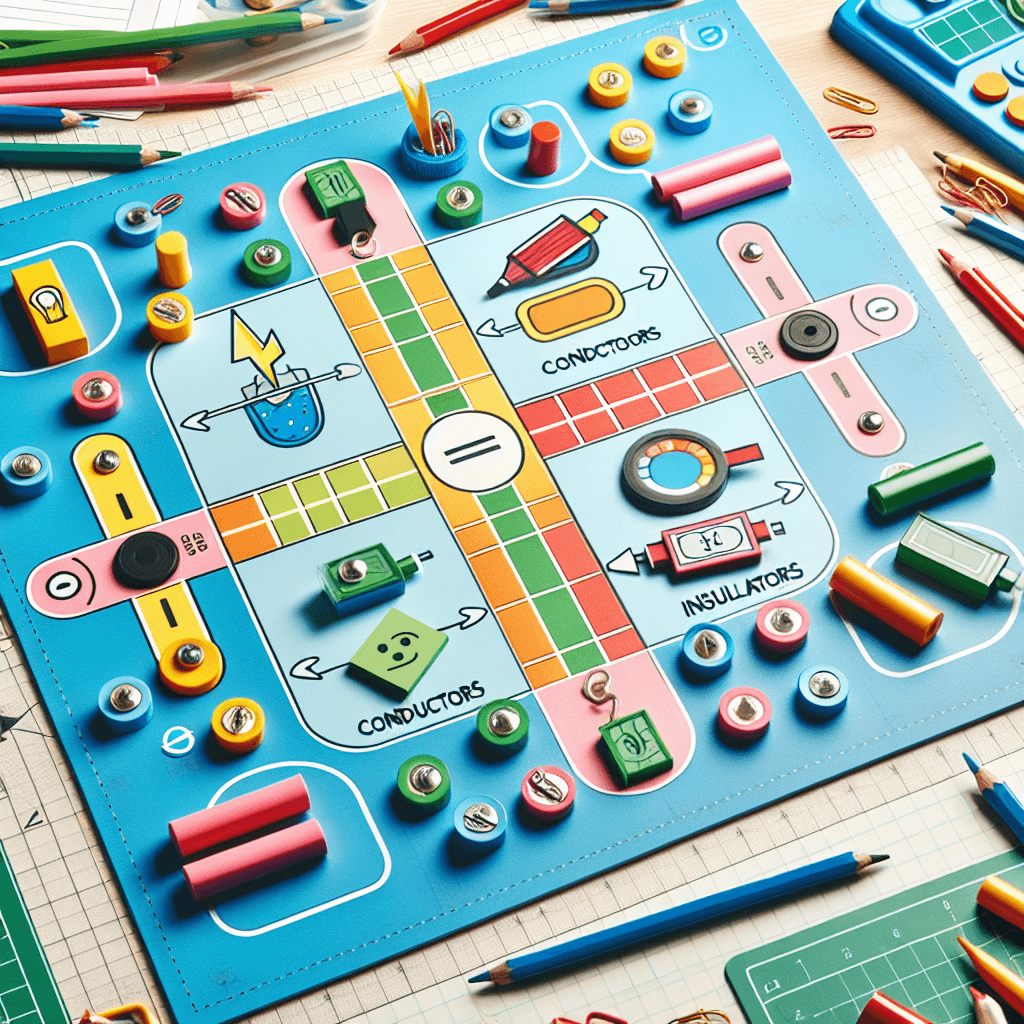
Circuit Board Game Challenge: Conductors vs. Insulators
Inquiry Framework
Question Framework
Driving Question
The overarching question that guides the entire project.How can we design a circuit board game that demonstrates the flow of electricity through conductors and insulators?Essential Questions
Supporting questions that break down major concepts.- What are conductors and insulators, and how do they affect the flow of electricity?
- How can we represent circuits in a game format?
- How does electricity flow through a circuit?
- How can we design a game?
Standards & Learning Goals
Learning Goals
By the end of this project, students will be able to:- Understand the difference between conductors and insulators.
- Design a playable board game that accurately represents electrical circuits.
- Carry out investigations on common materials to classify them as insulators or conductors of electricity.
- Explain how electricity flows through a circuit using game mechanics.
- Use game design to teach the difference between conductors and insulators
Teacher Specified
Entry Events
Events that will be used to introduce the project to studentsThe Mystery Materials Experiment
Present students with a collection of unusual materials and challenge them to create a simple circuit to test their conductivity. They then use their findings to design a board game where players must choose the right materials to complete circuits.The Broken Game Delivery
A mysterious package arrives containing a broken circuit board game and a plea for help from a fictional toy company. Students must reverse engineer the game to understand how it works and then design their own version.Portfolio Activities
Portfolio Activities
These activities progressively build towards your learning goals, with each submission contributing to the student's final portfolio.Conductivity Quest: Material Testers
Students will conduct a series of experiments to test various materials for conductivity. They will use a simple circuit tester to observe whether each material allows electricity to flow (conductor) or blocks it (insulator).Steps
Here is some basic scaffolding to help students complete the activity.Final Product
What students will submit as the final product of the activityA detailed lab report with observations, data, and classifications of at least 10 different materials as conductors or insulators.Alignment
How this activity aligns with the learning objectives & standardsAligns with standard PS.4.2.3 by requiring students to classify materials as conductors or insulators through hands-on investigation.Circuit Challenge: Game Component Design
Using the knowledge gained from the material testing activity, students will brainstorm how to represent conductors and insulators within their board game. This includes determining how players will interact with these elements and how they will affect gameplay.Steps
Here is some basic scaffolding to help students complete the activity.Final Product
What students will submit as the final product of the activityA detailed plan outlining how conductors and insulators will be represented in the game, including specific game mechanics and rules related to them.Alignment
How this activity aligns with the learning objectives & standardsBuilds on PS.4.2.3 by applying the understanding of conductors and insulators to the design of game components.Board Game Blitz: Prototype Creation
Students will create a fully functional board game prototype that incorporates the concepts of conductors and insulators. They will test their game to ensure it is both playable and educational.Steps
Here is some basic scaffolding to help students complete the activity.Final Product
What students will submit as the final product of the activityA playable board game prototype, complete with a game board, playing pieces, cards, and a rulebook. The game should clearly demonstrate the principles of electrical conductivity and insulation.Alignment
How this activity aligns with the learning objectives & standardsReinforces PS.4.2.3 by ensuring the game accurately reflects the properties of conductors and insulators in a fun, engaging way.Rubric & Reflection
Portfolio Rubric
Grading criteria for assessing the overall project portfolioCircuit Board Game Challenge Rubric
Experimental Investigation
Assesses students' ability to conduct experiments, collect and analyze data, and draw conclusions about conductors and insulators.Material Classification
Accuracy of identifying and classifying materials as conductors or insulators based on experimental evidence.
Exemplary
4 PointsAccurately classifies all materials with detailed supporting evidence and insightful observations.
Proficient
3 PointsCorrectly classifies most materials with clear supporting evidence and relevant observations.
Developing
2 PointsClassifies some materials correctly, but evidence is limited or unclear, and observations are superficial.
Beginning
1 PointsStruggles to classify materials accurately and provides little to no supporting evidence or relevant observations.
Lab Report Quality
Clarity and completeness of the lab report, including data tables, observations, and conclusions.
Exemplary
4 PointsLab report is exceptionally clear, well-organized, and comprehensive, with detailed data tables, thorough observations, and insightful conclusions.
Proficient
3 PointsLab report is clear, well-organized, and complete, with clear data tables, relevant observations, and logical conclusions.
Developing
2 PointsLab report is somewhat unclear or incomplete, with partially filled data tables, limited observations, or superficial conclusions.
Beginning
1 PointsLab report is unclear, disorganized, and incomplete, with missing data, irrelevant observations, and illogical or missing conclusions.
Conceptual Understanding
Depth of understanding demonstrated in the conclusion, including explanations of conductivity and insulation.
Exemplary
4 PointsDemonstrates a sophisticated understanding of conductivity and insulation, explaining the concepts clearly and connecting them to real-world applications with novel insights.
Proficient
3 PointsDemonstrates a thorough understanding of conductivity and insulation, explaining the concepts clearly and connecting them to real-world applications.
Developing
2 PointsDemonstrates a basic understanding of conductivity and insulation, but explanations may be simplistic or incomplete, and connections to real-world applications are limited.
Beginning
1 PointsDemonstrates a limited understanding of conductivity and insulation, with unclear explanations and no connection to real-world applications.
Game Design Application
Evaluates how well students apply their understanding of conductors and insulators to the design of game components and mechanics.Representation Accuracy
Effectiveness of representing conductors and insulators in the game design (e.g., using different types of spaces, cards, or tokens).
Exemplary
4 PointsInnovatively represents conductors and insulators in the game design, creating a highly engaging and educational gameplay experience.
Proficient
3 PointsEffectively represents conductors and insulators in the game design, creating a clear and understandable gameplay experience.
Developing
2 PointsPartially represents conductors and insulators in the game design, but the representation may be confusing or incomplete.
Beginning
1 PointsFails to adequately represent conductors and insulators in the game design, resulting in a confusing or inaccurate gameplay experience.
Mechanics Integration
Integration of game mechanics that accurately reflect the properties of conductors and insulators (e.g., conductors allow players to move faster, insulators block movement).
Exemplary
4 PointsSeamlessly integrates game mechanics that accurately and creatively reflect the properties of conductors and insulators, enhancing the overall gameplay experience.
Proficient
3 PointsEffectively integrates game mechanics that accurately reflect the properties of conductors and insulators, contributing to the educational value of the game.
Developing
2 PointsPartially integrates game mechanics that reflect the properties of conductors and insulators, but the connection may be weak or inconsistent.
Beginning
1 PointsFails to integrate game mechanics that reflect the properties of conductors and insulators, resulting in a game that does not accurately represent these concepts.
Game Plan Clarity
Clarity and detail of the plan outlining how conductors and insulators will be represented in the game, including specific game mechanics and rules related to them.
Exemplary
4 PointsProvides an exceptionally clear and detailed plan with innovative game mechanics and rules that thoroughly explain how conductors and insulators function within the game.
Proficient
3 PointsProvides a clear and detailed plan with well-defined game mechanics and rules that explain how conductors and insulators function within the game.
Developing
2 PointsProvides a somewhat unclear or incomplete plan with vague game mechanics and rules that only partially explain how conductors and insulators function within the game.
Beginning
1 PointsProvides an unclear and incomplete plan with poorly defined game mechanics and rules that fail to adequately explain how conductors and insulators function within the game.
Prototype Creation & Functionality
Focuses on the creation of a fully functional and educational board game prototype that demonstrates the principles of electrical conductivity and insulation.Board Design
Incorporation of spaces representing conductors and insulators into the game board design.
Exemplary
4 PointsThe game board design creatively and effectively incorporates spaces that represent conductors and insulators, enhancing the gameplay and educational value.
Proficient
3 PointsThe game board design clearly incorporates spaces that represent conductors and insulators, contributing to the overall functionality of the game.
Developing
2 PointsThe game board design partially incorporates spaces that represent conductors and insulators, but the integration may be inconsistent or confusing.
Beginning
1 PointsThe game board design fails to adequately incorporate spaces that represent conductors and insulators, hindering the game's functionality.
Component Design
Functionality and design of playing pieces, cards, and tokens in relation to the game's objectives and the concepts of conductivity and insulation.
Exemplary
4 PointsPlaying pieces, cards, and tokens are ingeniously designed and seamlessly integrated into the game, significantly enhancing the gameplay experience and reinforcing the concepts of conductivity and insulation.
Proficient
3 PointsPlaying pieces, cards, and tokens are well-designed and functionally integrated into the game, supporting the gameplay and representing the concepts of conductivity and insulation.
Developing
2 PointsPlaying pieces, cards, and tokens are partially designed and integrated into the game, but their functionality may be limited or inconsistent.
Beginning
1 PointsPlaying pieces, cards, and tokens are poorly designed and lack integration into the game, failing to effectively represent the concepts of conductivity and insulation.
Rulebook Quality
Clarity, accuracy, and completeness of the rulebook, including explanations of how to play the game and how conductors and insulators affect gameplay.
Exemplary
4 PointsThe rulebook is exceptionally clear, concise, and comprehensive, providing innovative and insightful explanations of the game rules and the role of conductors and insulators.
Proficient
3 PointsThe rulebook is clear, concise, and complete, providing accurate explanations of the game rules and the role of conductors and insulators.
Developing
2 PointsThe rulebook is somewhat unclear or incomplete, with partially accurate explanations of the game rules and the role of conductors and insulators.
Beginning
1 PointsThe rulebook is unclear, disorganized, and incomplete, failing to provide accurate explanations of the game rules and the role of conductors and insulators.
Prototype Effectiveness
Playability and educational value of the game prototype, as demonstrated through testing and feedback.
Exemplary
4 PointsThe game prototype is highly playable, engaging, and educational, providing a rich and insightful learning experience about electrical conductivity and insulation.
Proficient
3 PointsThe game prototype is playable, engaging, and educational, providing a clear and effective learning experience about electrical conductivity and insulation.
Developing
2 PointsThe game prototype is partially playable and educational, but the learning experience may be limited or inconsistent.
Beginning
1 PointsThe game prototype is not playable or educational, failing to provide an effective learning experience about electrical conductivity and insulation.