
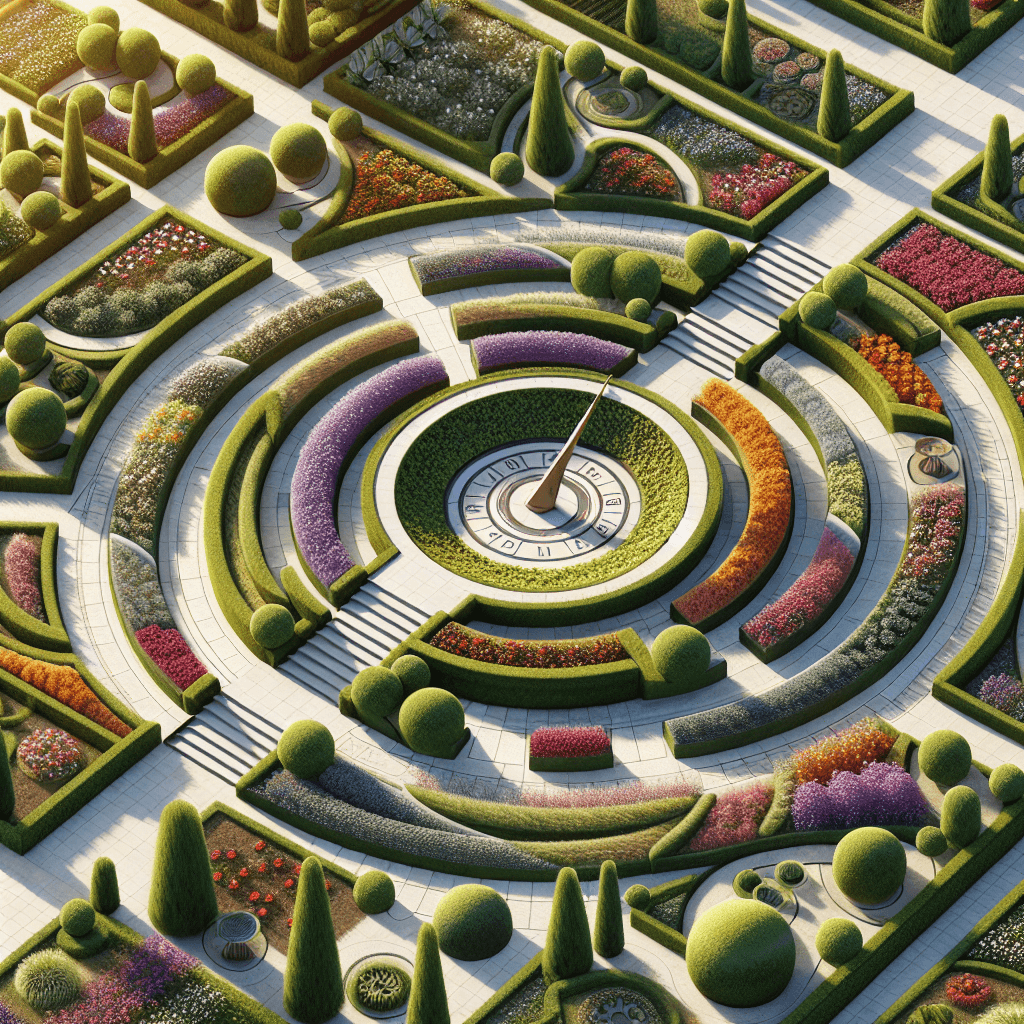
Circular Geometry: Designing Garden with Arcs & Sectors
Inquiry Framework
Question Framework
Driving Question
The overarching question that guides the entire project.How can we use mathematical concepts related to circles—such as arc measures, sector areas, and proportional relationships—to design a functional, aesthetically pleasing circular garden, and apply these principles in a real-world setting?Essential Questions
Supporting questions that break down major concepts.- How can we use circles to design functional and aesthetically appealing gardens?
- What is the relationship between arc measures and sector areas?
- How do proportional relationships help in understanding circular designs?
- In what ways can the Pythagorean Theorem be applied to circles?
- How can we determine the equation of a circle and apply it to real-life problems?
- What strategies can we use to calculate arc length and sector area effectively?
- How can solving problems in the coordinate plane help in designing circular gardens?
Standards & Learning Goals
Learning Goals
By the end of this project, students will be able to:- Students will be able to design a circular garden by applying mathematical concepts related to circles, such as arc measures, sector areas, and proportional relationships.
- Students will learn to solve for unknown measurements in circle-related problems, such as calculating arc measures, lengths, and sector areas.
- Students will demonstrate understanding of the Pythagorean Theorem as it applies to finding the equation of a circle.
- Students will develop problem-solving skills by applying circle equations for real-life scenarios, particularly in designing garden layouts.
- Students will be able to articulate the relationship between arc measures and sector areas, and how these contribute to the design of aesthetically pleasant and functional gardens.
- Students will practice using coordinate planes to plot and solve geometric problems within the context of the garden design.
Common Core Standards
Entry Events
Events that will be used to introduce the project to studentsCommunity Garden Design Contest
Students are presented with a challenge to design a community garden using circular patterns. They are provided with detailed requirements that align with community needs, like maximizing vegetable yield while considering aesthetic appeal. They must utilize mathematical concepts such as arc measures, sector areas, and proportional relationships to present a realistically implementable proposal.Portfolio Activities
Portfolio Activities
These activities progressively build towards your learning goals, with each submission contributing to the student's final portfolio.Circle Introduction Card
Students craft a 'Circle Introduction Card' to understand and illustrate basic circle concepts such as radius, diameter, and circumference. This builds foundational knowledge required for more complex project elements.Steps
Here is some basic scaffolding to help students complete the activity.Final Product
What students will submit as the final product of the activityA completed Circle Introduction Card that visually represents and defines radius, diameter, and circumference.Alignment
How this activity aligns with the learning objectives & standardsCovers G.PC.3 by establishing knowledge of basic circle properties.Arc Detective Challenge
In this activity, students become 'Arc Detectives' solving for arc measures and angles. This requires understanding the relationship between angles and arc length in circles, a fundamental skill for garden design.Steps
Here is some basic scaffolding to help students complete the activity.Final Product
What students will submit as the final product of the activityA workbook of solved arc measure problems, showing comprehensive calculations.Alignment
How this activity aligns with the learning objectives & standardsMeets aspects of G.PC.3 and G.PC.4 by solving for arc measures and applying these to real-world problems.Sector Area Lab
Students explore 'Sector Area Lab', an investigative task to calculate sector areas. This deepens understanding of how sectors contribute to garden space design.Steps
Here is some basic scaffolding to help students complete the activity.Final Product
What students will submit as the final product of the activityCompilation of worksheets displaying solved sector area calculations.Alignment
How this activity aligns with the learning objectives & standardsLinks to G.PC.3 and G.PC.4 focusing on understanding and calculating sector areas.Proportional Garden Plan
Students create a 'Proportional Garden Plan' using proportional relationships to ensure their garden meets specified design criteria effectively.Steps
Here is some basic scaffolding to help students complete the activity.Final Product
What students will submit as the final product of the activityA sketched garden plan focused on proportional relationships within circular designs.Alignment
How this activity aligns with the learning objectives & standardsBuilds on G.PC.4 by applying proportional reasoning to realistic design tasks.Sketching the Circle Equation
This activity helps students sketch and derive the equation of a circle using real-life layouts, integrating abstract mathematical concepts with practical applications.Steps
Here is some basic scaffolding to help students complete the activity.Final Product
What students will submit as the final product of the activityA series of derived circle equations and plotted garden circles on coordinate planes.Alignment
How this activity aligns with the learning objectives & standardsAddresses G.PC.3 and G.PC.4 by solidifying understanding of circle equations and their geometric representations.Rubric & Reflection
Portfolio Rubric
Grading criteria for assessing the overall project portfolioCircular Garden Design Rubric
Understanding Circle Properties
Evaluates student comprehension of circle vocabulary and basic properties, which are foundational for design tasks.Circle Vocabulary Mastery
Assesses ability to accurately define and illustrate basic circle terms like radius, diameter, and circumference.
Exemplary
4 PointsProvides precise definitions and creative visuals showing a sophisticated understanding of circle vocabulary.
Proficient
3 PointsProvides accurate definitions with clear visuals demonstrating thorough understanding.
Developing
2 PointsIncludes basic definitions and visuals with some inaccuracies.
Beginning
1 PointsShows limited understanding with incorrect definitions and unclear visuals.
Comprehension of Arc Measures
Evaluates the student's ability to calculate and understand arc measures and central angles.
Exemplary
4 PointsConsistently calculates arc measures with accuracy and connects them to central angles seamlessly.
Proficient
3 PointsAccurately calculates arc measures and shows good understanding of their relation to central angles.
Developing
2 PointsCalculates basic arc measures but struggles with linking them to central angles.
Beginning
1 PointsInaccurately calculates arc measures with limited understanding of central angle relationships.
Application of Sector Areas
Examines student skills in calculating and applying sector areas in varying design contexts.Sector Area Calculation
Measures ability to accurately determine sector areas and employ these calculations in design.
Exemplary
4 PointsFlawlessly calculates sector areas with innovative application in design contexts.
Proficient
3 PointsPrecisely calculates sector areas with consistent practical application.
Developing
2 PointsCalculates sector areas with some errors and lacks confident application in design.
Beginning
1 PointsStruggles to calculate sector areas correctly and applies poorly in designs.
Proportional Reasoning in Design
Assesses the use of proportional relationships to create effective garden layouts.Proportional Garden Layouts
Evaluates ability to utilize proportional reasoning in forming comprehensive garden plans.
Exemplary
4 PointsCreates innovative, proportionally balanced garden layouts enhancing both functionality and aesthetic.
Proficient
3 PointsDevelops well-proportioned garden plans with clear functionality and aesthetic value.
Developing
2 PointsDesigns show basic proportional reasoning with areas lacking balance and coherence.
Beginning
1 PointsMinimal use of proportional reasoning leads to incoherent, impractical designs.
Equation of Circle and Geometric Application
Evaluates understanding of deriving and utilizing circle equations within practical layouts.Circle Equation Mastery
Assesses derivation and application of circle equations in geometric design and analysis.
Exemplary
4 PointsDemonstrates exceptional ability in deriving circle equations and applying them fluently in real-world layouts.
Proficient
3 PointsShows strong grasp on deriving equations and applies them consistently in design contexts.
Developing
2 PointsStruggles with equation derivation, leading to inconsistent application in practical tasks.
Beginning
1 PointsIncorrectly derives and applies circle equations, limiting practical utility.