
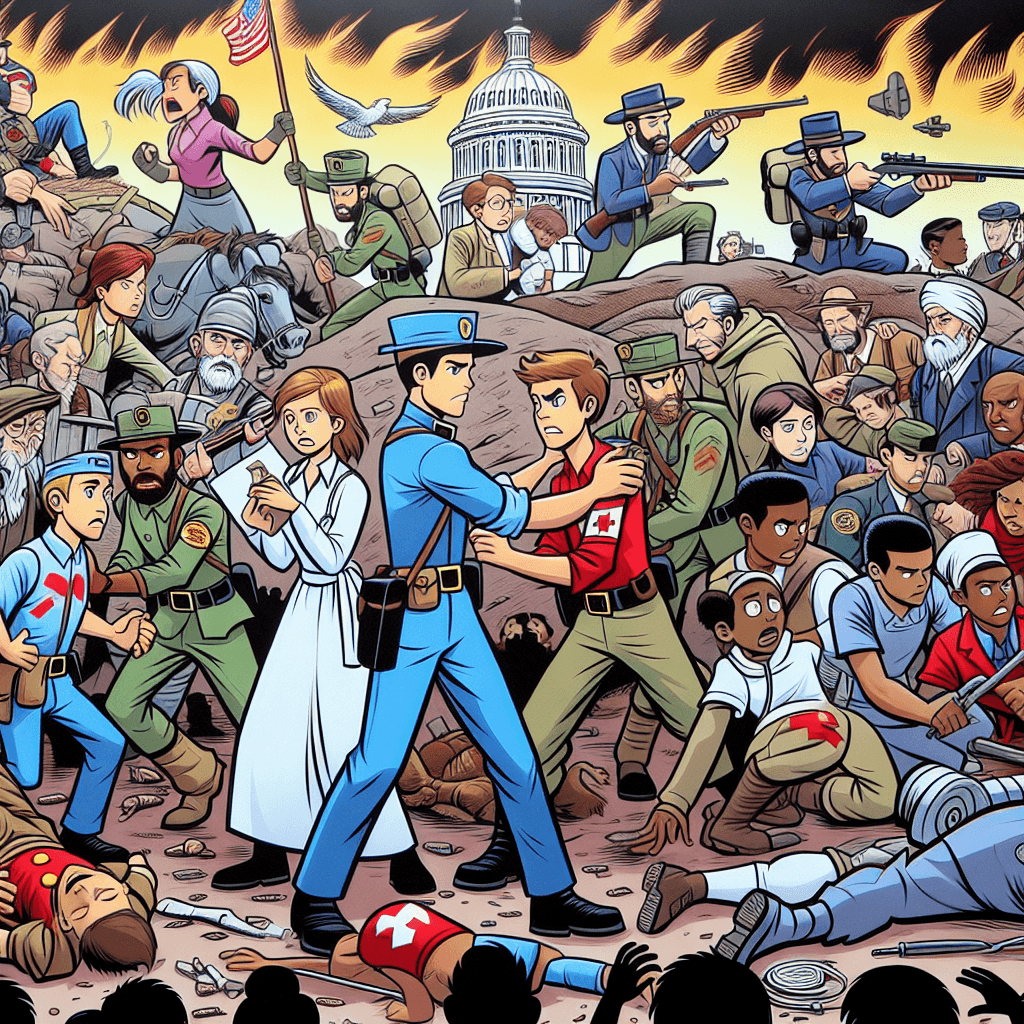
Civil War Comic Heroes: Illustrating History
Inquiry Framework
Question Framework
Driving Question
The overarching question that guides the entire project.How can we creatively depict the major causes, key figures, and significant impacts of the Civil War through the lens of a comic series, while exploring the transformation of American society during and after the war?Essential Questions
Supporting questions that break down major concepts.- What were the major causes of the Civil War, and how did they impact the course of the war?
- Who were the key figures before and during the Civil War, and what roles did they play in shaping its outcomes?
- How did the Civil War contribute to the end of slavery and the advancement of civil rights for African Americans?
- What were the significant battles of the Civil War and their impact on the war's outcome?
- How did Abraham Lincoln’s presidency influence the evolution of the Republican Party and the ratification of important Constitutional amendments?
- In what ways did the Industrial growth occurring in the North during the Civil War change the United States economically and politically?
- How did the Reconstruction era following the Civil War transform the social and political landscape of the United States?
Standards & Learning Goals
Learning Goals
By the end of this project, students will be able to:- Students will be able to identify and describe the major causes of the Civil War and its significant impacts on American society.
- Students will explain the roles and contributions of key Civil War figures and abolitionists in shaping historical events and outcomes.
- Students will illustrate and analyze major battles and military strategies of the Civil War, understanding their effects on the war's progression.
- Students will explore and communicate the social and political changes during the Reconstruction era following the Civil War.
- Students will create a comic book that creatively depicts the transformation of American society through the lives of key individuals and events during the Civil War period.
History-Social Science Standards
Entry Events
Events that will be used to introduce the project to studentsVirtual Reality Journey Through the Civil War
Students are introduced to the Civil War through a virtual reality experience, immersing them in key battles, and moments like the signing of the Emancipation Proclamation. This sparks curiosity about the personal stories of those who lived during this era, which they will explore by creating comic book narratives.Portfolio Activities
Portfolio Activities
These activities progressively build towards your learning goals, with each submission contributing to the student's final portfolio.Hero's Backstory Biography
Students start by researching key figures from the Civil War to understand their background and contributions. This activity sets the foundation for creating accurate and compelling comic characters.Steps
Here is some basic scaffolding to help students complete the activity.Final Product
What students will submit as the final product of the activityA comprehensive biography of a Civil War figure, detailing their contribution and personal history.Alignment
How this activity aligns with the learning objectives & standardsHSS.5.T5.03 and HSS.5.T5.05 - Focuses on understanding the roles of key figures and Lincoln's impact during the Civil War.Battle Scenario Storyboarding
Students create a storyboard that outlines a comic containing one of the major Civil War battles. This helps them translate historical events into visual narratives.Steps
Here is some basic scaffolding to help students complete the activity.Final Product
What students will submit as the final product of the activityA storyboard for a comic page illustrating a Civil War battle.Alignment
How this activity aligns with the learning objectives & standardsHSS.5.T5.04 - Highlights major battles and military leaders of the Civil War.Cause and Effect Comic Strip
Students illustrate a comic strip that describes the major causes of the Civil War and its direct impact on society. This connects historical causes with visual storytelling.Steps
Here is some basic scaffolding to help students complete the activity.Final Product
What students will submit as the final product of the activityA comic strip depicting the causes of the Civil War and their social effects.Alignment
How this activity aligns with the learning objectives & standardsHSS.5.T5.02 - Addresses the causes and outcomes of the Civil War.Lincoln's Leadership Comic Book Chapter
Students create a comic book chapter dedicated to Abraham Lincoln's leadership and influence during the Civil War, showcasing his historical decisions and political impacts.Steps
Here is some basic scaffolding to help students complete the activity.Final Product
What students will submit as the final product of the activityA comic book chapter illustrating the leadership of Abraham Lincoln during the Civil War.Alignment
How this activity aligns with the learning objectives & standardsHSS.5.T5.05 - Provides insights into Lincoln’s roles and political moves during the Civil War.Reconstruction Era Revolution
Students develop a visual narrative in comic form about the Reconstruction era, highlighting its role in transforming the American social and political landscape.Steps
Here is some basic scaffolding to help students complete the activity.Final Product
What students will submit as the final product of the activityA comic story depicting the post-Civil War Reconstruction era changes.Alignment
How this activity aligns with the learning objectives & standardsHSS.5.T5.02 - Focuses on the outcomes and changes following the Civil War.Rubric & Reflection
Portfolio Rubric
Grading criteria for assessing the overall project portfolioCivil War Comic Series Assessment Rubric
Historical Accuracy and Research
Assess the quality and accuracy of historical information used in the creation of the comic series, ensuring alignment with historical events and figures' true representations.Relevance and Depth of Research
Evaluate the extent and quality of research conducted on Civil War figures, battles, and events.
Exemplary
4 PointsConducts extensive research from multiple reliable sources, providing a deep understanding and rich historical detail.
Proficient
3 PointsConducts thorough research, utilizing more than one source to establish a well-rounded historical perspective.
Developing
2 PointsConducts basic research with limited sources, providing some historical detail but with gaps.
Beginning
1 PointsConducts minimal research with few sources, leading to inaccurate or oversimplified representations.
Historical Accuracy
Assess the correctness and factual alignment of the comic's content with the historical facts of the Civil War.
Exemplary
4 PointsAll historical facts are accurate, with detailed references to significant events and figures consistently throughout the comic.
Proficient
3 PointsMost historical facts are accurate, with only minor inaccuracies present.
Developing
2 PointsSome facts are correct, but key inaccuracies are present that may distort historical understanding.
Beginning
1 PointsMany historical inaccuracies are present, suggesting a misunderstanding of key events.
Creative Expression and Storytelling
Assess the creativity, narrative coherence, and appeal of the comic series, focusing on how well historical narratives are adapted into engaging stories.Narrative Structure and Clarity
Evaluate the organization and clarity of the comic's storyline.
Exemplary
4 PointsThe comic has a clear, engaging, and well-structured narrative that powerfully conveys historical events.
Proficient
3 PointsThe comic generally maintains a coherent narrative with some lapses in clarity.
Developing
2 PointsThe storyline lacks clarity and coherence with noticeable disorganization.
Beginning
1 PointsThe comic's narrative is unclear and disjointed, making it difficult to follow.
Artistic Creativity
Assess the creative elements and artistic endeavor demonstrated in the comic series.
Exemplary
4 PointsExhibits exceptional creativity and originality, with visually compelling and creative illustrations.
Proficient
3 PointsShows good creativity with engaging illustrations that effectively support the storyline.
Developing
2 PointsDisplays basic creativity, but illustrations are simplistic and do not fully support the narrative.
Beginning
1 PointsLimited creativity in illustrations, which are simple and lack support for the narrative.
Critical Thinking and Analysis
Assess the ability to critically analyze and interpret historical events, individuals, and their impacts.Analytical Depth
Evaluate how deeply students interpret historical events and the impacts depicted in their comics.
Exemplary
4 PointsProvides deep and insightful analysis of historical events and their impacts with clear connections to today’s context.
Proficient
3 PointsOffers thoughtful analysis with some connections to broader historical impacts.
Developing
2 PointsAnalysis is basic with limited insight into historical impacts.
Beginning
1 PointsLimited or superficial analysis with no clear linkage to broader contexts.