
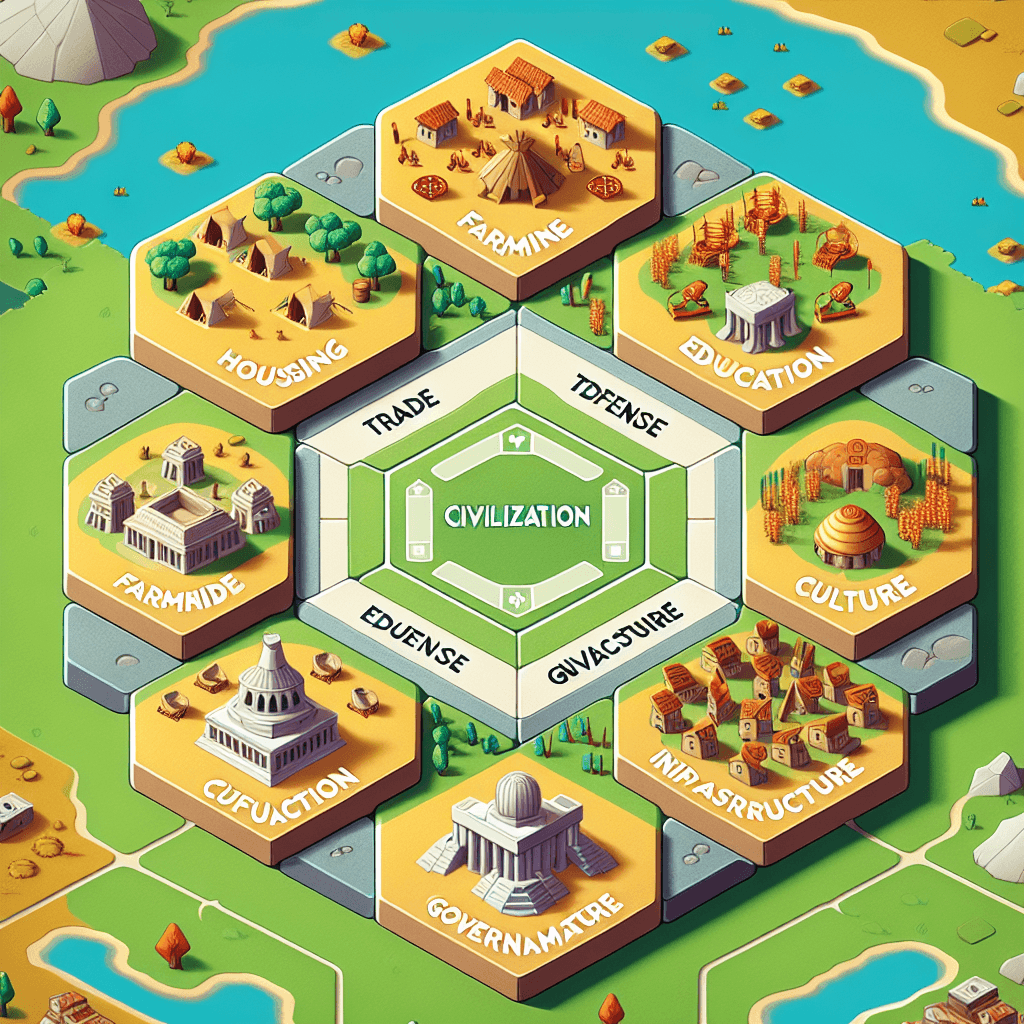
Civilization Game: Build and Rank the 8 Features
Inquiry Framework
Question Framework
Driving Question
The overarching question that guides the entire project.How can we design a civilization game that demonstrates the importance and interaction of the 8 features of a civilization, and what choices will lead our civilization to thrive or collapse?Essential Questions
Supporting questions that break down major concepts.- How do the 8 features of a civilization contribute to its growth and stability?
- What are the key characteristics of each of the 8 features of a civilization?
- How do civilizations develop and change over time?
- How do the 8 features of a civilization interact and influence each other?
- How can a civilization collapse?
Standards & Learning Goals
Learning Goals
By the end of this project, students will be able to:- Students will be able to define and describe the 8 features of a civilization.
- Students will be able to analyze the importance of each feature to a civilization's development.
- Students will be able to evaluate how decisions impact the success or failure of a civilization.
- Students will be able to create a civilization game that integrates the 8 features of civilization and demonstrates their interactions.
Entry Events
Events that will be used to introduce the project to studentsThe "Perfect" Civilization Design Contest
Students are challenged to design their own "perfect" civilization using all 8 features. A panel of judges (teachers, community members) evaluates the designs, prompting students to defend their choices and rankings.Portfolio Activities
Portfolio Activities
These activities progressively build towards your learning goals, with each submission contributing to the student's final portfolio.Civilization Feature Flashcards
Students will create flashcards for each of the 8 features of civilization. Each flashcard will include the name of the feature, a definition, and an example from a historical civilization.Steps
Here is some basic scaffolding to help students complete the activity.Final Product
What students will submit as the final product of the activityA set of 8 flashcards, each detailing a feature of civilization with a definition and historical example.Alignment
How this activity aligns with the learning objectives & standardsAddresses the learning goal: Students will be able to define and describe the 8 features of a civilization.Civilization Creation Blueprint
Students will design their own unique civilization, detailing how each of the 8 features is present and functions within their civilization. This serves as the blueprint for their civilization game.Steps
Here is some basic scaffolding to help students complete the activity.Final Product
What students will submit as the final product of the activityA detailed blueprint outlining the structure and function of each of the 8 features within the student's unique civilization.Alignment
How this activity aligns with the learning objectives & standardsAddresses the learning goal: Students will be able to create a civilization game that integrates the 8 features of civilization and demonstrates their interactions.Civilization Challenge Cards
Students will create a set of challenge cards for their civilization game. These cards will present players with difficult decisions related to the 8 features and force them to consider the consequences of their choices.Steps
Here is some basic scaffolding to help students complete the activity.Final Product
What students will submit as the final product of the activityA set of challenge cards that present players with difficult decisions and consequences related to the 8 features of civilization.Alignment
How this activity aligns with the learning objectives & standardsAddresses the learning goal: Students will be able to evaluate how decisions impact the success or failure of a civilization.Feature Importance Ranking & Justification
Students will rank the 8 features of civilization in order of importance, from most to least. They will then write a short paragraph justifying their ranking, explaining why they believe the top features are more crucial than the bottom ones.Steps
Here is some basic scaffolding to help students complete the activity.Final Product
What students will submit as the final product of the activityA ranked list of the 8 features of civilization with a written justification for the ranking.Alignment
How this activity aligns with the learning objectives & standardsAddresses the learning goal: Students will be able to analyze the importance of each feature to a civilization's development.Rubric & Reflection
Portfolio Rubric
Grading criteria for assessing the overall project portfolioCivilization Game Portfolio Rubric
Feature Flashcards
Demonstrates understanding of the 8 features of civilization through accurate definitions and relevant historical examples.Accuracy of Definitions
The degree to which the definitions of the 8 features are accurate and complete.
Exemplary
4 PointsDefinitions are exceptionally clear, comprehensive, and demonstrate a deep understanding of each feature. No inaccuracies present. Connects definitions with each other. Provides nuanced context. Great vocabulary usage. No support needed. Should be able to use these flashcards to teach someone else. Gives real world relevant and up to date examples. Exemplary.
Proficient
3 PointsDefinitions are accurate and demonstrate a solid understanding of each feature. Minor areas for improvement may exist, but overall, definitions are correct. Could use these flashcards to teach someone else with a little support. Provides a good example of how it relates to the real world. Good Job. I believe in you.
Developing
2 PointsDefinitions show a basic understanding of each feature, but may contain some inaccuracies or lack sufficient detail. Some support may be needed to teach someone else. Provides basic examples and is a little bland. You're on the right track.
Beginning
1 PointsDefinitions are incomplete, inaccurate, or demonstrate a limited understanding of the features of civilization. Needs significant support. Definitions are hard to understand and lacks real world examples. Keep trying!
Relevance of Historical Examples
The appropriateness and connection of the historical examples to the defined features.
Exemplary
4 PointsHistorical examples are highly relevant, specific, and clearly illustrate the defined features. Shows great insight into the connection. Examples showcase a deep understanding of historical context. Exemplary.
Proficient
3 PointsHistorical examples are relevant and illustrate the defined features effectively. Good examples and demonstrates understanding of historical context. Great Job. I believe in you.
Developing
2 PointsHistorical examples are somewhat relevant, but the connection to the defined features may not be clear or well-explained. Shows some understanding of historical context. You're on the right track.
Beginning
1 PointsHistorical examples are irrelevant, inaccurate, or missing. Shows a limited understanding of historical context. Keep trying!
Civilization Creation Blueprint
Demonstrates creativity and understanding of the interplay between the 8 features in the creation of a unique civilization.Originality and Creativity
The extent to which the civilization design is unique and imaginative.
Exemplary
4 PointsCivilization design is highly original, imaginative, and demonstrates exceptional creativity. Displays complex and interesting choices for the features. Exemplary.
Proficient
3 PointsCivilization design is creative and shows thoughtful consideration of the features. Choices are solid and makes sense. Great Job. I believe in you.
Developing
2 PointsCivilization design lacks originality and/or demonstrates limited creativity. Choices are basic and may not make sense. You're on the right track.
Beginning
1 PointsCivilization design is uninspired and shows no evidence of creative thought. Choices do not make sense and civilization wouldn't function. Keep trying!
Integration of Features
How well the 8 features are integrated and interconnected within the civilization design.
Exemplary
4 PointsAll 8 features are seamlessly integrated and demonstrate a clear understanding of their interconnectedness and interdependence. Features work together in a way that makes logical sense. Exemplary.
Proficient
3 PointsThe 8 features are well-integrated and their connections are evident within the civilization design. Features mostly work together and makes logical sense. Great Job. I believe in you.
Developing
2 PointsSome features are integrated, but the connections between them may be weak or unclear. Connections are there but don't stand out. You're on the right track.
Beginning
1 PointsThe 8 features are presented in isolation with little to no connection between them. No logical sense. Keep trying!
Civilization Challenge Cards
Demonstrates ability to analyze potential crises and consequences of decisions related to the 8 features.Relevance of Challenges
The degree to which the challenges are relevant to the 8 features and the civilization's context.
Exemplary
4 PointsChallenges are highly relevant, realistic, and directly related to the 8 features of civilization and the civilization's unique context. Challenges make sense and are highly applicable. Exemplary.
Proficient
3 PointsChallenges are relevant to the 8 features and the civilization's context. Challenges make sense. Great Job. I believe in you.
Developing
2 PointsChallenges are somewhat relevant, but the connection to the 8 features or civilization's context may be weak. Challenges may be far fetched. You're on the right track.
Beginning
1 PointsChallenges are irrelevant, unrealistic, or unrelated to the 8 features or civilization's context. Challenges do not make sense. Keep trying!
Clarity of Consequences
The clarity and depth of the described consequences (both positive and negative) for each decision.
Exemplary
4 PointsConsequences are clearly articulated, well-reasoned, and demonstrate a deep understanding of the potential impact of decisions on the civilization. Shows cause and effect well. Exemplary.
Proficient
3 PointsConsequences are clear and describe the potential impact of decisions on the civilization. Great Job. I believe in you.
Developing
2 PointsConsequences are described, but may lack detail or clarity. Understanding of potential impact is basic. You're on the right track.
Beginning
1 PointsConsequences are unclear, incomplete, or missing. Shows limited understanding of the impact. Keep trying!
Feature Importance Ranking & Justification
Demonstrates critical thinking and analytical skills in prioritizing and justifying the importance of the 8 features.Reasoning and Justification
The strength and clarity of the reasoning used to justify the ranking of the features.
Exemplary
4 PointsJustification is exceptionally well-reasoned, logical, and provides compelling evidence to support the ranking. Argument is well thought out and provides a fresh perspective. Exemplary.
Proficient
3 PointsJustification is logical and provides clear reasons for the ranking of the features. Argument is solid and well thought out. Great Job. I believe in you.
Developing
2 PointsJustification is present, but may lack depth or clarity in its reasoning. Argument may be difficult to understand and bland. You're on the right track.
Beginning
1 PointsJustification is weak, illogical, or missing. Ranking may not make sense. Keep trying!
Analysis of Importance
The depth of analysis in explaining the relative importance of the features.
Exemplary
4 PointsAnalysis demonstrates a sophisticated understanding of the relative importance of each feature and its impact on the overall success of a civilization. Provides a unique and insightful overview. Exemplary.
Proficient
3 PointsAnalysis demonstrates a thorough understanding of the relative importance of each feature. Shows good understanding of overall success and why things were chosen. Great Job. I believe in you.
Developing
2 PointsAnalysis demonstrates a basic understanding of the relative importance of each feature. Some areas are missing and understanding is not fully there. You're on the right track.
Beginning
1 PointsAnalysis is superficial and demonstrates a limited understanding of the relative importance of each feature. Limited understanding. Keep trying!