
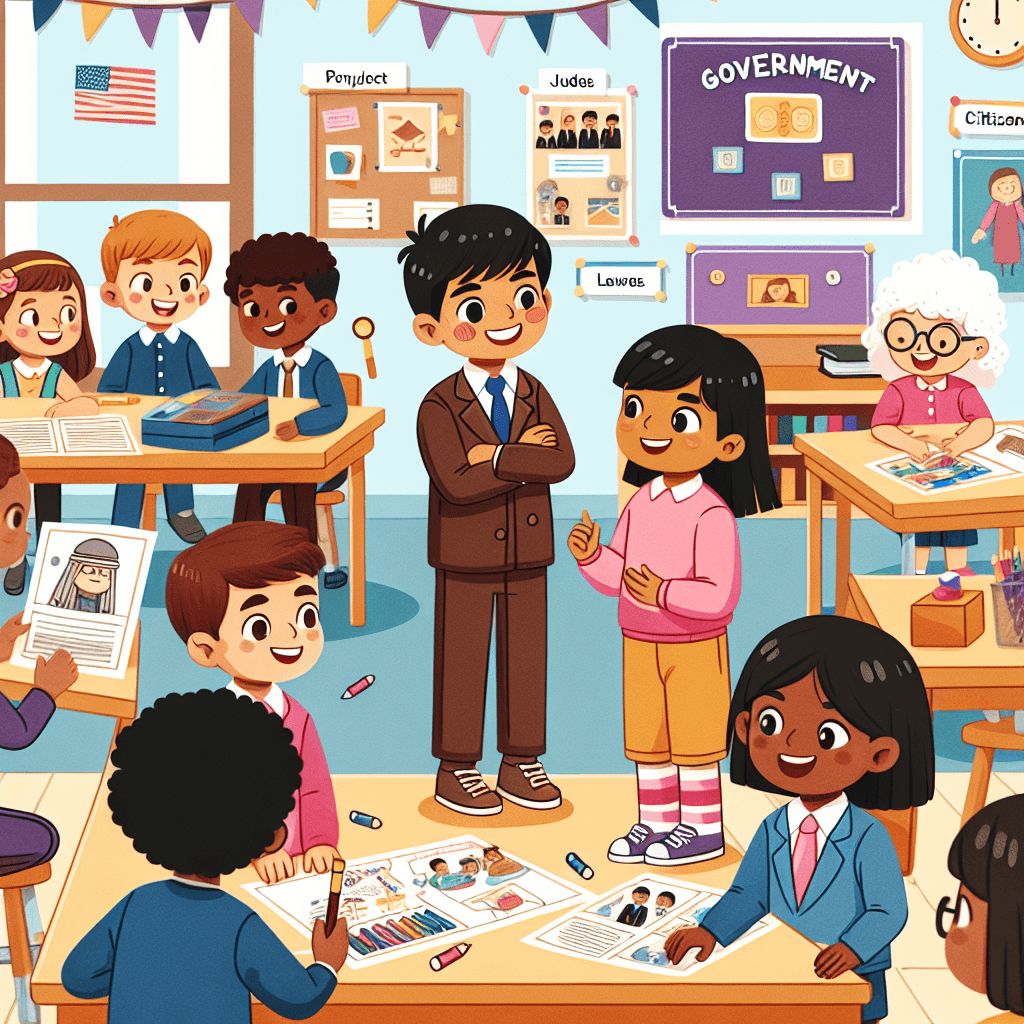
Classroom Government: Laws in Action for 2nd Graders
Inquiry Framework
Question Framework
Driving Question
The overarching question that guides the entire project.How can we, as a class, create our own government to understand the roles of laws and rights in a functioning society?Essential Questions
Supporting questions that break down major concepts.- What is the purpose of forming a government?
- How do laws function within a government setting?
- What are some examples of laws at state and national levels?
- How does the government influence our daily lives?
- In what ways does the U.S. government protect the rights and liberties of its citizens?
- What does it mean to be a U.S. citizen?
- How are equal rights ensured and protected within the U.S. Constitution?
Standards & Learning Goals
Learning Goals
By the end of this project, students will be able to:- Students will understand the reasons for forming a government by establishing a class government.
- Students will identify the roles and functions of laws within their created class government.
- Students will provide examples of state and national laws and apply these concepts in classroom scenarios.
- Students will explain how the government impacts everyday life through role-playing activities.
Social Studies Standards for 2nd Grade
Entry Events
Events that will be used to introduce the project to studentsPresidential Debate Day
Transform the classroom into a presidential debate stage where students represent various elements of government roles and responsibilities. Engage them by having a debate in which each student must emulate a government official's viewpoint, making laws come alive through interactive discussions and persuading classmates to form policies.Portfolio Activities
Portfolio Activities
These activities progressively build towards your learning goals, with each submission contributing to the student's final portfolio.Lawmakers in Action
Students will learn about the role of laws within a government by creating a set of classroom rules that mimic real-world laws.Steps
Here is some basic scaffolding to help students complete the activity.Final Product
What students will submit as the final product of the activityA written document of classroom laws approved by the class government.Alignment
How this activity aligns with the learning objectives & standardsCovers SS.2.CG.1.1 as students define laws and understand their roles.Daily Lives and Government Ties
Students explore how government decisions affect everyday life by acting out scenarios where government laws impact individuals and the community.Steps
Here is some basic scaffolding to help students complete the activity.Final Product
What students will submit as the final product of the activityA series of role-played scenarios demonstrating the impact of government decisions on daily life.Alignment
How this activity aligns with the learning objectives & standardsAligns with SS.2.CG.1.1 by showing how governments influence daily lives through laws.Rights and Responsibilities Expedition
Students will dive into the concept of citizenship and explore how the U.S. government protects rights using the Constitution.Steps
Here is some basic scaffolding to help students complete the activity.Final Product
What students will submit as the final product of the activityA portfolio of role-played scenarios and rights advocacy projects.Alignment
How this activity aligns with the learning objectives & standardsCorresponds with SS.2.CG.1.2 as students recognize citizen rights and protections under the Constitution.Government Formation Workshop
In this activity, students will work together to create a class government from scratch, exploring why people form governments and what functions they serve.Steps
Here is some basic scaffolding to help students complete the activity.Final Product
What students will submit as the final product of the activityA structured plan of a class government including defined roles and responsibilities.Alignment
How this activity aligns with the learning objectives & standardsAligns with SS.2.CG.1.1 as students explore the reasons behind forming a government.Rubric & Reflection
Portfolio Rubric
Grading criteria for assessing the overall project portfolioClassroom Government Project Rubric
Understanding of Government Purpose
Evaluates students' comprehension of why governments are formed and their primary functions.Explanation of Government Formation
Assesses the student's ability to explain the reasons why governments are formed and their necessity.
Exemplary
4 PointsProvides a detailed and sophisticated explanation of why governments are formed, demonstrating deep understanding of governmental purpose and articulate reasoning with examples.
Proficient
3 PointsOffers a thorough explanation of government formation with clear understanding and appropriate examples.
Developing
2 PointsShows basic understanding with partial explanation and limited examples of government formation.
Beginning
1 PointsAttempts to explain government formation with minimal understanding and lacks clarity.
Identification of Government Functions
Measures students' ability to identify and understand the various functions a government serves.
Exemplary
4 PointsIdentifies a comprehensive range of government functions, demonstrating advanced insight into governmental roles.
Proficient
3 PointsAccurately identifies numerous government functions and demonstrates a solid understanding.
Developing
2 PointsIdentifies some governmental functions but lacks comprehensive understanding of roles.
Beginning
1 PointsStruggles to identify government functions and shows minimal understanding.
Role of Laws in Government
Focuses on the student's ability to understand how laws function within a government setting.Creation of Classroom Laws
Evaluates the process and creativity involved in students creating a set of classroom rules.
Exemplary
4 PointsCreates imaginative and comprehensive classroom laws that reflect a deep understanding of real-world equivalents.
Proficient
3 PointsConstructs relevant and well-considered classroom laws that show clear understanding.
Developing
2 PointsDevelops basic classroom laws with limited reflection of real-world laws.
Beginning
1 PointsStruggles to create laws and shows minimal understanding of their application.
Debate and Discussion Skills
Assesses how students engage in debates and discussions regarding proposed laws.
Exemplary
4 PointsEngages in debates with exceptional clarity and persuasiveness, showing leadership in discussions.
Proficient
3 PointsParticipates effectively in debates and discussions, presenting clear arguments.
Developing
2 PointsEngages in debates with some difficulty articulating ideas and arguments.
Beginning
1 PointsStruggles to participate in debates and provide coherent arguments.
Understanding of Law Impact
Evaluates comprehension of how laws affect daily life and community functioning.
Exemplary
4 PointsDemonstrates an advanced understanding of the impact of laws through insightful analysis and examples.
Proficient
3 PointsClearly explains how laws impact daily life with relevant examples.
Developing
2 PointsProvides a basic explanation of law impact with limited examples.
Beginning
1 PointsStruggles to connect laws with their impact on daily life and community.
Citizenship and Rights Awareness
Assesses the students' understanding of U.S. citizenship and constitutional rights protection.Understanding of Citizenship
Evaluates students' knowledge about what it means to be a U.S. citizen and methods of obtaining citizenship.
Exemplary
4 PointsDemonstrates exceptional understanding of U.S. citizenship and articulates various pathways to obtain it.
Proficient
3 PointsShows clear understanding of citizenship with examples of how it is obtained.
Developing
2 PointsExhibits basic understanding of citizenship with few examples.
Beginning
1 PointsDisplays minimal understanding of U.S. citizenship and its acquisition.
Constitutional Rights Advocacy
Assesses the ability to advocate for and understand rights protected by the U.S. Constitution.
Exemplary
4 PointsEffectively advocates for constitutional rights with thorough understanding and compelling arguments.
Proficient
3 PointsProvides clear advocacy for rights with a good understanding of constitutional protections.
Developing
2 PointsShows basic advocacy skills and limited understanding of rights.
Beginning
1 PointsStruggles to advocate for constitutional rights with minimal understanding.