
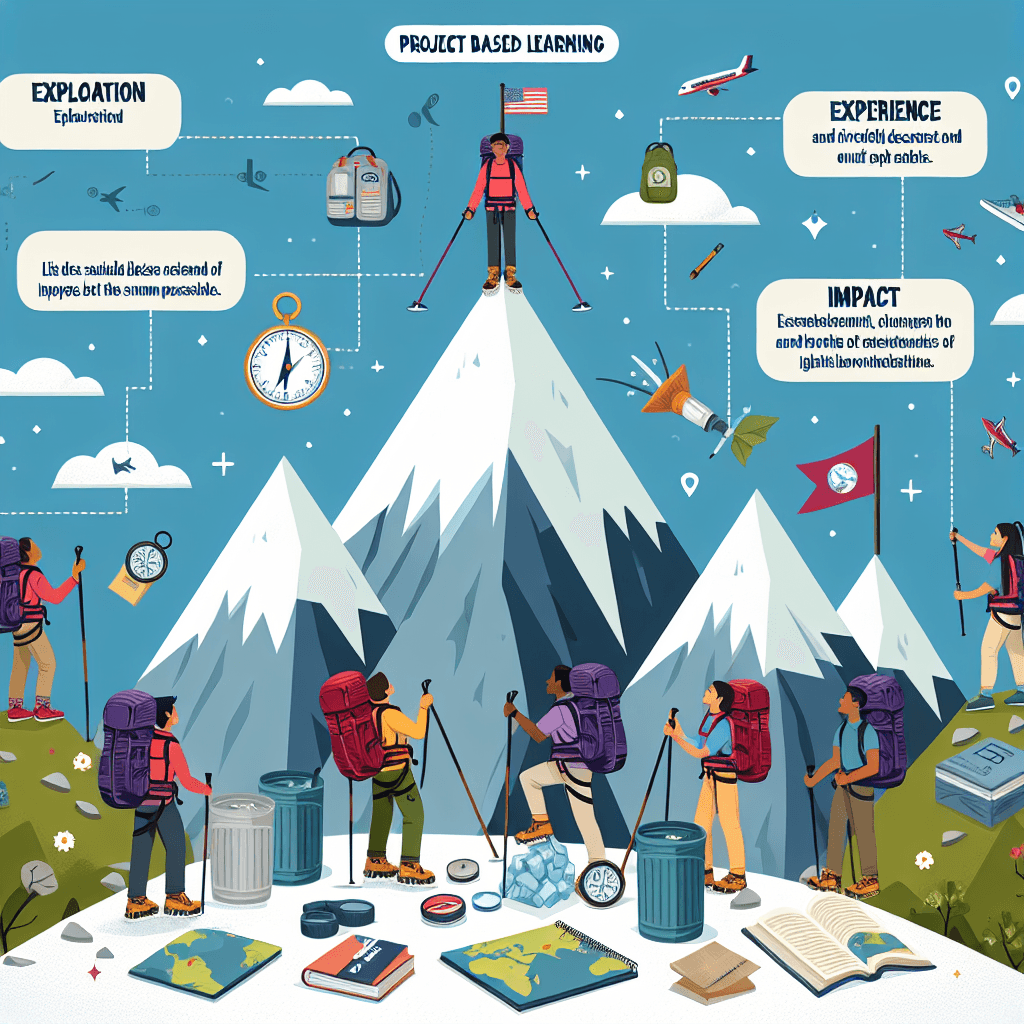
Climbing Mt. Everest: Impact and Exploration
Inquiry Framework
Question Framework
Driving Question
The overarching question that guides the entire project.How can we balance the need for adventure and exploration of Mt. Everest with the need to protect and preserve its environment and support the local communities?Essential Questions
Supporting questions that break down major concepts.- What are the different routes to climb Mt. Everest and what challenges do they present?
- How have human actions impacted the environment of Mt. Everest?
- What are the effects of tourism and climbing expeditions on the local communities around Mt. Everest?
- How do the Sherpa people and other local communities interact with and adapt to their environment?
- What measures can be taken to minimize the negative impacts of human activity on Mt. Everest and its surroundings?
Standards & Learning Goals
Learning Goals
By the end of this project, students will be able to:- Analyze the different routes to climb Mt. Everest and identify the challenges associated with each.
- Describe the various ways in which human activities have impacted the environment of Mt. Everest.
- Evaluate the effects of tourism and climbing expeditions on the local communities around Mt. Everest.
- Investigate how the Sherpa people and other local communities interact with and adapt to their environment.
- Propose measures that could be taken to minimize the negative impacts of human activity on Mt. Everest and its surroundings.
Common Core Standards
C3 Framework for Social Studies State Standards
Next Generation Science Standards
Entry Events
Events that will be used to introduce the project to studentsTrash on the Trail Challenge
Present students with real data and images about the waste problem on Everest. Challenge them to brainstorm creative solutions to reduce environmental impact, promoting critical thinking about human-environment interactions.Virtual Summit
Kick off the project with a virtual reality expedition to the summit of Mt. Everest, letting students experience the breathtaking views and challenges climbers face. This immersive experience will spark questions about the geography, climate, and socio-economic significance of the region.Climbers' Forum
Invite a panel of real-world mountaineers and Sherpas for a live Q&A session, where students can ask about their personal experiences and the cultural impact of climbing on the local communities. This will illuminate the human stories connected to the mountain and inspire inquiry into the social and environmental aspects.Portfolio Activities
Portfolio Activities
These activities progressively build towards your learning goals, with each submission contributing to the student's final portfolio.Route Mapper Adventure
Students will learn about the different climbing routes to the summit of Mt. Everest by designing their own route maps. This activity helps students understand the geographical challenges and the impact of these routes on the environment.Steps
Here is some basic scaffolding to help students complete the activity.Final Product
What students will submit as the final product of the activityA detailed route map of Mt. Everest highlighting major paths and key geographical points.Alignment
How this activity aligns with the learning objectives & standardsAligns with 6.G.5 by helping students understand human interactions with geography and the environment through route selection.Impact Investigation
Students will research and describe the various human impacts on Mt. Everest, focusing on environmental degradation caused by climbing and tourism activities.Steps
Here is some basic scaffolding to help students complete the activity.Final Product
What students will submit as the final product of the activityA research report detailing human impacts on Mt. Everest, supplemented with graphs or charts.Alignment
How this activity aligns with the learning objectives & standardsAligns with 6.G.5 and NGSS MS-ESS3-3 by analyzing human modification of environments and proposing ways to reduce negative impacts.Cultural Connection Explorer
Students explore how the Sherpa people and local communities adapt to and interact with their environment, focusing on cultural practices that promote sustainability.Steps
Here is some basic scaffolding to help students complete the activity.Final Product
What students will submit as the final product of the activityA storytelling project showcasing sustainable cultural practices among Sherpa communities.Alignment
How this activity aligns with the learning objectives & standardsAligns with 6.G.5 by highlighting human-environment interactions and cultural adaptations.Preservation Proposal
Students propose actionable measures to minimize human impact on Mt. Everest through a written report, supporting their arguments with evidence and researched data.Steps
Here is some basic scaffolding to help students complete the activity.Final Product
What students will submit as the final product of the activityA comprehensive proposal report on measures to preserve and protect Mt. Everest.Alignment
How this activity aligns with the learning objectives & standardsAligns with CCSS.ELA-LITERACY.W.6.1 by writing arguments with clear reasons and evidence, and NGSS MS-ESS3-3 by proposing minimized human impact solutions.Community Conundrum
Students investigate the effects of tourism and climbing expeditions on the Sherpa and other local communities, examining socio-economic benefits and environmental challenges.Steps
Here is some basic scaffolding to help students complete the activity.Final Product
What students will submit as the final product of the activityA presentation outlining the socio-economic and environmental challenges faced by local communities due to tourism.Alignment
How this activity aligns with the learning objectives & standardsAligns with C3 Framework D2.Geo.5.6-8 by evaluating human interactions and socio-economic impacts.Rubric & Reflection
Portfolio Rubric
Grading criteria for assessing the overall project portfolioMt. Everest Exploration and Environmental Impact Rubric
Content Understanding
Assesses the depth of students' understanding of the environmental issues and cultural aspects related to Mt. Everest.Environmental Impact Analysis
Evaluates the student's ability to analyze human impacts on Mt. Everest and articulate their significance.
Exemplary
4 PointsProvides comprehensive and insightful analysis of the human impacts on Mt. Everest, demonstrating a thorough understanding of their significance and consequences.
Proficient
3 PointsOffers a clear and well-supported analysis of human impacts on Mt. Everest, addressing key aspects effectively.
Developing
2 PointsPresents a basic analysis of human impacts on Mt. Everest, with some support and detail.
Beginning
1 PointsProvides incomplete or minimal analysis, with limited understanding of human impacts on Mt. Everest.
Cultural Understanding
Measures the student's grasp of the cultural practices of the Sherpa and their interaction with the environment.
Exemplary
4 PointsDemonstrates a deep understanding of Sherpa cultural practices, articulates innovations and sustainability in interactions with the environment.
Proficient
3 PointsShows a solid understanding of Sherpa cultural practices, detailing interactions with the environment with some insights.
Developing
2 PointsGives a marginal understanding of Sherpa cultural practices and their environmental interactions.
Beginning
1 PointsExhibits little or no understanding of Sherpa cultural practices or their environmental interactions.
Critical Thinking and Problem Solving
Evaluates the students' abilities in problem solving and proposing viable solutions for minimizing human impact on Mt. Everest.Solution Proposal
Assesses the student's ability to propose thoughtful and feasible solutions to environmental challenges on Mt. Everest.
Exemplary
4 PointsProposes innovative, well-reasoned solutions to environmental issues that reflect thorough analysis and critical thinking.
Proficient
3 PointsPresents reasonable and plausible solutions supported by data, demonstrating sound problem-solving skills.
Developing
2 PointsSuggests basic solutions with some support, showing emerging problem-solving abilities.
Beginning
1 PointsOffers limited or unsupported solutions with minimal evidence of critical thinking.
Communication and Presentation
Assesses the effectiveness of the student's communication and presentation of their learning through different media forms.Clarity and Coherence
Evaluates the clarity and organization of communication in written or oral presentations.
Exemplary
4 PointsCommunicates ideas clearly with excellent organization and coherence, using well-structured arguments.
Proficient
3 PointsCommunicates effectively with clear organization and logical progression of ideas.
Developing
2 PointsCommunicates ideas with some clarity and organization, but lacks coherence in places.
Beginning
1 PointsStruggles to communicate ideas clearly or with coherence, with disorganized presentation.
Engagement and Collaboration
Measures the students' participation and collaboration in discussions and teamwork.
Exemplary
4 PointsDemonstrates leadership and initiative in discussions, actively contributing and collaborating effectively.
Proficient
3 PointsParticipates actively and works well with others, contributing effectively to group tasks.
Developing
2 PointsParticipates occasionally, showing some collaboration but inconsistent engagement.
Beginning
1 PointsRarely participates or collaborates, with limited contribution to discussions.