
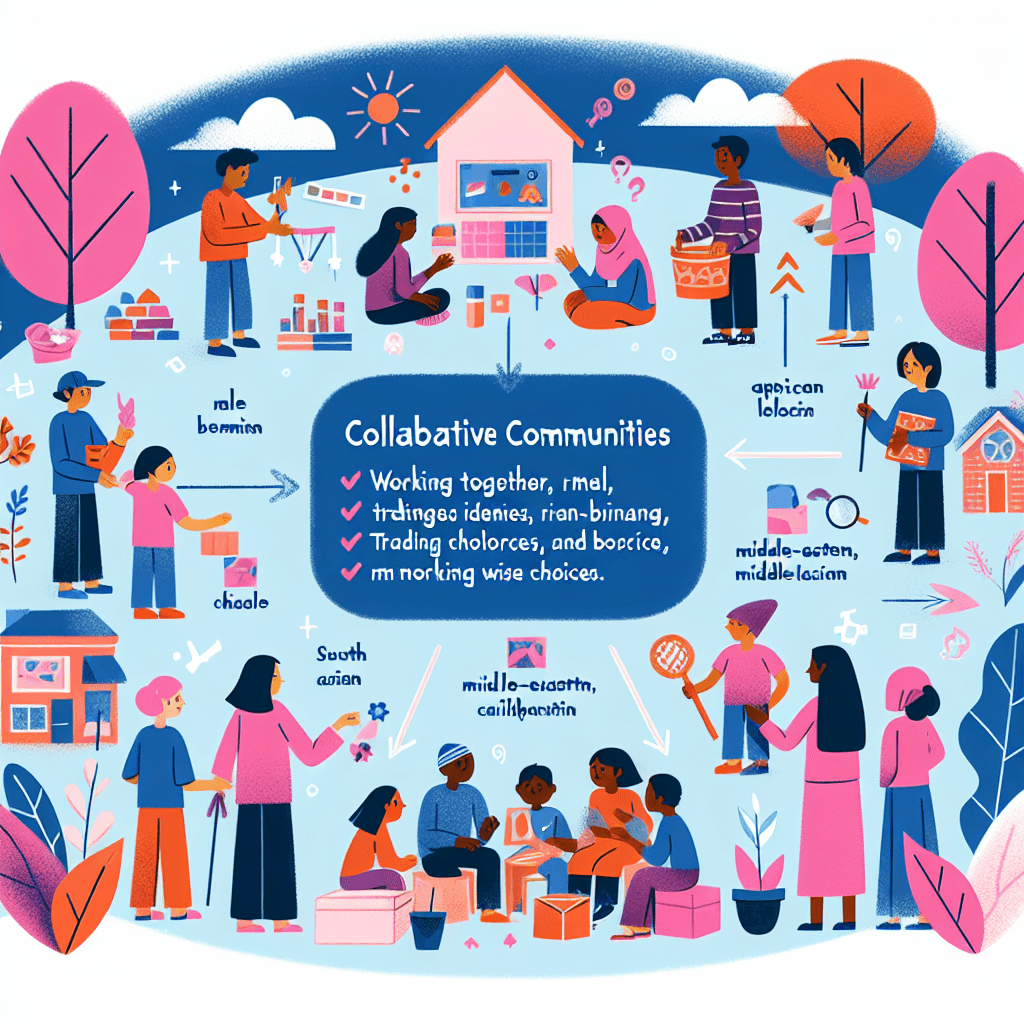
Collaborative Communities
Inquiry Framework
Question Framework
Driving Question
The overarching question that guides the entire project.How can we understand the different roles needed in a community to ensure its well-being?Essential Questions
Supporting questions that break down major concepts.- What roles do different people play in a community?
- How do community members help each other?
- Why is it important for communities to have rules?
- What are some examples of how people solve problems together in a community?
Standards & Learning Goals
Learning Goals
By the end of this project, students will be able to:- Students will understand the roles different people play in a community and how these roles contribute to its well-being.
- Students will explore how community members cooperate and help each other.
- Students will analyze the importance of rules in a community and how they are decided.
- Students will learn about problem-solving within a community and how individuals work together to achieve common goals.
- Students will understand how resources are used to produce goods and services.
Common Core Standards
Next Generation Science Standards
Entry Events
Events that will be used to introduce the project to studentsCommunity Role-Play
Create a role-play scenario where each student is assigned a different community role (e.g., teacher, firefighter, shop owner). Students must work together to solve a community issue like a 'flood' or a 'parade needing organization.'Community Scavenger Hunt
Organize a scavenger hunt where students explore their local area (or a simulated environment) to find resources and learn about community roles. Provide clues related to how different community members contribute to overall well-being.Guest Speaker Series
Invite local community members (e.g., a police officer, nurse, city council member) to the class to discuss their roles and how they collaborate with others. This real-world insight can inspire students and deepen understanding.Local Business Partnership
Partner with a local business to give students a behind-the-scenes look at how goods and services are produced and provided to the community. Students can learn about economic choices and collaboration firsthand.Portfolio Activities
Portfolio Activities
These activities progressively build towards your learning goals, with each submission contributing to the student's final portfolio.Role-Play Resolvers
In this activity, students will engage in a role-play to understand community roles by solving a simulated community issue. This helps them comprehend how people work together, addressing community needs like a flood or parade organization.Steps
Here is some basic scaffolding to help students complete the activity.Final Product
What students will submit as the final product of the activityA collaborative plan and enactment of the role-play scenario, demonstrating understanding of community roles and cooperation.Alignment
How this activity aligns with the learning objectives & standardsAligns with CCSS.SS.2.3 (Describing community dependence) and CCSS.ELA-LITERACY.SL.2.1 (Collaborative discussions).Scavenger Hunt for Resources
Students participate in a scavenger hunt to explore their local environment or a simulated one, learning about resource locations and community roles contributing to well-being.Steps
Here is some basic scaffolding to help students complete the activity.Final Product
What students will submit as the final product of the activityA group presentation summarizing their findings on community resources and roles.Alignment
How this activity aligns with the learning objectives & standardsAligns with NGSS.2-ESS2-2 (Understanding geographical aspects) and CCSS.SS.2.1 (Economic choices).Guest Insights Panel
Students engage with guest speakers to deepen their understanding of community roles and collaboration through real-life stories and discussions.Steps
Here is some basic scaffolding to help students complete the activity.Final Product
What students will submit as the final product of the activityA reflection journal where students document insights and draw connections between different community roles and cooperation.Alignment
How this activity aligns with the learning objectives & standardsAligns with CCSS.SS.2.3 (Community interdependence) and CCSS.ELA-LITERACY.SL.2.1 (Collaborative conversations).Business Behind-the-Scenes
Students partner with a local business to learn firsthand about the production of goods and services and good economic choices in a community.Steps
Here is some basic scaffolding to help students complete the activity.Final Product
What students will submit as the final product of the activityA class report detailing the production process and economic aspects of the business visited.Alignment
How this activity aligns with the learning objectives & standardsAligns with CCSS.SS.2.1 (Economic choices) and CCSS.SS.2.3 (Community collaboration).Rubric & Reflection
Portfolio Rubric
Grading criteria for assessing the overall project portfolioCommunity Roles and Cooperation Assessment Rubric
Understanding Community Roles
Evaluates the student’s ability to identify and explain different roles in a community and how they contribute to community well-being.Identification of Roles
Ability to accurately identify various roles within the community.
Exemplary
4 PointsIdentifies all major community roles and precisely describes their functions and contributions.
Proficient
3 PointsIdentifies most community roles and describes their basic functions adequately.
Developing
2 PointsIdentifies some community roles with minimal descriptions.
Beginning
1 PointsStruggles to identify roles or misidentifies them with unclear descriptions.
Explanation of Contributions
Quality of explanation provided for how these roles contribute to community well-being.
Exemplary
4 PointsProvides detailed and insightful explanations of how each role supports community well-being.
Proficient
3 PointsExplains how various roles support community well-being satisfactorily.
Developing
2 PointsOffers limited explanations about role contributions.
Beginning
1 PointsFails to explain the roles' contributions to the community.
Collaborative Problem-Solving
Assesses the student’s ability to engage in effective problem-solving within a team setting for community issues.Participation and Contribution
Level of active participation and quality of contributions made during collaborative activities.
Exemplary
4 PointsConsistently contributes high-quality ideas and actively engages in team discussions.
Proficient
3 PointsRegularly contributes useful ideas and participates in most discussions.
Developing
2 PointsOccasionally contributes and participates with moderate engagement.
Beginning
1 PointsRarely contributes or engages in discussions during activities.
Problem-Solving Strategy
Ability to develop effective strategies for addressing community issues presented in activities.
Exemplary
4 PointsDevelops an innovative and highly effective strategy that addresses the community issue comprehensively.
Proficient
3 PointsDevelops a satisfactory strategy that addresses the community issue effectively.
Developing
2 PointsProposes a basic strategy with some gaps in addressing the issue.
Beginning
1 PointsStruggles to propose a clear strategy for the issue.
Economic Choices and Understanding
Evaluates the comprehension of economic factors such as scarcity, resources, and decision-making in a community.Understanding Scarcity and Choices
Ability to articulate the concept of scarcity and how it influences economic decisions.
Exemplary
4 PointsProvides a thorough understanding of scarcity with examples and relates it to informed economic choices.
Proficient
3 PointsExplains scarcity and its impact on choices adequately.
Developing
2 PointsShows a basic understanding of scarcity with minimal examples.
Beginning
1 PointsStruggles to understand or explain the concept of scarcity.
Use of Resources
Ability to describe how resources are utilized to produce goods and services.
Exemplary
4 PointsDescribes resource use in production with detailed examples and insights.
Proficient
3 PointsDescribes resource use in production adequately.
Developing
2 PointsOffers limited insights into resource use in production.
Beginning
1 PointsUnable to describe how resources are used in production.