
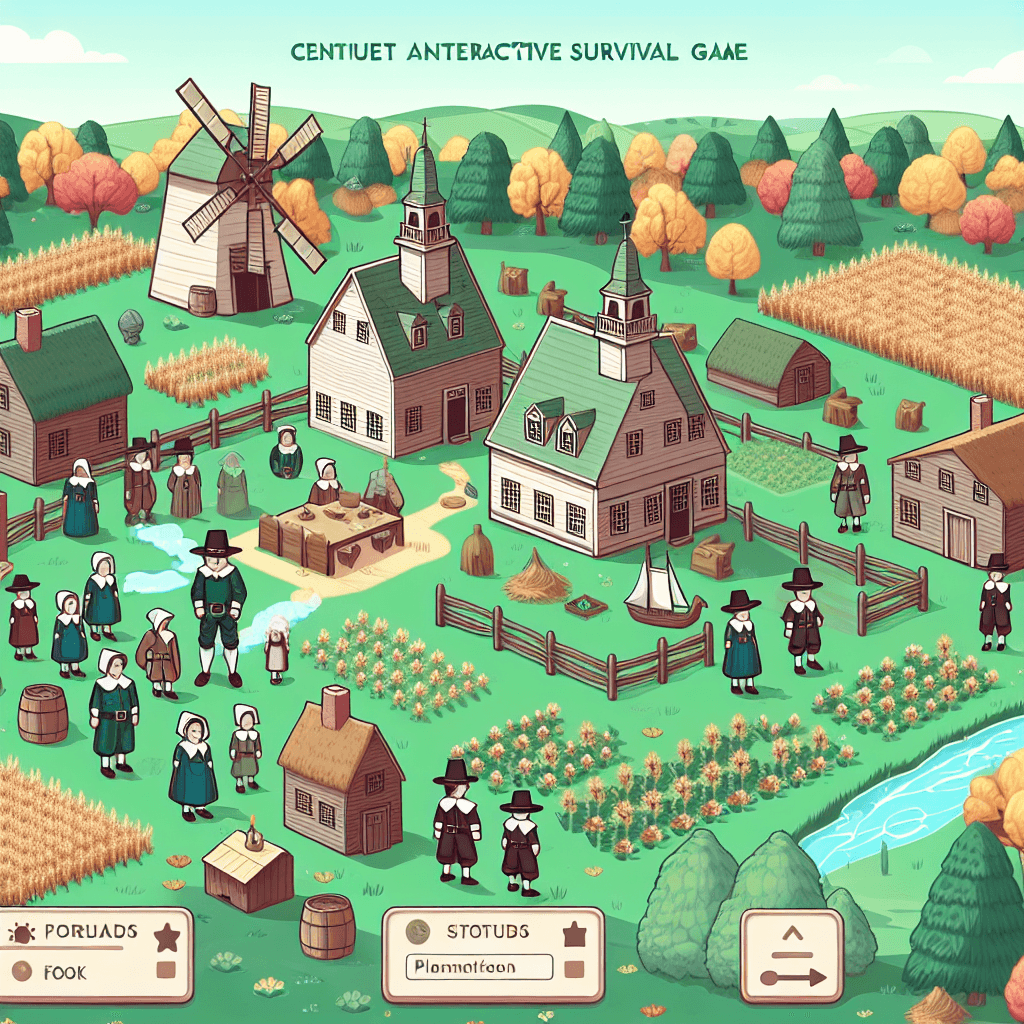
Colonial Survival Game: Of Plymouth Plantation
Inquiry Framework
Question Framework
Driving Question
The overarching question that guides the entire project.How can we, as members of the Plymouth colony, navigate the challenges of the New World, balancing our values, social responsibilities, and interactions with the environment and Native Americans, to ensure our survival and build a thriving community?Essential Questions
Supporting questions that break down major concepts.- How did the physical environment shape the daily life and survival strategies of the early colonists?
- In what ways did social roles and responsibilities contribute to the success or failure of the Plymouth colony?
- How did the values and beliefs of the Pilgrims influence their interactions with each other and the Native Americans?
- What were the critical factors that determined whether an individual or family survived and thrived in the Plymouth colony?
- How does understanding the challenges faced by the Plymouth colonists inform our understanding of contemporary issues related to survival, community, and cultural exchange?
Standards & Learning Goals
Learning Goals
By the end of this project, students will be able to:- Students will understand the challenges faced by the Plymouth colonists.
- Students will understand social roles and responsibilities of the Plymouth colonists.
- Students will explore the values and beliefs of the Pilgrims.
- Students will determine the critical factors that determined whether an individual or family survived and thrived in the Plymouth colony.
Entry Events
Events that will be used to introduce the project to studentsThe Lost Journal of Plymouth
A mysterious journal, supposedly written by a Plymouth colonist, is "discovered" in the classroom. The journal details the first few months of the colony, but the last few entries are missing. Students must use historical research and creative problem-solving to fill in the blanks and determine the fate of the journal's author.Portfolio Activities
Portfolio Activities
These activities progressively build towards your learning goals, with each submission contributing to the student's final portfolio.Plymouth Occupations: A Day in the Life
Students will analyze the social dynamics and responsibilities within the Plymouth colony by researching an occupation. This will help them understand how decisions impact the community in the game.Steps
Here is some basic scaffolding to help students complete the activity.Final Product
What students will submit as the final product of the activityA research report exploring the social roles, responsibilities, and the impact of individual decisions on the Plymouth community, focusing on a specific occupation.Alignment
How this activity aligns with the learning objectives & standardsAligns with the learning goal of understanding the challenges faced by colonists and the social responsibilities of the Plymouth colonists.Plymouth Playbook: Survival Guide
Students will create a survival guide based on their research, providing advice to new colonists on how to overcome challenges and thrive in Plymouth.Steps
Here is some basic scaffolding to help students complete the activity.Final Product
What students will submit as the final product of the activityA comprehensive survival guide for new colonists, including tips, strategies, and advice on how to overcome the challenges of the New World.Alignment
How this activity aligns with the learning objectives & standardsThis activity addresses the learning goal of understanding the challenges faced by the Plymouth colonists, as well as the critical factors for survival and thriving.Rubric & Reflection
Portfolio Rubric
Grading criteria for assessing the overall project portfolioSocial Contracts Essay Rubric
Analysis of Social Contracts
Focuses on the depth of understanding, use of evidence, and clarity of expression in the analysis of social contracts within the Plymouth colony.Understanding of Social Dynamics
Depth of understanding of social roles and responsibilities within the Plymouth colony, as demonstrated through accurate and insightful analysis.
Exemplary
4 PointsDemonstrates a sophisticated understanding of social roles and responsibilities in Plymouth, providing nuanced insights and interpretations supported by extensive evidence. Essay demonstrates how decisions made by the colonists could have helped or hurt the colony.
Proficient
3 PointsDemonstrates a thorough understanding of social roles and responsibilities in Plymouth, providing clear and accurate explanations with relevant examples. Essay demonstrates how decisions made by the colonists could have helped or hurt the colony.
Developing
2 PointsShows an emerging understanding of social roles and responsibilities in Plymouth, but explanations may be simplistic or lack sufficient supporting evidence. Essay has minimal demonstration of how decisions made by the colonists could have helped or hurt the colony.
Beginning
1 PointsShows a limited understanding of social roles and responsibilities in Plymouth, with inaccurate or irrelevant information and minimal supporting evidence.
Evidence and Source Quality
Quality and relevance of evidence from primary and secondary sources used to support analysis and arguments.
Exemplary
4 PointsUses a wide range of primary and secondary sources effectively to support analysis, demonstrating excellent source evaluation skills.
Proficient
3 PointsUses a sufficient range of primary and secondary sources to support analysis, demonstrating good source evaluation skills.
Developing
2 PointsUses a limited number of sources, which may not always be relevant or effectively integrated into the analysis. Demonstrates basic source evaluation skills.
Beginning
1 PointsUses few or no sources to support analysis, or sources are irrelevant or inaccurately cited. Demonstrates poor source evaluation skills.
Clarity and Organization
Clarity, organization, and coherence of the essay, including logical flow of ideas and effective use of language.
Exemplary
4 PointsEssay is exceptionally clear, well-organized, and coherent, with a compelling and insightful presentation of ideas. Writing is sophisticated and engaging.
Proficient
3 PointsEssay is clear, well-organized, and coherent, with a logical flow of ideas and effective use of language.
Developing
2 PointsEssay shows some organization and coherence, but ideas may be presented in a disjointed or confusing manner. Language is basic and may contain errors.
Beginning
1 PointsEssay lacks clarity, organization, and coherence, making it difficult to follow the line of reasoning. Language is unclear and contains numerous errors.