
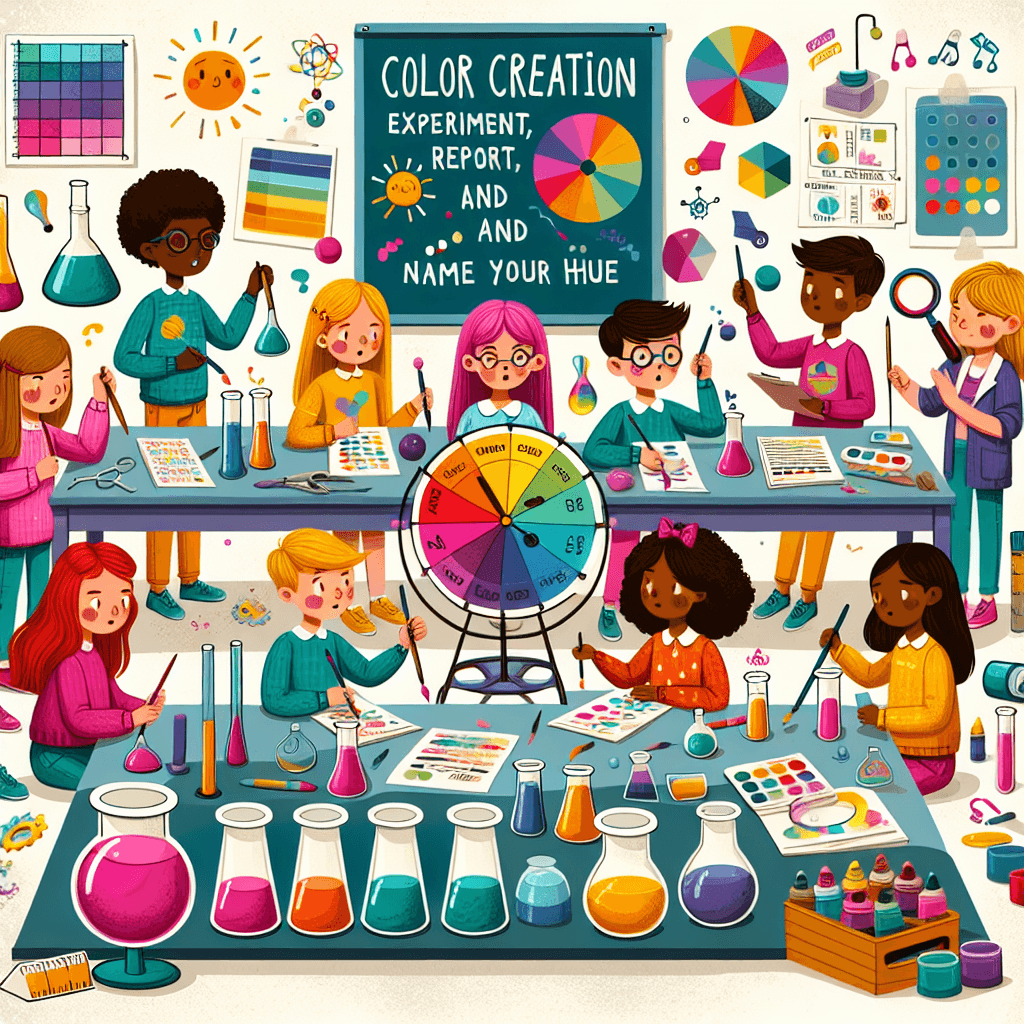
Color Creation: Experiment, Report, and Name Your Hue
Inquiry Framework
Question Framework
Driving Question
The overarching question that guides the entire project.How can we, as color scientists, discover, name, and explain the creation of a unique color through experimentation and research?Essential Questions
Supporting questions that break down major concepts.- What color combinations create purple, orange, and green?
- How can I conduct an experiment to discover new colors?
- How do I write a report that clearly explains my experiment and findings?
- How can I effectively name and describe a new color I create?
- How do I evaluate the arguments and claims in informational texts about color theory?
Standards & Learning Goals
Learning Goals
By the end of this project, students will be able to:- Conduct experiments to create purple, orange, or green by mixing colors.
- Research and document the color combinations required to produce target colors.
- Write a detailed report describing the color experiment process, findings, and the creation of a new color.
- Evaluate and trace arguments and claims made in informational texts about color theory.
- Name a newly created color and provide a descriptive explanation of its unique characteristics and creation process.
- Write informative/explanatory texts with clear organization and structure
Common Core Standards
Entry Events
Events that will be used to introduce the project to studentsWelcome to the Color Lab
The classroom is transformed into a 'Color Lab,' complete with lab coats and safety goggles. Students embark on a series of guided experiments involving color mixing, recording their observations and hypotheses in lab notebooks, fostering a sense of scientific exploration and discovery.Decoding Color in Masterpieces
Students analyze famous paintings that prominently feature purple, orange, and green, discussing the artists' color choices and their intended effects. This activity encourages critical thinking, visual literacy, and an appreciation for the power of color in art.The New Toy Color Challenge
Present students with a scenario: A toy company wants to create a new line of toys with unique colors and the students have to come up with new colors. They must mix colors, name them and write a report to the toy company.Portfolio Activities
Portfolio Activities
These activities progressively build towards your learning goals, with each submission contributing to the student's final portfolio.Color Claim Investigators
Students will read different texts that discuss color theory, focusing on the creation of purple, orange, and green. They will identify the author's main arguments and claims, and determine whether these claims are supported by evidence.Steps
Here is some basic scaffolding to help students complete the activity.Final Product
What students will submit as the final product of the activityA completed worksheet or graphic organizer for each text, outlining the author's claims, supporting evidence, and the student's evaluation of the argument's strength.Alignment
How this activity aligns with the learning objectives & standardsCovers RI.6.8 (Trace and evaluate an author’s argument and claims).Report Blueprint Architects
Students will plan and outline their color experiment report, focusing on clear organization and logical structure. They will determine the sections of their report (introduction, methods, results, conclusion) and what information to include in each.Steps
Here is some basic scaffolding to help students complete the activity.Final Product
What students will submit as the final product of the activityA detailed outline of the color experiment report, including the main points to be covered in each section.Alignment
How this activity aligns with the learning objectives & standardsCovers W.6.2 (Write informative/explanatory texts with clear organization).Color Mixing Mavericks
Students conduct their own color mixing experiment focusing on purple, orange, or green. They document the process, materials, and results meticulously, noting any challenges encountered and solutions applied.Steps
Here is some basic scaffolding to help students complete the activity.Final Product
What students will submit as the final product of the activityDetailed experimental notes, including materials used, steps followed, observations made during color mixing, and the final color achieved. This serves as the foundation for writing the methods and results sections of their report.Alignment
How this activity aligns with the learning objectives & standardsCovers W.6.2 (Write informative/explanatory texts to examine a topic and convey ideas, concepts, and information through the selection, organization, and analysis of relevant content).Color Naming Novelists
Students will create a descriptive name for their new color and write a paragraph explaining its unique characteristics, inspired by the color mixing experiment.Steps
Here is some basic scaffolding to help students complete the activity.Final Product
What students will submit as the final product of the activityA creatively named color with a well-written descriptive paragraph that includes details about its appearance, the colors used to create it, and what the color evokes or represents.Alignment
How this activity aligns with the learning objectives & standardsCovers W.6.2 (Write informative/explanatory texts to examine a topic and convey ideas, concepts, and information through the selection, organization, and analysis of relevant content).The Grand Color Chronicle
Students will compile all their work – the color claim investigations, report outline, experimental notes, and color description – into a final report. They will write an introduction and conclusion, synthesize their findings, and ensure the report is well-organized and clearly written.Steps
Here is some basic scaffolding to help students complete the activity.Final Product
What students will submit as the final product of the activityA complete and well-organized color experiment report that includes an introduction, methods, results, discussion, conclusion, and a creative color name and description. The report should demonstrate an understanding of color theory and the scientific process.Alignment
How this activity aligns with the learning objectives & standardsCovers RI.6.8 (Trace and evaluate an author’s argument and claims) and W.6.2 (Write informative/explanatory texts with clear organization).Rubric & Reflection
Portfolio Rubric
Grading criteria for assessing the overall project portfolioColor Mixing and Reporting Mastery Rubric
Research and Evaluation
Assessing the student's ability to research and evaluate authors' claims about color theory as related to informational texts.Claim Identification and Evidence Evaluation
Traces and evaluates an author’s arguments and specific claims in a text, distinguishing supported claims from unsupported ones.
Exemplary
4 PointsIdentifies all claims with precision, thoroughly evaluates evidence supporting each claim, and provides insightful analysis of the author's arguments.
Proficient
3 PointsIdentifies most claims accurately, evaluates evidence for most claims, and provides a clear analysis of the author's arguments.
Developing
2 PointsIdentifies some claims, attempts to evaluate evidence but may miss key points or analysis lacks depth.
Beginning
1 PointsStruggles to identify the claims or evaluate evidence, shows little understanding of the text's arguments.
Use of Graphic Organizers
Effectively uses graphic organizers to summarize claims and evidence from texts on color theory.
Exemplary
4 PointsUses graphic organizers strategically and effectively summarizes all claims, evidence, and provides comprehensive insights.
Proficient
3 PointsUses graphic organizers adequately to summarize most claims and evidence, showing clear understanding.
Developing
2 PointsUses graphic organizers inconsistently, summary may lack detail or clarity.
Beginning
1 PointsRarely uses graphic organizers or provides unclear summaries.
Evaluation of Arguments
Ability to evaluate arguments by identifying biases and unsupported statements in the context of color theory.
Exemplary
4 PointsExpertly identifies biases and unsupported statements with complete rationalization and suggests improvements.
Proficient
3 PointsCorrectly identifies most biases and unsupported statements and offers some rationale.
Developing
2 PointsIdentifies a few biases and unsupported statements but misses or misinterprets others.
Beginning
1 PointsStruggles to identify biases or unsupported claims, provides limited rationale.
Experimentation and Observation
Assessment of students' ability to conduct color mixing experiments and document observations.Documenting Experimental Process
The ability to meticulously document the color mixing process, challenges, and outcomes.
Exemplary
4 PointsComprehensively documents each step of the experiment, challenges faced, and outcomes with clear, detailed notes and visual aids.
Proficient
3 PointsAccurately documents the experimental process and outcomes with clear notes, includes some visuals.
Developing
2 PointsDocuments the process with some gaps in detail or clarity, visuals may be incomplete.
Beginning
1 PointsProvides incomplete or unclear documentation of the experiment process and results.
Outcomes and Solutions
The ability to reflect on outcomes, identify challenges in the color mixing process, and describe solutions applied.
Exemplary
4 PointsProvides a thorough reflection on outcomes, clearly identifies challenges, and expertly describes solutions applied.
Proficient
3 PointsReflects on outcomes well, identifies challenges, and describes solutions with clarity.
Developing
2 PointsReflects on some outcomes, identifies few challenges and solutions, may lack detail.
Beginning
1 PointsLimited reflection on outcomes, struggles to identify challenges or solutions.
Report Writing and Communication
Evaluation of the ability to write a well-organized, clear, and informative report detailing the color experiment findings.Organization and Structure
The organization and logical flow of the color experiment report, covering all essential sections.
Exemplary
4 PointsExcellently organized report with all sections detailed and logically connected, including smooth transitions.
Proficient
3 PointsWell-organized report with all major sections present and transitions that connect ideas clearly.
Developing
2 PointsOrganized report with some sections incomplete or lacking logical transitions between ideas.
Beginning
1 PointsPoorly organized report, missing key sections and lacks coherence.
Content and Explanations
The richness of content and clarity in explanations regarding the color mixing experiment and newly created color.
Exemplary
4 PointsProvides rich, detailed content with clear, precise explanations, covering all aspects of the experiment and new color.
Proficient
3 PointsProvides detailed content with clear explanations of the experiment and new color.
Developing
2 PointsContent includes some details with explanations often lacking clarity or completeness.
Beginning
1 PointsContent is sparse, with unclear explanations and lack of detail.
Creativity and Innovation
Assessment of students' creativity in naming their new color and describing it descriptively.Color Naming and Description
Ability to creatively name and descriptively explain the unique characteristics of the newly created color.
Exemplary
4 PointsInnovatively names the new color, providing an exceptional, descriptive explanation that vividly captures its essence.
Proficient
3 PointsNames the new color creatively with a descriptive explanation that clearly conveys its characteristics.
Developing
2 PointsOffers a basic color name with a simple description that may lack vividness or thoroughness.
Beginning
1 PointsStruggles to creatively name or describe the new color, offering minimal detail.