
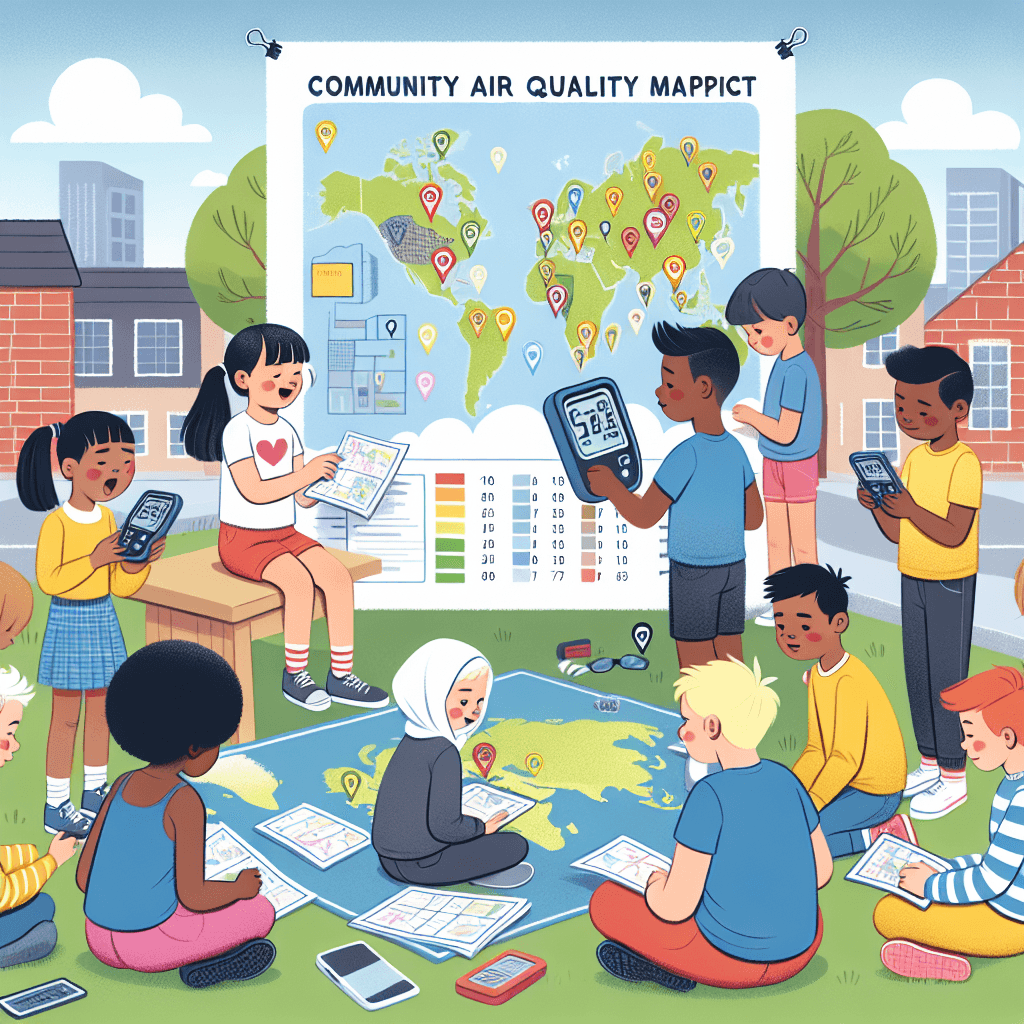
Community Air Quality Mapping Project
Inquiry Framework
Question Framework
Driving Question
The overarching question that guides the entire project.How can we, as community scientists, investigate, map, and advocate for improved air quality in our local area?Essential Questions
Supporting questions that break down major concepts.- How does air quality vary across our community?
- What are the main sources of air pollution in our area?
- How can we accurately measure and map air quality?
- What actions can community members take to improve air quality?
Standards & Learning Goals
Learning Goals
By the end of this project, students will be able to:- Students will be able to design and implement an air quality monitoring project.
- Students will be able to create maps and reports to visualize air quality data.
- Students will be able to identify sources of air pollution.
- Students will be able to advocate for improved air quality in their community.
Entry Events
Events that will be used to introduce the project to studentsCommunity Air Quality Crisis Simulation
Students participate in a role-playing simulation where they are community stakeholders responding to a sudden air quality crisis event (e.g., industrial accident, wildfire smoke). They must make quick decisions based on limited information, experiencing the real-world consequences of air pollution and motivating them to proactively map and understand local air quality.Mystery Air Sample Analysis
Students receive an anonymous air sample collected from a location in their community with unusually high pollution levels. They must analyze the sample using provided tools and resources, identify potential sources, and hypothesize about the causes, sparking their curiosity and setting the stage for the project's focus on air quality mapping.Portfolio Activities
Portfolio Activities
These activities progressively build towards your learning goals, with each submission contributing to the student's final portfolio.Air Quality Hotspot Identification
Students will begin by brainstorming potential air pollution sources in their community and predicting areas likely to have higher pollution levels. This activity sets the stage for targeted monitoring.Steps
Here is some basic scaffolding to help students complete the activity.Final Product
What students will submit as the final product of the activityA map of the community with marked potential air quality hotspots and a list of suspected pollution sources for each location.Alignment
How this activity aligns with the learning objectives & standardsAddresses the learning goal: Students will be able to identify sources of air pollution. It also introduces the concept of mapping air quality data.DIY Air Quality Sensor Construction
Students will learn about air quality sensors and construct their own simple, low-cost sensors using readily available materials. This hands-on activity provides a deeper understanding of how air quality is measured.Steps
Here is some basic scaffolding to help students complete the activity.Final Product
What students will submit as the final product of the activityA functional, low-cost air quality sensor capable of measuring particulate matter or specific gases.Alignment
How this activity aligns with the learning objectives & standardsAddresses the learning goal: Students will be able to design and implement an air quality monitoring project. It also introduces the technical aspects of air quality measurement.Community Air Quality Monitoring Campaign
Students will deploy their DIY sensors in the identified hotspots and collect air quality data over a period of time. This activity provides real-world data for analysis and mapping.Steps
Here is some basic scaffolding to help students complete the activity.Final Product
What students will submit as the final product of the activityA comprehensive dataset of air quality measurements collected from various locations in the community.Alignment
How this activity aligns with the learning objectives & standardsAddresses the learning goal: Students will be able to design and implement an air quality monitoring project. It also provides the data needed for creating air quality maps.Air Quality Data Visualization and Mapping
Students will analyze the collected data and create maps to visualize air quality patterns in their community. This activity develops data analysis and presentation skills.Steps
Here is some basic scaffolding to help students complete the activity.Final Product
What students will submit as the final product of the activityA detailed air quality map of the community, showing pollution levels and patterns.Alignment
How this activity aligns with the learning objectives & standardsAddresses the learning goal: Students will be able to create maps and reports to visualize air quality data. It also reinforces the ability to identify pollution sources based on the data.Community Air Quality Report and Action Plan
Students will prepare a report summarizing their findings and propose actions to improve air quality in their community. This activity promotes advocacy and community engagement.Steps
Here is some basic scaffolding to help students complete the activity.Final Product
What students will submit as the final product of the activityA comprehensive report on community air quality with a detailed action plan for improvement, ready for presentation to community stakeholders.Alignment
How this activity aligns with the learning objectives & standardsAddresses the learning goal: Students will be able to advocate for improved air quality in their community. It also integrates all previous learning goals into a culminating project.Rubric & Reflection
Portfolio Rubric
Grading criteria for assessing the overall project portfolioCommunity Air Quality Mapping Rubric
Air Quality Hotspot Identification
Assesses the student's ability to identify potential sources of air pollution and predict areas with higher pollution levels.Identification of Pollution Sources
Accuracy and completeness of identifying potential pollution sources in the community.
Exemplary
4 PointsIdentifies a comprehensive range of potential pollution sources with specific details and accurate locations. Demonstrates a deep understanding of local environmental factors.
Proficient
3 PointsIdentifies most of the major potential pollution sources with reasonable accuracy. Shows a good understanding of local pollution issues.
Developing
2 PointsIdentifies some potential pollution sources, but the list is incomplete or lacks specific details. Shows a basic awareness of local pollution issues.
Beginning
1 PointsStruggles to identify potential pollution sources or provides inaccurate information. Shows limited awareness of local pollution issues.
Mapping of Potential Hotspots
Clarity and accuracy of the map identifying potential air quality hotspots.
Exemplary
4 PointsCreates a clear and detailed map accurately identifying potential air quality hotspots with clear justification for each location. Demonstrates excellent spatial reasoning skills.
Proficient
3 PointsCreates a map identifying potential air quality hotspots with reasonable accuracy. Provides adequate justification for most locations.
Developing
2 PointsCreates a map with some identified hotspots, but the accuracy or justification is lacking. Shows some spatial reasoning skills.
Beginning
1 PointsStruggles to create a map or identify potential hotspots. Lacks spatial reasoning skills.
DIY Air Quality Sensor Construction
Evaluates the student's ability to construct a functional low-cost air quality sensor.Sensor Assembly
Correctness and completeness of sensor assembly.
Exemplary
4 PointsAssembles the sensor correctly and completely, demonstrating a thorough understanding of the components and wiring. The sensor functions flawlessly.
Proficient
3 PointsAssembles the sensor mostly correctly with minor errors that do not significantly affect functionality. The sensor functions adequately.
Developing
2 PointsAssembles the sensor with some significant errors that affect functionality. Requires assistance to troubleshoot issues.
Beginning
1 PointsStruggles to assemble the sensor or makes major errors that prevent it from functioning. Requires significant assistance.
Sensor Calibration
Accuracy and effectiveness of sensor calibration (if applicable).
Exemplary
4 PointsCalibrates the sensor accurately using appropriate standards and methods. Demonstrates a deep understanding of calibration principles.
Proficient
3 PointsCalibrates the sensor adequately using available resources. Shows a good understanding of calibration.
Developing
2 PointsAttempts to calibrate the sensor but struggles with the process or achieves inaccurate results.
Beginning
1 PointsDoes not attempt to calibrate the sensor or lacks understanding of the calibration process.
Community Air Quality Monitoring Campaign
Assesses the student's ability to plan and execute a community air quality monitoring campaign.Monitoring Plan
Completeness and feasibility of the monitoring plan.
Exemplary
4 PointsDevelops a comprehensive and feasible monitoring plan with clear objectives, locations, schedule, and data collection methods. The plan demonstrates a deep understanding of the community context.
Proficient
3 PointsDevelops a reasonable monitoring plan with most of the key elements included. The plan is generally feasible and appropriate for the community context.
Developing
2 PointsDevelops an incomplete monitoring plan with some missing elements or unrealistic aspects. The plan may not be fully appropriate for the community context.
Beginning
1 PointsStruggles to develop a monitoring plan or creates a plan that is largely incomplete or infeasible.
Data Collection
Accuracy and consistency of data collection.
Exemplary
4 PointsCollects air quality data accurately and consistently, following the monitoring plan and documenting any challenges encountered with detailed explanations. The dataset is comprehensive and reliable.
Proficient
3 PointsCollects air quality data with reasonable accuracy and consistency, following the monitoring plan. Documents any challenges encountered.
Developing
2 PointsCollects air quality data with some inconsistencies or inaccuracies. Documentation of challenges is limited.
Beginning
1 PointsStruggles to collect air quality data or collects data that is largely inaccurate or incomplete.
Air Quality Data Visualization and Mapping
Evaluates the student's ability to analyze and visualize air quality data using mapping tools.Data Analysis
Effectiveness of data analysis in identifying trends and patterns.
Exemplary
4 PointsAnalyzes the air quality data effectively, identifying significant trends and patterns with clear explanations and insightful interpretations. Demonstrates advanced data analysis skills.
Proficient
3 PointsAnalyzes the air quality data adequately, identifying most of the major trends and patterns. Shows a good understanding of data analysis techniques.
Developing
2 PointsAnalyzes the air quality data with limited success, identifying some basic trends but missing key patterns. Requires guidance on data analysis techniques.
Beginning
1 PointsStruggles to analyze the air quality data or draw meaningful conclusions.
Map Creation
Clarity and accuracy of the air quality map.
Exemplary
4 PointsCreates a clear, accurate, and visually appealing air quality map that effectively communicates the data and highlights key findings. Demonstrates excellent mapping skills and attention to detail.
Proficient
3 PointsCreates an air quality map that is reasonably clear and accurate, showing the major pollution patterns. Shows a good understanding of mapping principles.
Developing
2 PointsCreates an air quality map with some inaccuracies or lack of clarity. Requires guidance on mapping techniques.
Beginning
1 PointsStruggles to create an air quality map or the map is largely inaccurate or incomprehensible.
Community Air Quality Report and Action Plan
Evaluates the student's ability to synthesize findings and propose actions to improve air quality.Report Quality
Completeness and clarity of the project report.
Exemplary
4 PointsWrites a comprehensive and well-organized report summarizing the project methodology, findings, and conclusions with exceptional clarity and insight. Demonstrates excellent writing and communication skills.
Proficient
3 PointsWrites a clear and complete report summarizing the project, including the key findings and conclusions. Shows a good understanding of scientific writing.
Developing
2 PointsWrites an incomplete or poorly organized report with some missing information or lack of clarity. Requires guidance on scientific writing.
Beginning
1 PointsStruggles to write a coherent report or the report is largely incomplete or incomprehensible.
Action Plan
Feasibility and potential impact of the proposed action plan.
Exemplary
4 PointsDevelops a feasible and impactful action plan with specific, measurable, achievable, relevant, and time-bound (SMART) goals. The plan demonstrates a deep understanding of community needs and resources.
Proficient
3 PointsDevelops a reasonable action plan with concrete steps that community members can take to improve air quality. The plan is generally feasible and relevant.
Developing
2 PointsDevelops an action plan with some vague or unrealistic aspects. The plan may lack specificity or relevance to the community context.
Beginning
1 PointsStruggles to develop a meaningful action plan or the plan is largely infeasible or irrelevant.