
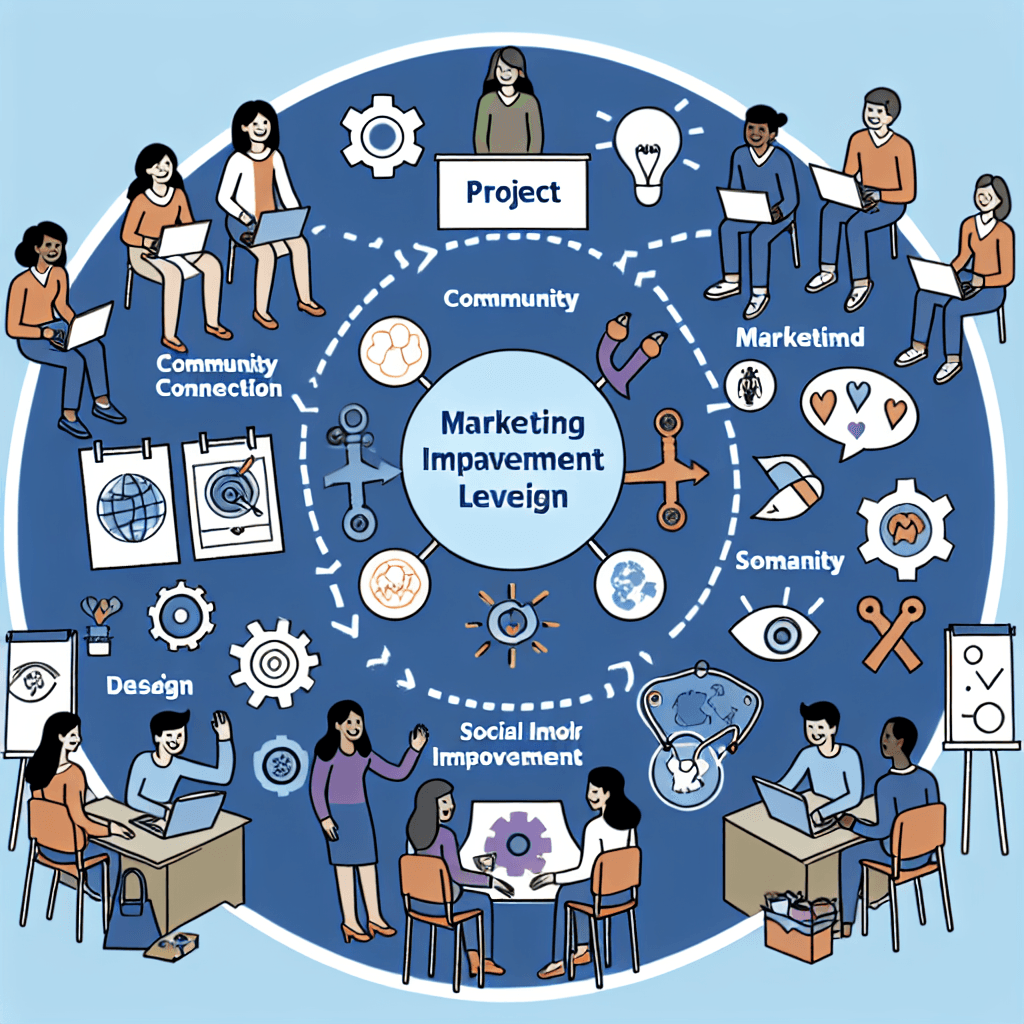
Community Connection: Marketing Design for Social Improvement
Inquiry Framework
Question Framework
Driving Question
The overarching question that guides the entire project.How can students leverage marketing strategies, collaboration with industry partners, and technology to design and implement a project that improves their community, taking into account cultural and societal contexts?Essential Questions
Supporting questions that break down major concepts.- How can marketing strategies be used to effectively address and solve community problems?
- In what ways does visual design influence public perception and engagement within a community?
- How can collaboration between industry partners and students lead to successful community improvement projects?
- What role does technology play in modern marketing and community engagement initiatives?
- How can mathematical concepts be applied to analyze and predict the effectiveness of marketing campaigns?
- In what way does understanding cultural and societal contexts enhance the relevancy and impact of a marketing campaign?
Standards & Learning Goals
Learning Goals
By the end of this project, students will be able to:- Students will develop marketing strategies that leverage technology to address community problems.
- Students will collaborate effectively with industry partners to design and implement a community project.
- Students will apply mathematical concepts to analyze, predict and present data on the effectiveness of their marketing strategies.
- Students will create visual designs to influence public perception and engagement.
- Students will gain cultural awareness and consider societal contexts in the development of marketing campaigns.
Common Core Standards
Next Generation Science Standards
National Core Arts Standards
ISTE Standards for Students
Entry Events
Events that will be used to introduce the project to studentsCommunity Billboard Challenge
Students discover a mysterious, blank billboard in their community with a challenge note: "Create a message that matters." This prompts investigations into influential marketing strategies and design, with a focus on devising impactful designs with local significance. By contacting local businesses and exploring successful campaigns, students gain insights into real-world marketing techniques.Interactive Design Gallery Walk
Transform the classroom into an interactive gallery showcasing incomplete community projects from around the world. At each station, students add their ideas on how to market and design solutions for these projects, fostering creativity and critical thinking about solving real-world problems. Students gain skills in approaching projects from multiple angles and appreciate the value of diverse perspectives.Mystery Box Scenario
Each group receives a "Mystery Box" containing various artifacts, pictures, and articles related to different community challenges. Students delve into research to unveil the story behind these artifacts, connecting past community issues to current ones while crafting possible marketing and design campaigns. This investigative approach taps into students' curiosity, creative problem-solving, and inquiry skills.Portfolio Activities
Portfolio Activities
These activities progressively build towards your learning goals, with each submission contributing to the student's final portfolio.Marketing Strategy Launch Pad
Students explore the fundamentals of marketing strategies by researching successful campaigns and constructing a foundation of marketing skills, which they will later apply to their project.Steps
Here is some basic scaffolding to help students complete the activity.Final Product
What students will submit as the final product of the activityA portfolio of researched marketing strategies tailored to community improvements.Alignment
How this activity aligns with the learning objectives & standardsAligns with CCSS.ELA-LITERACY.CCRA.W.6: Using digital tools to research and craft writing about marketing strategies.Visual Design Mastery
This activity focuses on visual design principles, allowing students to practice and develop their aesthetic skills to create engaging and influential visuals for their community project.Steps
Here is some basic scaffolding to help students complete the activity.Final Product
What students will submit as the final product of the activityA digital draft of a visual design component for the community marketing project.Alignment
How this activity aligns with the learning objectives & standardsAligns with CCSS.ART.VA:Re9.1.II: Establishing aesthetic criteria for visual designs in preparation for presentation.Data Analysis Adventures
Students delve into the mathematical side of marketing by using statistical data to predict and analyze the effectiveness of their marketing strategies.Steps
Here is some basic scaffolding to help students complete the activity.Final Product
What students will submit as the final product of the activityA report featuring statistical representations of data and a detailed analysis predicting the campaign’s effectiveness.Alignment
How this activity aligns with the learning objectives & standardsAligns with CCSS.MATH.CONTENT.HSS.ID.A.1: Using plots to represent and understand data.Communication and Collaboration Champs
Students practice effective communication and collaboration skills essential for engaging with community and industry partners.Steps
Here is some basic scaffolding to help students complete the activity.Final Product
What students will submit as the final product of the activityA journal of reflections on communication practices and feedback from partners.Alignment
How this activity aligns with the learning objectives & standardsAligns with CCSS.ELA-LITERACY.CCRA.SL.1: Developing communication skills with diverse partners through conversations and reflections.Cultural Context Explorers
In this activity, students explore cultural and societal contexts to ensure their marketing campaign resonates with the community and respects cultural norms.Steps
Here is some basic scaffolding to help students complete the activity.Final Product
What students will submit as the final product of the activityA cultural awareness report that guides the marketing campaign to respect and reflect community values.Alignment
How this activity aligns with the learning objectives & standardsAligns with NGSS.HS-ESS3-1: Using research to understand cultural contexts in human activities and marketing.Tech-Savvy Innovators
This activity hones students' abilities to use technology creatively as they identify innovative marketing solutions for community enhancement.Steps
Here is some basic scaffolding to help students complete the activity.Final Product
What students will submit as the final product of the activityA prototype utilizing technology to create a high-impact marketing solution for community improvement.Alignment
How this activity aligns with the learning objectives & standardsAligns with ISTE.1.b: Using technology to solve problems and innovate solutions for real-world applications.Rubric & Reflection
Portfolio Rubric
Grading criteria for assessing the overall project portfolioCommunity Improvement Marketing Project Rubric
Marketing Strategy Development
Assesses the ability to research, develop, and refine effective marketing strategies that address community problems.Research and Understanding
Measures the depth and breadth of research conducted on successful marketing campaigns and the understanding of marketing principles.
Exemplary
4 PointsConducts thorough, extensive research and demonstrates a sophisticated understanding of marketing principles.
Proficient
3 PointsConducts solid research and demonstrates a thorough understanding of marketing principles.
Developing
2 PointsConducts limited research and demonstrates an emerging understanding of marketing principles.
Beginning
1 PointsConducts minimal research and shows initial understanding of marketing principles.
Strategy Formulation and Refinement
Evaluates the ability to formulate and refine marketing strategies based on research and feedback.
Exemplary
4 PointsDevelops innovative marketing strategies and refines them effectively using comprehensive feedback.
Proficient
3 PointsDevelops appropriate marketing strategies and effectively refines them using feedback.
Developing
2 PointsDevelops basic marketing strategies with limited refinement based on feedback.
Beginning
1 PointsStruggles to develop marketing strategies and incorporate feedback.
Visual Design and Impact
Evaluates the application of visual design principles to create engaging and impactful visuals.Design Principles Application
Measures the ability to apply key principles of visual design in the creation of marketing visuals.
Exemplary
4 PointsExceptionally applies visual design principles, creating highly engaging and aesthetically pleasing visuals.
Proficient
3 PointsConsistently applies visual design principles, creating effective and attractive visuals.
Developing
2 PointsApplies some visual design principles inconsistently, resulting in visually basic designs.
Beginning
1 PointsStruggles to apply visual design principles, resulting in ineffective visuals.
Audience Engagement
Assesses the ability to design visuals that effectively engage the intended audience.
Exemplary
4 PointsCreates visuals that exceptionally engage and resonate with the audience, clearly reflecting community relevance.
Proficient
3 PointsCreates visuals that effectively engage the audience and reflect some aspects of community relevance.
Developing
2 PointsCreates visuals with limited audience engagement and relevance.
Beginning
1 PointsCreates visuals that do not engage the audience or reflect community relevance.
Collaboration and Communication
Assesses collaboration with industry partners and effective communication skills.Collaboration Skills
Measures the effectiveness of collaborative efforts with community partners and peers.
Exemplary
4 PointsDemonstrates exceptional collaboration skills, actively contributing and leading in group settings.
Proficient
3 PointsDemonstrates effective collaboration skills, contributing positively to group efforts.
Developing
2 PointsShows basic collaboration skills, but contributions to group efforts are inconsistent.
Beginning
1 PointsDemonstrates limited collaboration skills and requires guidance to contribute effectively.
Communication Effectiveness
Evaluates the ability to communicate ideas clearly and persuasively.
Exemplary
4 PointsCommunicates ideas exceptionally clearly and persuasively in various contexts.
Proficient
3 PointsCommunicates ideas clearly and persuasively in most contexts.
Developing
2 PointsCommunicates ideas with limited clarity and persuasiveness.
Beginning
1 PointsStruggles to communicate ideas clearly and persuasively.
Data Analysis and Application
Evaluates the ability to use statistical data to analyze and predict marketing strategy effectiveness.Data Collection and Representation
Assesses the ability to collect relevant data and accurately represent it using statistical methods.
Exemplary
4 PointsCollects highly relevant data and accurately represents it using sophisticated statistical methods.
Proficient
3 PointsCollects relevant data and represents it accurately using appropriate statistical methods.
Developing
2 PointsCollects some relevant data and represents it with basic statistical methods.
Beginning
1 PointsStruggles to collect relevant data or use statistical methods effectively.
Data Analysis
Measures the ability to analyze data and draw valid conclusions to enhance marketing strategies.
Exemplary
4 PointsAnalyzes data thoroughly, drawing insightful conclusions that significantly enhance marketing strategies.
Proficient
3 PointsAnalyzes data effectively, drawing valid conclusions that improve marketing strategies.
Developing
2 PointsAnalyzes data with limited effectiveness, drawing basic conclusions.
Beginning
1 PointsStruggles to analyze data or draw valid conclusions.
Cultural Context and Sensitivity
Assesses the consideration of cultural and societal contexts in marketing campaign development.Cultural Awareness and Integration
Measures the understanding and integration of cultural elements into the marketing campaign.
Exemplary
4 PointsDemonstrates deep cultural awareness, integrating cultural elements seamlessly into the campaign.
Proficient
3 PointsDemonstrates cultural awareness, integrating some cultural elements effectively.
Developing
2 PointsShows limited cultural awareness, with basic integration of cultural elements.
Beginning
1 PointsStruggles to demonstrate cultural awareness or integrate cultural elements.