
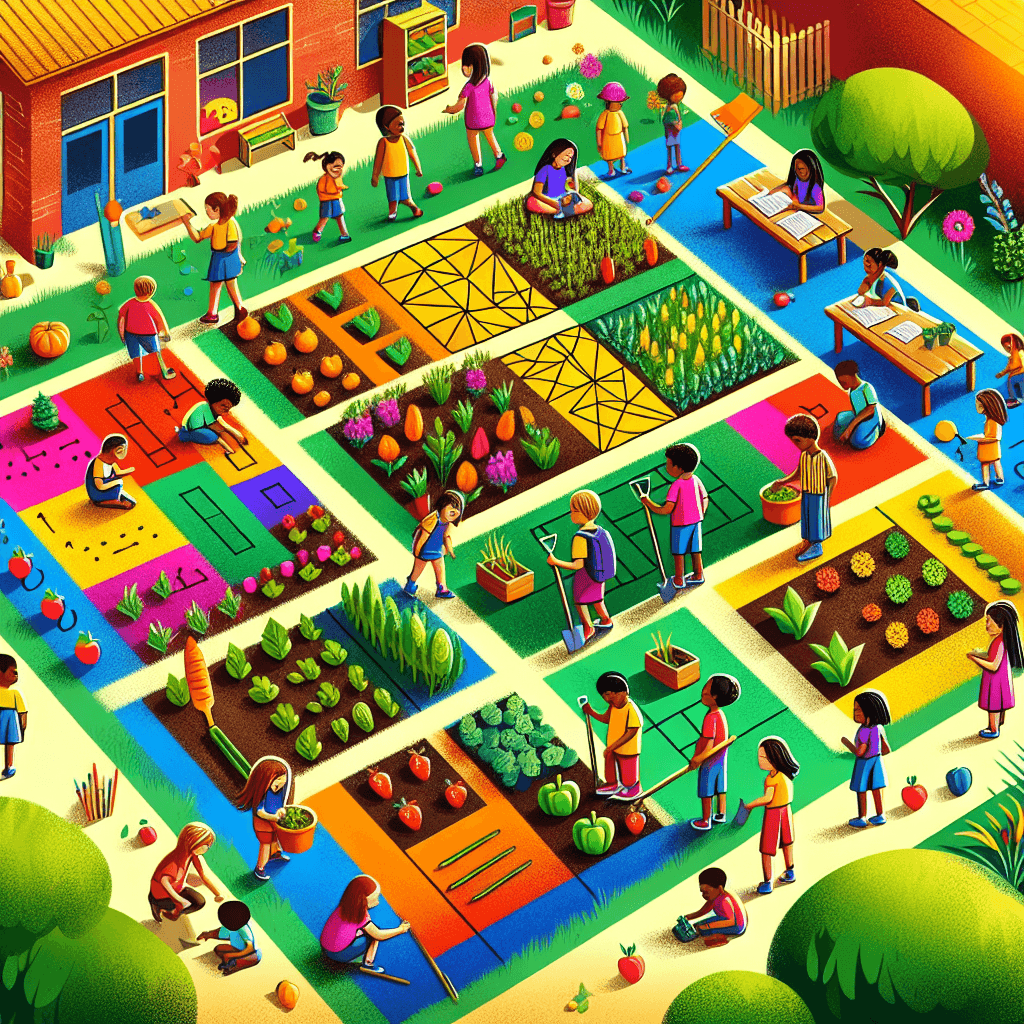
Community Garden Design: Area and Perimeter in Action!
Inquiry Framework
Question Framework
Driving Question
The overarching question that guides the entire project.How can we use our knowledge of measurement to design a community garden that benefits our neighborhood?Essential Questions
Supporting questions that break down major concepts.- How do we measure the space inside the garden?
- How do we measure the distance around the garden?
- How can we use math to plan our garden?
Standards & Learning Goals
Learning Goals
By the end of this project, students will be able to:- Students will be able to calculate the area of rectangular garden plots.
- Students will be able to calculate the perimeter to determine fencing needs.
- Students will apply measurement skills to design a functional and aesthetically pleasing community garden.
Common Core Standards
Entry Events
Events that will be used to introduce the project to studentsNews Report: Food Desert
A local news report airs, highlighting the lack of green spaces and fresh produce access in the community. Students watch the report and discuss the impact on residents, brainstorming how a community garden could help. This sparks initial ideas and empathy, leading them to investigate potential locations and design solutions.Portfolio Activities
Portfolio Activities
These activities progressively build towards your learning goals, with each submission contributing to the student's final portfolio.Fence It In: Perimeter Planners
Students will focus on calculating the perimeter of their designed garden plots to determine the amount of fencing needed. They will explore different plot shapes and their impact on fencing requirements.Steps
Here is some basic scaffolding to help students complete the activity.Final Product
What students will submit as the final product of the activityA fencing proposal for each garden plot design, including perimeter calculations and a cost estimate for the fencing material.Alignment
How this activity aligns with the learning objectives & standardsCovers 3.MD.D.8 (solving real-world problems involving perimeters) and applies perimeter calculations to determine fencing needs.Community Garden Architects
Students combine their knowledge of area and perimeter to optimize their garden designs. They will consider factors like maximizing planting space (area) while minimizing fencing costs (perimeter).Steps
Here is some basic scaffolding to help students complete the activity.Final Product
What students will submit as the final product of the activityA final community garden design plan, including scaled drawings of garden plots with labeled dimensions, area calculations, perimeter calculations, and a rationale for design choices.Alignment
How this activity aligns with the learning objectives & standardsIntegrates 3.MD.C.6 (area) and 3.MD.D.8 (perimeter) in a practical design task.Grid Garden Designers
Students transition from counting individual square units to using multiplication to calculate the area of rectangles. They will design garden plots on paper, using grid paper to represent square units, and then calculate the area using multiplication.Steps
Here is some basic scaffolding to help students complete the activity.Final Product
What students will submit as the final product of the activityScaled garden plot designs on grid paper with calculated areas using multiplication.Alignment
How this activity aligns with the learning objectives & standardsCovers 3.MD.C.6 (measuring areas) and introduces using multiplication to find area.Rubric & Reflection
Portfolio Rubric
Grading criteria for assessing the overall project portfolioCommunity Garden Design Rubric
Area Calculation & Design
Assesses the student’s ability to accurately design garden plots on grid paper and calculate their areas using multiplication.Area Calculation Accuracy
Accuracy of area calculations for individual garden plots.
Exemplary
4 PointsArea calculations are completely accurate and clearly demonstrate understanding of the formula (Area = length x width). Units are correctly labeled.
Proficient
3 PointsArea calculations are mostly accurate with minor errors. Demonstrates general understanding of the formula and labels units correctly most of the time.
Developing
2 PointsArea calculations contain significant errors, indicating a lack of understanding of the formula. Units are missing or incorrect.
Beginning
1 PointsArea calculations are not attempted or are entirely incorrect. Shows no understanding of the concept of area or the formula.
Drawing Clarity & Accuracy
Clarity and precision of scaled drawings of garden plots on grid paper.
Exemplary
4 PointsDrawings are exceptionally clear, precise, and accurately represent the dimensions of the garden plots. The scale is consistent and easy to understand.
Proficient
3 PointsDrawings are clear and mostly accurate, with minor inconsistencies in representing the dimensions. The scale is generally consistent.
Developing
2 PointsDrawings are somewhat unclear and contain noticeable inaccuracies in representing the dimensions. The scale is inconsistent.
Beginning
1 PointsDrawings are unclear, inaccurate, and do not represent the dimensions of the garden plots. The scale is missing or incomprehensible.
Multiplication Application
Application of multiplication to calculate the area of garden plots.
Exemplary
4 PointsConsistently and correctly applies multiplication to find the area of all garden plots. Demonstrates a strong understanding of the relationship between multiplication and area.
Proficient
3 PointsApplies multiplication to find the area of most garden plots with only minor errors. Shows a good understanding of the relationship between multiplication and area.
Developing
2 PointsAttempts to use multiplication to find the area, but makes significant errors or struggles with the concept.
Beginning
1 PointsDoes not use multiplication or demonstrates no understanding of how to apply it to calculate area.
Perimeter & Fencing Proposal
Focuses on evaluating the student’s ability to calculate perimeter, estimate fencing costs, and propose a fencing solution for their garden plots.Perimeter Calculation Accuracy
Accuracy of perimeter calculations for different garden plot designs.
Exemplary
4 PointsPerimeter calculations are flawlessly accurate and demonstrate a complete understanding of how to calculate the perimeter by adding all sides. All units are correctly labeled.
Proficient
3 PointsPerimeter calculations are mostly accurate with only minor errors. Shows a good understanding of the concept of perimeter and labels units correctly.
Developing
2 PointsPerimeter calculations contain significant errors, indicating a misunderstanding of how to calculate perimeter. Units are missing or incorrect.
Beginning
1 PointsPerimeter calculations are not attempted or are entirely incorrect. Demonstrates no understanding of the concept of perimeter.
Fencing Cost Estimates
Research and accuracy of fencing cost estimates.
Exemplary
4 PointsThoroughly researches fencing costs and provides highly accurate estimates based on perimeter calculations. Considers different fencing options and justifies the selection.
Proficient
3 PointsResearches fencing costs and provides reasonably accurate estimates based on perimeter calculations.
Developing
2 PointsAttempts to research fencing costs but provides inaccurate estimates or lacks justification for the cost.
Beginning
1 PointsDoes not research fencing costs or provides no estimates related to the perimeter calculations.
Proposal Clarity & Justification
Clarity and completeness of the fencing proposal, including justification for design choices.
Exemplary
4 PointsProposal is exceptionally clear, well-organized, and thoroughly justifies the fencing choices based on perimeter calculations and cost considerations.
Proficient
3 PointsProposal is clear, organized, and justifies the fencing choices based on perimeter calculations and cost considerations.
Developing
2 PointsProposal is somewhat unclear or incomplete, with limited justification for fencing choices.
Beginning
1 PointsProposal is unclear, disorganized, and lacks justification for fencing choices.
Community Garden Design
Evaluates the student’s ability to synthesize their knowledge of area and perimeter to create an optimized community garden design.Integration of Calculations
Integration of area and perimeter calculations in the final community garden design.
Exemplary
4 PointsDemonstrates sophisticated integration of area and perimeter calculations to optimize the garden design for space efficiency and cost-effectiveness.
Proficient
3 PointsSuccessfully integrates area and perimeter calculations into the garden design, demonstrating a good understanding of their relationship.
Developing
2 PointsShows some attempt to integrate area and perimeter calculations, but the relationship is not fully clear in the design.
Beginning
1 PointsFails to integrate area and perimeter calculations into the garden design.
Drawing Quality & Accuracy
Quality and accuracy of the final scaled drawing of the community garden.
Exemplary
4 PointsThe scaled drawing is of exceptional quality, with precise dimensions and clear labeling, demonstrating a thorough understanding of scale and proportion.
Proficient
3 PointsThe scaled drawing is accurate and clearly labeled, with a good representation of the garden's dimensions.
Developing
2 PointsThe scaled drawing contains some inaccuracies or lacks clarity in labeling.
Beginning
1 PointsThe scaled drawing is inaccurate, poorly labeled, and does not effectively represent the garden design.
Rationale Effectiveness
Effectiveness of the rationale for design choices in optimizing space and minimizing costs.
Exemplary
4 PointsThe rationale is highly effective, providing a compelling explanation of how design choices optimize space and minimize fencing costs, demonstrating deep insight.
Proficient
3 PointsThe rationale clearly explains how design choices optimize space and minimize fencing costs.
Developing
2 PointsThe rationale provides a limited or unclear explanation of the design choices.
Beginning
1 PointsThe rationale is missing or provides no justification for the design choices.