
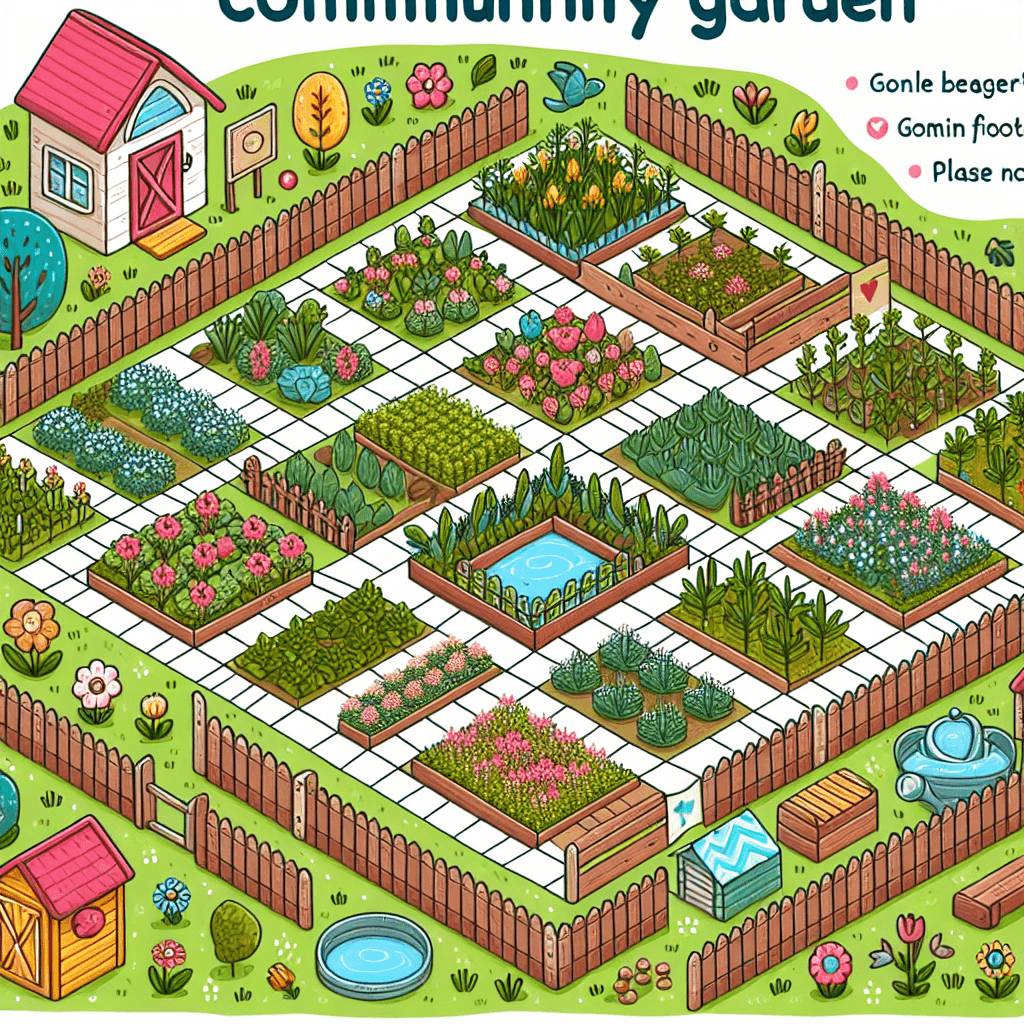
Community Garden Design Challenge: Area and Perimeter
Inquiry Framework
Question Framework
Driving Question
The overarching question that guides the entire project.How can we design a community garden using our knowledge of area and perimeter to maximize the growing space and provide healthy vegetables for everyone?Essential Questions
Supporting questions that break down major concepts.- How can we measure the area and perimeter of different garden shapes?
- How can we maximize the growing space within a given perimeter?
- How do different vegetables impact the design of our garden?
- How can we use math to plan and create a community garden that benefits everyone?
Standards & Learning Goals
Learning Goals
By the end of this project, students will be able to:- Students will be able to calculate the area and perimeter of various shapes.
- Students will be able to design a garden layout that maximizes growing space within a given perimeter.
- Students will be able to apply mathematical concepts to real-world problems.
Entry Events
Events that will be used to introduce the project to studentsThe Great Garden Challenge!
A local farmer announces that a blight has devastated crops and challenges the students to design the most productive vegetable garden to help feed the community. The farmer provides specific (and limited) dimensions for the garden plot, requiring students to optimize their designs.Portfolio Activities
Portfolio Activities
These activities progressively build towards your learning goals, with each submission contributing to the student's final portfolio.Garden Shape Explorers
Students explore different shapes and their area/perimeter relationships to understand how shapes impact growing space.Steps
Here is some basic scaffolding to help students complete the activity.Final Product
What students will submit as the final product of the activityA chart comparing different shapes, their perimeters, and their areas.Alignment
How this activity aligns with the learning objectives & standardsAddresses the learning goal: Students will be able to calculate the area and perimeter of various shapes.Vegetable Plot Planner
Students plan their vegetable plots by selecting vegetables and determining the space required for each, using area and perimeter calculations.Steps
Here is some basic scaffolding to help students complete the activity.Final Product
What students will submit as the final product of the activityA detailed plan showing the area allocated to each vegetable in the garden.Alignment
How this activity aligns with the learning objectives & standardsAddresses the learning goal: Students will be able to design a garden layout that maximizes growing space within a given perimeter.The Perimeter Challenge
Students experiment with different garden designs, focusing on maximizing area within a fixed perimeter.Steps
Here is some basic scaffolding to help students complete the activity.Final Product
What students will submit as the final product of the activityA report detailing the different garden designs, their areas, and the optimal design with the largest area.Alignment
How this activity aligns with the learning objectives & standardsAddresses the learning goal: Students will be able to design a garden layout that maximizes growing space within a given perimeter.Community Garden Blueprint
Students create a final blueprint of their community garden, incorporating all their learning about area, perimeter, and vegetable needs.Steps
Here is some basic scaffolding to help students complete the activity.Final Product
What students will submit as the final product of the activityA detailed blueprint of the community garden with a written justification.Alignment
How this activity aligns with the learning objectives & standardsAddresses the learning goals: Students will be able to calculate the area and perimeter of various shapes; Students will be able to design a garden layout that maximizes growing space within a given perimeter; Students will be able to apply mathematical concepts to real-world problems.Rubric & Reflection
Portfolio Rubric
Grading criteria for assessing the overall project portfolioCommunity Garden Design Rubric
Mathematical Accuracy
Demonstrates accurate calculation and application of area and perimeter concepts.Area and Perimeter Calculations
Accuracy of area and perimeter calculations for different shapes and garden designs.
Exemplary
4 PointsAll area and perimeter calculations are accurate and clearly presented with correct units. Demonstrates a sophisticated understanding of the relationship between area and perimeter.
Proficient
3 PointsMost area and perimeter calculations are accurate with minor errors. Shows a good understanding of the relationship between area and perimeter.
Developing
2 PointsSome area and perimeter calculations are accurate, but there are noticeable errors. Shows a basic understanding of area and perimeter.
Beginning
1 PointsArea and perimeter calculations are largely inaccurate. Struggles to apply the concepts of area and perimeter.
Vegetable Space Planning
Accuracy in calculating and allocating space for different vegetables based on their requirements.
Exemplary
4 PointsAccurately calculates and allocates space for all vegetables based on their needs, demonstrating a sophisticated understanding of plant spacing.
Proficient
3 PointsCalculates and allocates space for most vegetables accurately with minor errors in spacing.
Developing
2 PointsAttempts to calculate space for vegetables, but there are significant errors in spacing and allocation.
Beginning
1 PointsStruggles to calculate and allocate space for vegetables. Demonstrates little understanding of plant spacing.
Design Efficiency
Effectiveness of the garden design in maximizing growing space within the given constraints.Space Maximization
Effectiveness of the design in maximizing growing space within the fixed perimeter.
Exemplary
4 PointsThe garden design demonstrates an innovative approach to maximizing growing space within the fixed perimeter. All available space is utilized effectively.
Proficient
3 PointsThe garden design effectively maximizes growing space within the fixed perimeter. Most available space is utilized.
Developing
2 PointsThe garden design attempts to maximize growing space, but there are areas that are not efficiently utilized.
Beginning
1 PointsThe garden design does not effectively maximize growing space. Significant portions of the space are wasted.
Layout and Organization
Clarity and organization of the garden layout, including placement of different vegetables.
Exemplary
4 PointsThe garden layout is exceptionally clear, organized, and visually appealing, with logical placement of different vegetables that considers sun exposure, plant compatibility, and accessibility.
Proficient
3 PointsThe garden layout is clear and organized, with logical placement of different vegetables.
Developing
2 PointsThe garden layout is somewhat disorganized, and the placement of vegetables is not always logical.
Beginning
1 PointsThe garden layout is confusing and disorganized. The placement of vegetables appears random.
Justification and Explanation
Clarity and completeness of the justification for the design choices, including reasoning for maximizing growing space.Design Rationale
Explanation of the design choices, including the rationale for selecting specific shapes and vegetable placements.
Exemplary
4 PointsProvides a comprehensive and insightful justification for all design choices, explaining the reasoning behind the selection of specific shapes, vegetable placements, and space allocation strategies. Demonstrates a deep understanding of the design principles.
Proficient
3 PointsProvides a clear justification for most design choices, explaining the reasoning behind the selection of specific shapes and vegetable placements.
Developing
2 PointsAttempts to justify the design choices, but the explanation is incomplete and lacks specific reasoning.
Beginning
1 PointsProvides little or no justification for the design choices. The reasoning is unclear or missing.
Mathematical Reasoning
Use of mathematical concepts to support and justify the design choices.
Exemplary
4 PointsUses mathematical concepts effectively to support and justify all design choices, demonstrating a sophisticated understanding of how area and perimeter influence the garden design. Presents clear and logical arguments based on mathematical evidence.
Proficient
3 PointsUses mathematical concepts to support and justify most design choices.
Developing
2 PointsAttempts to use mathematical concepts, but the connection to the design choices is weak or unclear.
Beginning
1 PointsShows little or no use of mathematical concepts to support the design choices.