
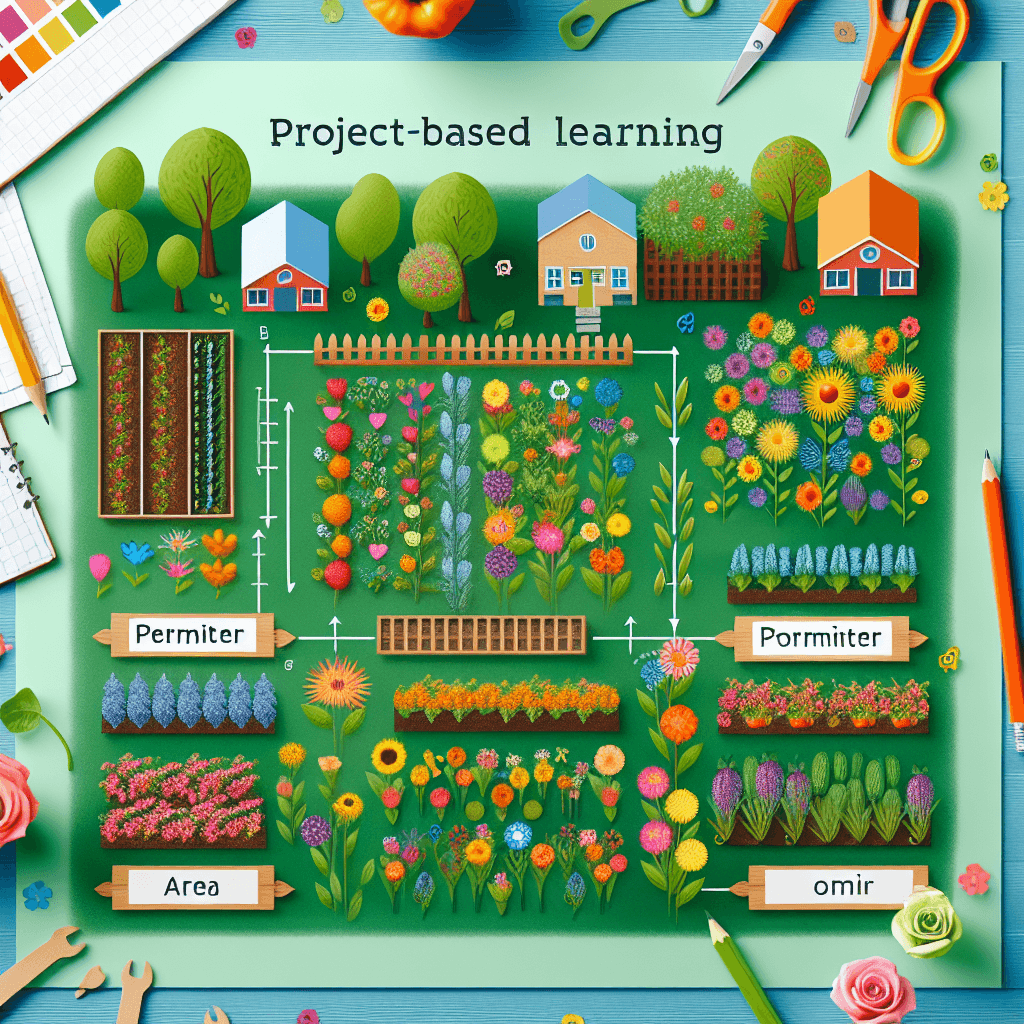
Community Garden Design: Perimeter and Area Optimization
Inquiry Framework
Question Framework
Driving Question
The overarching question that guides the entire project.How can we use our knowledge of area and perimeter to design the most efficient and beneficial community garden for our town, considering the limitations of space and resources?Essential Questions
Supporting questions that break down major concepts.- How do we measure the size of the garden?
- How do we measure the boundary of the garden?
- How can we use math to plan a garden?
- How does the shape of the garden affect the amount of fencing we need?
- How can we make the garden as big as possible with a limited amount of fencing?
Standards & Learning Goals
Learning Goals
By the end of this project, students will be able to:- Apply area and perimeter formulas to optimize garden space.
- Design a community garden layout considering space and resource constraints.
- Calculate the area and perimeter of different garden shapes.
- Understand the relationship between area and perimeter in practical design scenarios.
Entry Events
Events that will be used to introduce the project to studentsCommunity Garden Design Contest
The mayor announces a contest: design a community garden that will revitalize a neglected urban space. Winning design gets built! This event immediately establishes relevance and taps into students' desire to contribute to their community.Portfolio Activities
Portfolio Activities
These activities progressively build towards your learning goals, with each submission contributing to the student's final portfolio.Rectangle Roundup
Students will start by measuring common rectangular objects (desks, books, etc.) to understand area and perimeter.Steps
Here is some basic scaffolding to help students complete the activity.Final Product
What students will submit as the final product of the activityA worksheet with measurements and calculations of area and perimeter for various rectangular objects.Alignment
How this activity aligns with the learning objectives & standardsAddresses the learning goals related to applying area and perimeter formulas in practical design scenarios.Shape Fusion Challenge
Students will combine rectangles to form more complex shapes and calculate the total area and perimeter.Steps
Here is some basic scaffolding to help students complete the activity.Final Product
What students will submit as the final product of the activityA design blueprint showing combined rectangular shapes with calculated areas and perimeters.Alignment
How this activity aligns with the learning objectives & standardsFocuses on calculating area and perimeter of combined shapes.Garden Architect Blueprint
Students will design a garden using a specific area and perimeter, considering different shapes to maximize space.Steps
Here is some basic scaffolding to help students complete the activity.Final Product
What students will submit as the final product of the activityA scaled garden design plan, including dimensions, total area, perimeter, and a rationale for shape choice.Alignment
How this activity aligns with the learning objectives & standardsDirectly applies area and perimeter knowledge to garden design, meeting the goal of optimizing garden space.Rubric & Reflection
Portfolio Rubric
Grading criteria for assessing the overall project portfolioCommunity Garden Design Rubric
Rectangle Roundup
Assesses the student's ability to accurately measure, calculate, and present area and perimeter data for rectangular objects.Accuracy of Calculations
Accuracy of measurements and calculations for area and perimeter of rectangular objects.
Exemplary
4 PointsMeasurements and calculations are precise and demonstrate a deep understanding of area and perimeter formulas. All values are correct and clearly labeled.
Proficient
3 PointsMeasurements and calculations are mostly accurate with minor errors. Demonstrates a good understanding of area and perimeter formulas. Most values are correct and clearly labeled.
Developing
2 PointsMeasurements and calculations contain several errors, indicating a partial understanding of area and perimeter formulas. Some values may be missing or mislabeled.
Beginning
1 PointsMeasurements and calculations are largely inaccurate, demonstrating a limited understanding of area and perimeter formulas. Many values are missing or mislabeled.
Organization and Clarity
Clarity and organization of the worksheet, including the presentation of measurements and calculations in a table.
Exemplary
4 PointsThe worksheet is exceptionally clear, well-organized, and easy to read. The table is neatly presented with all data clearly labeled and formatted.
Proficient
3 PointsThe worksheet is clear and organized, with a well-presented table that includes all necessary data. Labels are present and mostly clear.
Developing
2 PointsThe worksheet is somewhat disorganized and may be difficult to follow. The table is present but may lack clear labels or formatting.
Beginning
1 PointsThe worksheet is disorganized and difficult to understand. The table is poorly presented or missing key information.
Shape Fusion Challenge
Evaluates the student's ability to combine rectangular shapes and accurately calculate the resulting area and perimeter, presented in a design blueprint.Calculation Accuracy
Accuracy in calculating the area and perimeter of combined rectangular shapes.
Exemplary
4 PointsAll area and perimeter calculations are accurate, demonstrating a comprehensive understanding of how to combine rectangles. Calculations are thoroughly explained.
Proficient
3 PointsArea and perimeter calculations are mostly accurate with only minor errors. Demonstrates a good understanding of combining rectangles.
Developing
2 PointsArea and perimeter calculations contain some errors, indicating a partial understanding of how to combine rectangles.
Beginning
1 PointsArea and perimeter calculations are significantly inaccurate, demonstrating a limited understanding of how to combine rectangles.
Blueprint Quality
Quality and clarity of the design blueprint, including labeled dimensions and clear representation of the combined shapes.
Exemplary
4 PointsThe design blueprint is exceptionally clear, detailed, and visually appealing. All dimensions are accurately labeled, and the combined shapes are clearly represented.
Proficient
3 PointsThe design blueprint is clear and well-organized with accurately labeled dimensions. The combined shapes are clearly represented.
Developing
2 PointsThe design blueprint is somewhat unclear or disorganized. Some dimensions may be missing or mislabeled, and the combined shapes may be difficult to interpret.
Beginning
1 PointsThe design blueprint is unclear, incomplete, and poorly organized. Dimensions are missing or inaccurate, and the combined shapes are difficult to understand.
Garden Architect Blueprint
Assesses the student's ability to apply area and perimeter knowledge to design a garden, considering shape, space optimization, and clear communication of their design choices.Space Maximization
Effectiveness of the chosen garden shape in maximizing planting space within the given perimeter, as demonstrated in the design.
Exemplary
4 PointsThe chosen garden shape is exceptionally efficient in maximizing planting space, demonstrating a sophisticated understanding of the relationship between area and perimeter. The design is innovative and well-justified.
Proficient
3 PointsThe chosen garden shape is efficient in maximizing planting space, demonstrating a good understanding of the relationship between area and perimeter. The design is practical and well-considered.
Developing
2 PointsThe chosen garden shape is somewhat effective in maximizing planting space, but there is room for improvement. Demonstrates a basic understanding of the relationship between area and perimeter.
Beginning
1 PointsThe chosen garden shape is not effective in maximizing planting space, indicating a limited understanding of the relationship between area and perimeter. The design is impractical and poorly justified.
Plan Clarity and Completeness
Clarity and completeness of the scaled garden design plan, including accurate dimensions, total area, perimeter, and a rationale for the shape choice.
Exemplary
4 PointsThe garden design plan is exceptionally clear, complete, and detailed. All dimensions are accurate, the total area and perimeter are correctly calculated, and the rationale for the shape choice is compelling and well-supported.
Proficient
3 PointsThe garden design plan is clear and complete, with accurate dimensions, correctly calculated total area and perimeter, and a reasonable rationale for the shape choice.
Developing
2 PointsThe garden design plan is somewhat incomplete or unclear. Some dimensions may be missing or inaccurate, the total area and perimeter may not be correctly calculated, or the rationale for the shape choice may be weak.
Beginning
1 PointsThe garden design plan is incomplete, unclear, and lacks essential information. Dimensions are missing or inaccurate, the total area and perimeter are incorrectly calculated, and the rationale for the shape choice is missing or unconvincing.
Rationale Strength
Strength and clarity of the paragraph explaining the rationale for choosing the specific garden shape.
Exemplary
4 PointsThe paragraph provides a compelling and insightful explanation of why the chosen shape is the most efficient for maximizing planting space, demonstrating a deep understanding of the relationship between area and perimeter.
Proficient
3 PointsThe paragraph provides a clear and logical explanation of why the chosen shape is efficient for maximizing planting space, demonstrating a good understanding of the relationship between area and perimeter.
Developing
2 PointsThe paragraph provides a basic explanation of why the chosen shape was chosen, but the reasoning may be unclear or incomplete. Demonstrates a partial understanding of the relationship between area and perimeter.
Beginning
1 PointsThe paragraph provides a weak or missing explanation of why the chosen shape was chosen, indicating a limited understanding of the relationship between area and perimeter.