
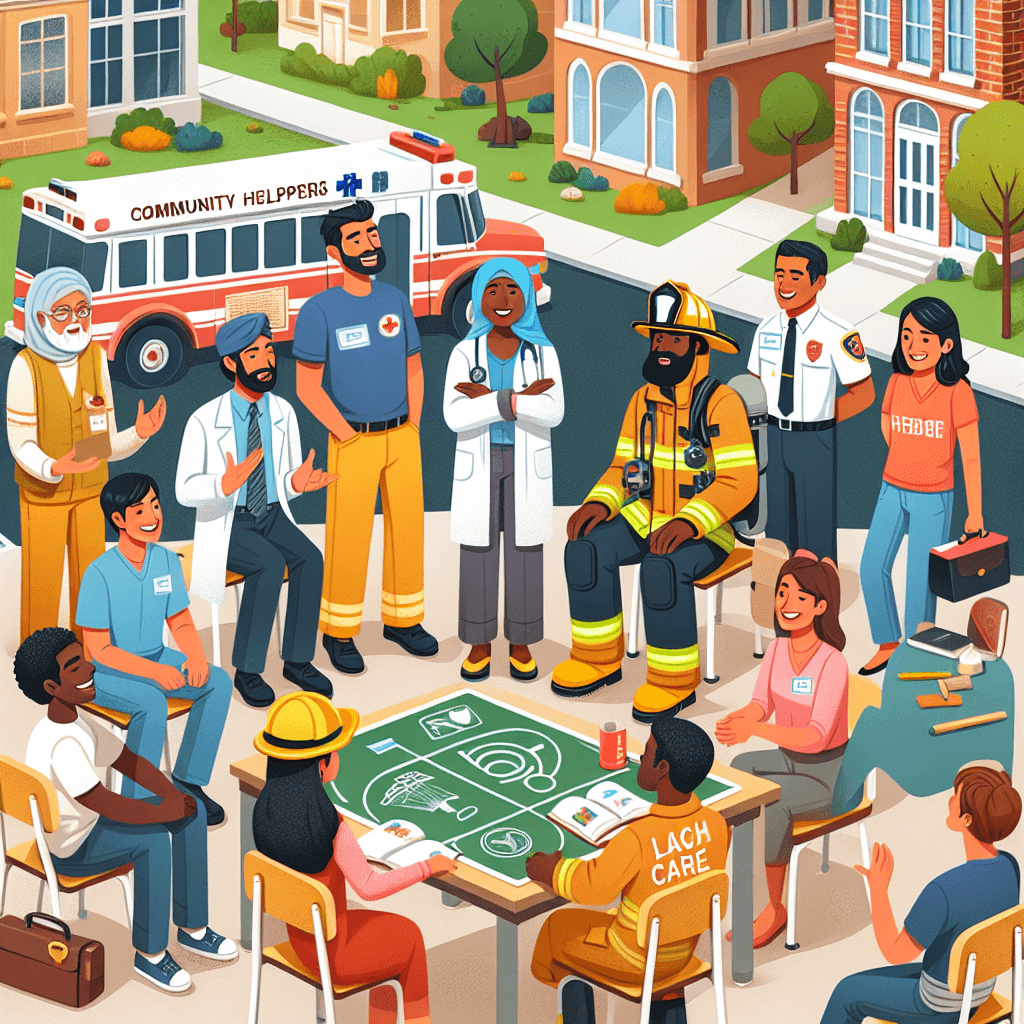
Community Helpers Debate: Understanding Local Roles
Inquiry Framework
Question Framework
Driving Question
The overarching question that guides the entire project.How do various community helpers impact our neighborhood, and why are their roles essential to our safety and well-being?Essential Questions
Supporting questions that break down major concepts.- What role do community helpers play in our neighborhood?
- Why are community helpers important to us?
- How do different community helpers contribute to our safety and well-being?
- What skills and qualities are important for community helpers to have?
Standards & Learning Goals
Learning Goals
By the end of this project, students will be able to:- Students will identify different community helpers and their roles within the neighborhood.
- Students will articulate reasons why community helpers are essential to safety and well-being.
- Students will develop and present a position on the role of community helpers using clear and convincing language.
- Students will participate in a debate to enhance their public speaking and critical thinking skills.
Common Core Standards
Entry Events
Events that will be used to introduce the project to studentsInvestigative News Conference
Invite a local firefighter, nurse, and postal worker to a 'mock' press conference with the students as journalists. Students will prepare questions to unearth each professional's roles and community impact, prompting inquiry into the significance of these roles.Virtual Town Hall Debate
Host a virtual meeting with prerecorded video messages from community helpers highlighting their daily challenges and accomplishments. Students will pose questions and discuss these challenges, fostering a debate on the importance of each profession in maintaining community wellbeing.Portfolio Activities
Portfolio Activities
These activities progressively build towards your learning goals, with each submission contributing to the student's final portfolio.Community Roles Investigator
Students become 'community detectives' who research and gather information about different community helpers. They learn the distinct roles of each helper and understand their impact on the community.Steps
Here is some basic scaffolding to help students complete the activity.Final Product
What students will submit as the final product of the activityA visual poster showcasing the essential duties and impact of a specific community helper.Alignment
How this activity aligns with the learning objectives & standardsThis activity aligns with CCSS.ELA-LITERACY.SL.2.4 as students articulate their understanding through facts and details about community helpers.Role Play Roundtable
Students engage in role-play, presenting themselves as their researched community helper. They will explain their helper's daily tasks and importance to the class.Steps
Here is some basic scaffolding to help students complete the activity.Final Product
What students will submit as the final product of the activityA presentation where each student speaks as a community helper, sharing essential details about their role.Alignment
How this activity aligns with the learning objectives & standardsThis aligns with CCSS.ELA-LITERACY.SL.2.1 as it supports collaborative conversations and role understanding.Debate Prep Workshop
Students prepare for the debate by identifying key arguments for the importance of their community helper and practice presenting their viewpoints.Steps
Here is some basic scaffolding to help students complete the activity.Final Product
What students will submit as the final product of the activityA set of arguments prepared to articulate in a debate highlighting the importance of various community helpers.Alignment
How this activity aligns with the learning objectives & standardsThis aligns with CCSS.ELA-LITERACY.SL.2.4 by fostering articulate expression of viewpoints.Great Debate Day
Students engage in a formal debate describing the significance and value of different community helpers' roles. This debate allows them to put all their research, role-play, and preparation into practice.Steps
Here is some basic scaffolding to help students complete the activity.Final Product
What students will submit as the final product of the activityA full debate performance demonstrating understanding and articulation about community helpers.Alignment
How this activity aligns with the learning objectives & standardsThis activity supports CCSS.ELA-LITERACY.SL.2.3 by promoting critical engagement and understanding through debate participation.Rubric & Reflection
Portfolio Rubric
Grading criteria for assessing the overall project portfolioCommunity Helpers Debate Assessment Rubric
Content Understanding
Assesses the student's understanding and articulation of the roles and significance of community helpers.Role Identification
Ability to clearly identify and describe the assigned community helper and their role within the community.
Exemplary
4 PointsIdentifies and describes the community helper and their role comprehensively and with great detail, using insightful examples.
Proficient
3 PointsIdentifies and describes the community helper and their role clearly and accurately with relevant details.
Developing
2 PointsIdentifies the community helper with some relevant details, but descriptions lack some clarity and accuracy.
Beginning
1 PointsIdentifies the community helper minimally, with unclear or inaccurate details about their role.
Importance Articulation
Ability to convincingly articulate reasons why the community helper is essential to the community.
Exemplary
4 PointsArticulates reasons convincingly with thoughtful insights and detailed supporting evidence for the helper's importance.
Proficient
3 PointsArticulates reasons clearly with appropriate supporting evidence for the helper's importance.
Developing
2 PointsArticulates reasons with basic supporting evidence, lacking some clarity or depth.
Beginning
1 PointsArticulates reasons minimally or unclearly, with little to no supporting evidence.
Integration of Prior Knowledge
Integration of prior knowledge and research into presentation and debate.
Exemplary
4 PointsSkillfully integrates extensive prior knowledge and research, enhancing overall presentation and debate contribution.
Proficient
3 PointsEffectively integrates prior knowledge and research with some insightful elements.
Developing
2 PointsIntegrates prior knowledge and research inconsistently or with limited depth.
Beginning
1 PointsLittle to no integration of prior knowledge, impacting presentation quality.
Critical Thinking and Communication
Evaluates the student's ability to think critically and communicate ideas during their presentations and debates.Clarity of Expression
Clarity and coherence in expressing ideas and arguments.
Exemplary
4 PointsExpresses ideas and arguments very clearly with logical consistency and outstanding organization.
Proficient
3 PointsExpresses ideas and arguments clearly and logically with good organization.
Developing
2 PointsExpression of ideas and arguments is somewhat clear but may lack organization or logic.
Beginning
1 PointsExpresses ideas and arguments unclearly or inconsistently, with poor organization.
Question and Answer Engagement
Ability to engage with questions and provide reasoned answers.
Exemplary
4 PointsEngages thoughtfully with questions, providing well-reasoned and insightful answers.
Proficient
3 PointsEngages effectively with questions, providing clear and reasoned answers.
Developing
2 PointsEngages with questions but provides basic or insufficiently reasoned answers.
Beginning
1 PointsEngages minimally or struggles with answering questions with reasoned responses.
Collaboration and Participation
Assesses student's collaboration in group activities and participation in discussions and debates.Team Contribution
Contribution to group activities and support for team members.
Exemplary
4 PointsContributes significantly to group activities, showing leadership and proactive support for peers.
Proficient
3 PointsContributes effectively to group activities and supports team members.
Developing
2 PointsContributes inconsistently to group activities, with limited support for team members.
Beginning
1 PointsMinimal contribution to group activities, with little or no support for team members.
Active Participation
Participation in class activities and debates.
Exemplary
4 PointsParticipates actively and enthusiastically in all class activities and debates, demonstrating engagement and interest.
Proficient
3 PointsParticipates actively in class activities and debates with consistent engagement.
Developing
2 PointsParticipates in class activities and debates but engagement may be inconsistent.
Beginning
1 PointsLimited participation in class activities and debates, showing minimal engagement.