
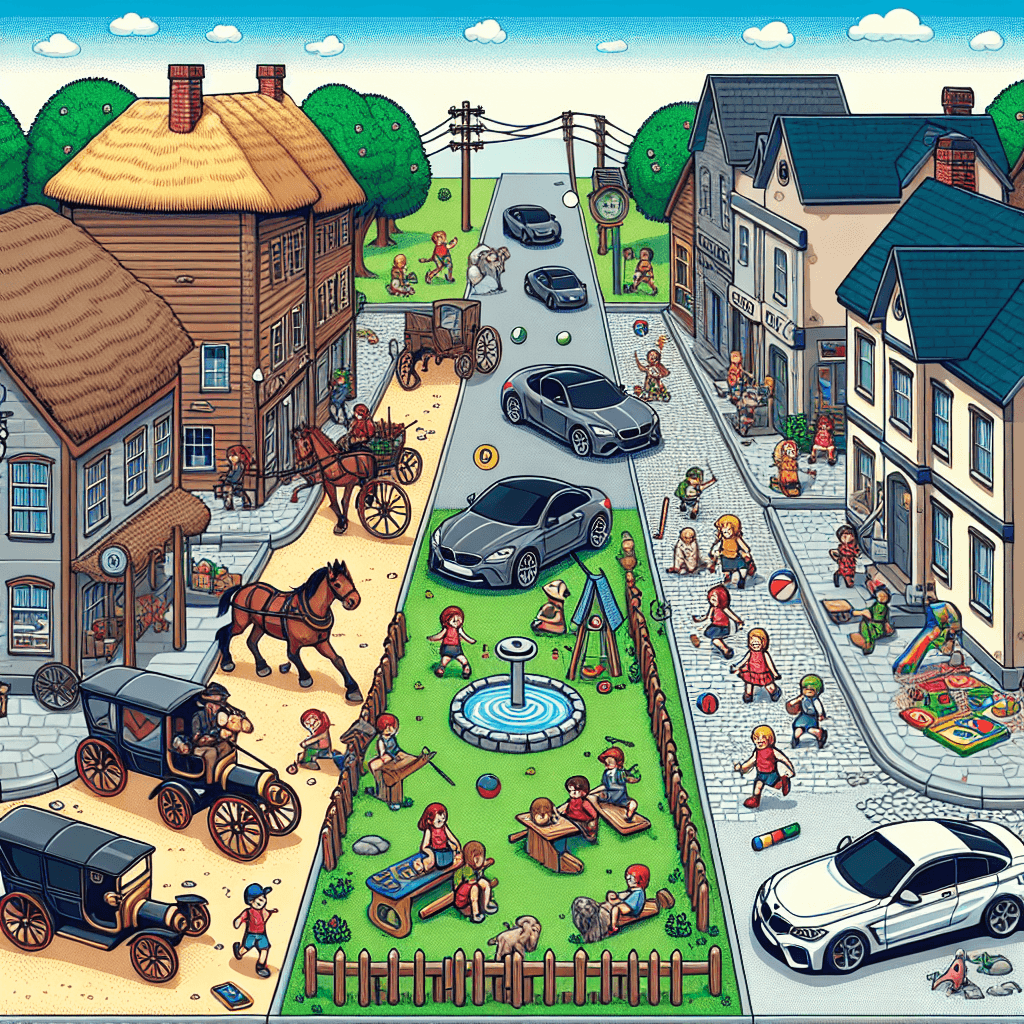
Community Then and Now: A First Grade Exploration
Inquiry Framework
Question Framework
Driving Question
The overarching question that guides the entire project.How has our community changed over time, and what can we learn from these changes about our community's identity?Essential Questions
Supporting questions that break down major concepts.- How is our community the same as it was long ago?
- How is our community different from the community long ago?
- What can we learn about our community by studying the past?
Standards & Learning Goals
Learning Goals
By the end of this project, students will be able to:- Students will be able to compare and contrast the past and present of their community.
- Students will be able to identify changes and continuities in their community over time.
- Students will be able to use primary and secondary sources to learn about the history of their community.
Entry Events
Events that will be used to introduce the project to studentsMystery Guest Interview
Invite a long-time resident to class for a live interview. The guest shares stories and photos from their childhood, highlighting differences between then and now. Students prepare questions beforehand, fostering active listening and historical inquiry.Photo Comparison Challenge
Present pairs of photographs - one from the community's past and one from the present day (same location). Challenge students to identify the differences and similarities, prompting discussions about urban development, technology, and social changes.Portfolio Activities
Portfolio Activities
These activities progressively build towards your learning goals, with each submission contributing to the student's final portfolio.Community Interview Project
Students interview long-time residents of the community to gather firsthand accounts of its history and changes.Steps
Here is some basic scaffolding to help students complete the activity.Final Product
What students will submit as the final product of the activityA written report or presentation summarizing the findings from the community interviews, including key insights and quotes.Alignment
How this activity aligns with the learning objectives & standardsAddresses the learning goal of using primary sources to learn about the history of their community. It aligns with the standard by helping students develop historical perspective through firsthand accounts and understand issues of continuity and change.Then and Now Photo Album
Students compile a photo album comparing historical photos of the community with current photos of the same locations.Steps
Here is some basic scaffolding to help students complete the activity.Final Product
What students will submit as the final product of the activityA photo album that visually compares the past and present of the community, highlighting changes and continuities.Alignment
How this activity aligns with the learning objectives & standardsAddresses the learning goal of comparing and contrasting the past and present of their community and identifying changes and continuities over time. It aligns with the standard by using primary and secondary sources (photos) to develop historical perspective and understand continuity and change.Community Timeline Creation
Students create a visual timeline showing significant changes in their community over time.Steps
Here is some basic scaffolding to help students complete the activity.Final Product
What students will submit as the final product of the activityA visually appealing timeline that showcases the community's history and significant changes.Alignment
How this activity aligns with the learning objectives & standardsAddresses the learning goal of identifying changes and continuities in their community over time and using primary and secondary sources to learn about the history of their community. It aligns with the standard by helping students develop historical perspective and understand issues of continuity and change in the community.Rubric & Reflection
Portfolio Rubric
Grading criteria for assessing the overall project portfolioCommunity History Portfolio Rubric
Historical Inquiry
Demonstrates the ability to investigate the community's history using primary and secondary sources, formulating insightful questions, and gathering relevant information.Source Utilization
Effectively uses a variety of primary and secondary sources to gather information about the community's past and present.
Exemplary
4 PointsConsistently and effectively uses a wide range of primary and secondary sources to gather detailed and relevant information. Sources are critically evaluated for bias and reliability.
Proficient
3 PointsUses a variety of primary and secondary sources to gather relevant information about the community's past and present. Sources are generally reliable.
Developing
2 PointsUses some primary and secondary sources, but the information gathered is limited or not always relevant. Some sources may not be reliable.
Beginning
1 PointsStruggles to use primary and secondary sources to gather information. Relies heavily on one type of source or provides very little information.
Question Formulation
Formulates thoughtful and relevant questions to guide historical inquiry.
Exemplary
4 PointsFormulates insightful and probing questions that demonstrate a deep curiosity and guide the inquiry effectively. Questions explore complex aspects of community history.
Proficient
3 PointsFormulates thoughtful and relevant questions that guide the inquiry process. Questions are focused and contribute to understanding community history.
Developing
2 PointsFormulates basic questions, but some may be irrelevant or lack depth. Questions provide limited guidance for the inquiry.
Beginning
1 PointsStruggles to formulate relevant questions or asks questions that are too broad and do not focus on community history.
Analysis and Interpretation
Demonstrates the ability to analyze historical data, identify patterns of change and continuity, and draw meaningful conclusions about the community's history.Identification of Changes and Continuities
Accurately identifies and describes significant changes and continuities in the community over time.
Exemplary
4 PointsIdentifies and describes changes and continuities with nuanced understanding, explaining the underlying causes and long-term effects. Demonstrates a sophisticated grasp of historical context.
Proficient
3 PointsAccurately identifies and describes several significant changes and continuities in the community, providing clear examples.
Developing
2 PointsIdentifies some changes and continuities, but the descriptions are vague or incomplete. Struggles to provide specific examples.
Beginning
1 PointsStruggles to identify changes and continuities in the community or provides inaccurate information.
Drawing Conclusions
Draws logical and well-supported conclusions about the community's history based on the evidence gathered.
Exemplary
4 PointsDraws insightful and original conclusions that are strongly supported by evidence. Conclusions demonstrate a deep understanding of the community's history and its significance.
Proficient
3 PointsDraws logical conclusions that are supported by the evidence gathered. Conclusions are clearly stated and relevant to the research questions.
Developing
2 PointsDraws some conclusions, but they are not always well-supported by the evidence or are somewhat vague.
Beginning
1 PointsStruggles to draw conclusions or provides conclusions that are not supported by the evidence.
Presentation and Communication
Effectively presents the findings of the historical investigation in a clear, organized, and engaging manner.Organization and Clarity
Presents information in a logical and well-organized manner, making it easy to understand.
Exemplary
4 PointsPresents information in a highly organized and engaging manner. The presentation is exceptionally clear, concise, and easy to follow.
Proficient
3 PointsPresents information in a logical and organized manner. The presentation is clear and easy to understand.
Developing
2 PointsPresents information in a somewhat disorganized manner, making it difficult to follow at times. Clarity could be improved.
Beginning
1 PointsPresents information in a disorganized and confusing manner. The presentation is difficult to understand.
Visual Appeal
The final product (report, photo album, timeline) is visually appealing and enhances understanding of the community's history.
Exemplary
4 PointsThe final product is exceptionally visually appealing and effectively enhances the understanding of the community's history. Visual elements are creative and thoughtfully integrated.
Proficient
3 PointsThe final product is visually appealing and enhances the understanding of the community's history. Visual elements are appropriate and well-presented.
Developing
2 PointsThe final product has some visual appeal, but the visual elements could be improved to better enhance understanding.
Beginning
1 PointsThe final product lacks visual appeal and does not enhance understanding of the community's history.