
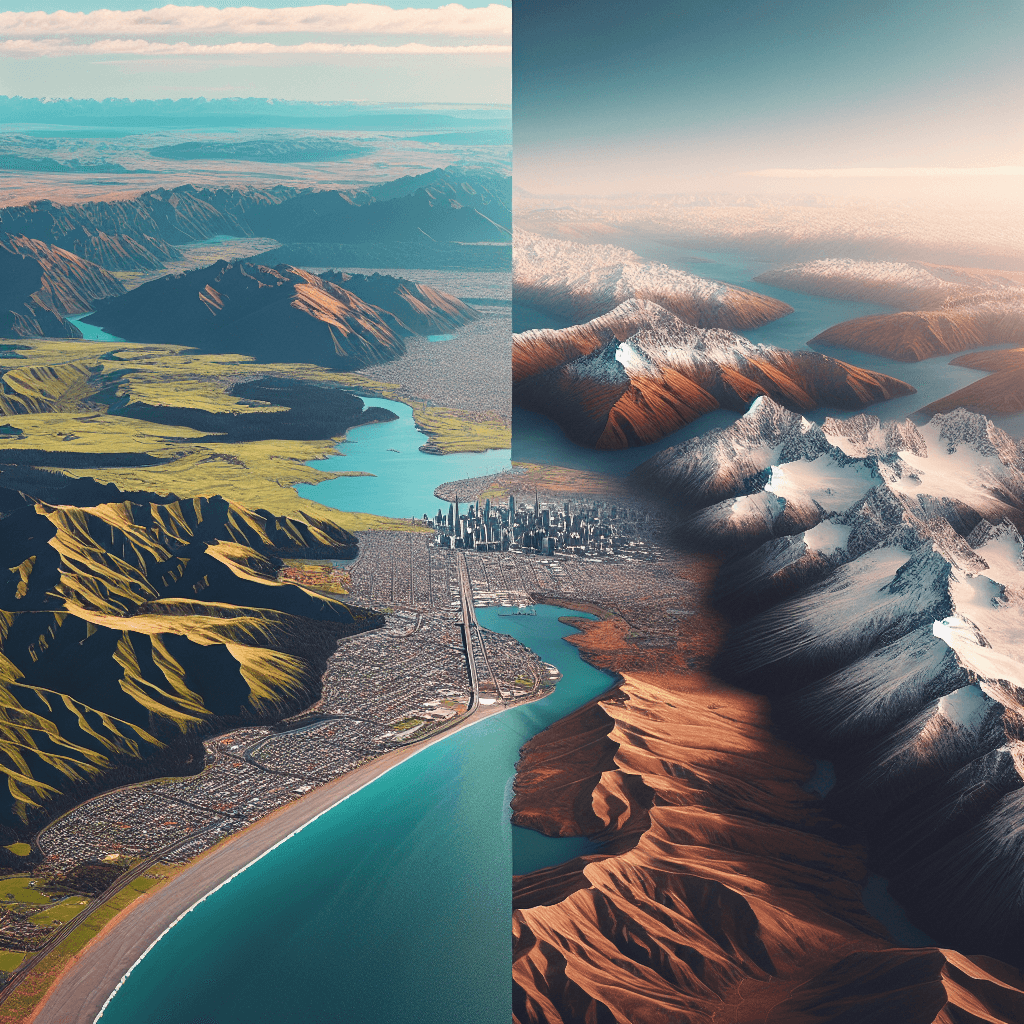
Comparative Land Study: New Zealand vs. Another Country
Inquiry Framework
Question Framework
Driving Question
The overarching question that guides the entire project.How can we as students create a hands-on activity that explores and compares 'te whenua' (the land) and its representation and significance in New Zealand with that of another country, using insights from different subjects such as geography, art, history, and technology?Essential Questions
Supporting questions that break down major concepts.- How do we define and understand the concept of 'te whenua' or 'the land' in different cultures?
- In what ways do geographical features of New Zealand differ from or resemble those of another country?
- How can we use mathematical concepts to compare the size, population, and other statistics of New Zealand with another country?
- What role does technology play in understanding and representing the differences and similarities between New Zealand and another country?
- How do art and cultural expressions reflect the relationship people have with their land in New Zealand and another country?
- How do the historical events in New Zealand compare and contrast with those in another country and their impact on the land and society?
- What scientific phenomena can we explore to understand how environment and land shape the way of life in New Zealand and another country?
- How does language, particularly English, help us in discussing and sharing our findings about 'the land' – te whenua, of New Zealand and another country?
Standards & Learning Goals
Learning Goals
By the end of this project, students will be able to:- Students will compare and contrast geographical features of New Zealand and another country, focusing on 'te whenua' or 'the land.'
- Students will explore and articulate the different cultural perspectives and historical contexts of land significance in New Zealand and a selected country.
- Students will use mathematical skills to analyse and present statistical comparisons between New Zealand and another country.
- Students will express their understanding through artistic creations that reflect the significance of land in both cultures.
- Students will improve their English language skills by discussing and presenting their findings about 'te whenua.'
- Students will investigate scientific phenomena related to the environment that influence lifestyle in New Zealand and another country.
New Zealand curriculum phase 1
Entry Events
Events that will be used to introduce the project to studentsInteractive Cultural Fair
The class is transformed into a 'Cultural Fair' with two sections representing New Zealand and another chosen country. Students walk through these sections, exploring displays of cultural artifacts, traditional clothing, music, and food samples, sparking curiosity about the similarities and differences tied to the land and culture of each country.Portfolio Activities
Portfolio Activities
These activities progressively build towards your learning goals, with each submission contributing to the student's final portfolio.Cultural Comparison Zine Creation
Students design and create a zine - a small, self-published booklet - that compares cultural aspects of New Zealand and another country, focusing on the concept of 'te whenua' or 'the land'.Steps
Here is some basic scaffolding to help students complete the activity.Final Product
What students will submit as the final product of the activityA completed cultural comparison zine compiling all students’ contributions: articles, illustrations, and designs.Alignment
How this activity aligns with the learning objectives & standardsAligns with NZC-SS-1 (understanding of land influence) and NZC-ENG-1 (understanding across texts), supporting the inquiry about cultural expressions.Mapping Wonders: A Geographic Arts Project
Students create artistic maps depicting the geographical features of New Zealand and the selected country, incorporating artistic expression to highlight key differences and similarities.Steps
Here is some basic scaffolding to help students complete the activity.Final Product
What students will submit as the final product of the activityA set of artistic maps visually representing the geographical features of New Zealand and another country.Alignment
How this activity aligns with the learning objectives & standardsAligns with NZC-SS-1 (geographical influence), NZC-MTH-1 (using additive strategies), and NZC-ART-1 (artwork creation).Statistical Storytelling: By the Numbers
Using mathematical concepts, students analyze statistics about New Zealand and another country, focusing on aspects such as population, land size, and demographics, and create a story that connects these numbers to cultural and geographical contexts.Steps
Here is some basic scaffolding to help students complete the activity.Final Product
What students will submit as the final product of the activityA statistical storytelling report consisting of charts, graphs, and narratives linking numbers to cultural contexts.Alignment
How this activity aligns with the learning objectives & standardsAligns with NZC-MTH-1 (using mathematical strategies) and NZC-SS-2 (different perspectives) by contextualizing statistics in storytelling.Technological Showcase: Virtual Reality Exploration
Engage students in a technological project where they create a simple virtual reality representation of significant landmarks and landscapes in New Zealand and the chosen country.Steps
Here is some basic scaffolding to help students complete the activity.Final Product
What students will submit as the final product of the activityA virtual reality experience showcasing major geographical features and cultural landmarks of New Zealand and another country.Alignment
How this activity aligns with the learning objectives & standardsAligns with NZC-ENG-1 (communication through texts) and NZC-TECH-1 (technological outcome design), enhancing understanding through VR.Language and Land: An English Presentation
Students work on their presentation skills by presenting their findings about 'te whenua' in New Zealand and the chosen country, incorporating aspects from previous activities.Steps
Here is some basic scaffolding to help students complete the activity.Final Product
What students will submit as the final product of the activityA formal oral presentation summarizing key insights about 'te whenua' or 'the land' in cultural and geographical terms.Alignment
How this activity aligns with the learning objectives & standardsAligns with NZC-ENG-1 (communication and understanding) and standards promoting expressive and communication skills.Rubric & Reflection
Portfolio Rubric
Grading criteria for assessing the overall project portfolioCultural and Geographic Comparison Project Rubric
Understanding of 'Te Whenua'
Assesses student's comprehension of the concept of 'the land' in different cultural and geographical contexts.Cultural Context Understanding
Evaluate how well students articulate the cultural significance of 'te whenua' in both New Zealand and the chosen country.
Exemplary
4 PointsDemonstrates sophisticated understanding by detailing cultural significance with numerous examples and insights.
Proficient
3 PointsDemonstrates thorough understanding with clear examples of cultural significance.
Developing
2 PointsShows emerging understanding with some examples lacking depth.
Beginning
1 PointsShows initial understanding with minimal examples or relevance.
Geographical Context Understanding
Assess student's ability to compare and contrast geographical features.
Exemplary
4 PointsProvides detailed comparisons with innovative representations and deep analysis.
Proficient
3 PointsProvides solid comparisons with effective use of data and representations.
Developing
2 PointsOffers basic comparisons with limited representation.
Beginning
1 PointsProvides minimal comparisons with unclear representation.
Creative Expression and Design
Evaluates the creativity, integration of artistic elements, and design principles in student outputs.Artistic Creativity
Rate the innovative use of artistic techniques and creativity in project outputs.
Exemplary
4 PointsDisplays exceptional creativity with unique artistic elements enhancing interpretation.
Proficient
3 PointsDisplays strong creativity with effective use of artistic techniques.
Developing
2 PointsShows some creativity with straightforward application of techniques.
Beginning
1 PointsMinimal creativity, lacking unique features or techniques.
Design and Presentation
Evaluate the overall design coherence and effectiveness of presenting information.
Exemplary
4 PointsOutstanding design with clear, dynamic presentations that engage audiences.
Proficient
3 PointsEffective design with clear and organized presentation.
Developing
2 PointsBasic design with presentation lacking in organization or appeal.
Beginning
1 PointsDisorganized design, with ineffective presentation delivery.
Collaboration and Communication
Assesses the ability for effective collaboration with peers and communication of ideas.Collaborative Effort
Evaluates teamwork and collaborative effort in project completion.
Exemplary
4 PointsLeads group efforts, encourages participation, and effectively manages tasks.
Proficient
3 PointsActively contributes to group work, supporting team goals.
Developing
2 PointsParticipates in group work with occasional support from peers.
Beginning
1 PointsLimited participation, relying heavily on peers for task completion.
Communication Skills
Assess the clarity and effectiveness of students' communication both in writing and orally.
Exemplary
4 PointsCommunicates ideas with clarity and finesse, engaging audience through compelling detail.
Proficient
3 PointsCommunicates ideas clearly with sound reasoning and articulation.
Developing
2 PointsCommunicates basic ideas with limited detail and engagement.
Beginning
1 PointsStruggles to communicate ideas clearly, with minimal engagement.
Analytical Skills
Evaluates the use of critical thinking and analysis in interpreting data and cultural findings.Data Analysis
Assess ability to interpret and analyze statistical and geographical data to draw conclusions.
Exemplary
4 PointsDemonstrates insightful analysis with nuanced understanding of data.
Proficient
3 PointsProvides solid analysis with logical interpretation of data.
Developing
2 PointsOffers basic analysis with some logical interpretations.
Beginning
1 PointsLimited analysis with minimal logical conclusions drawn.