
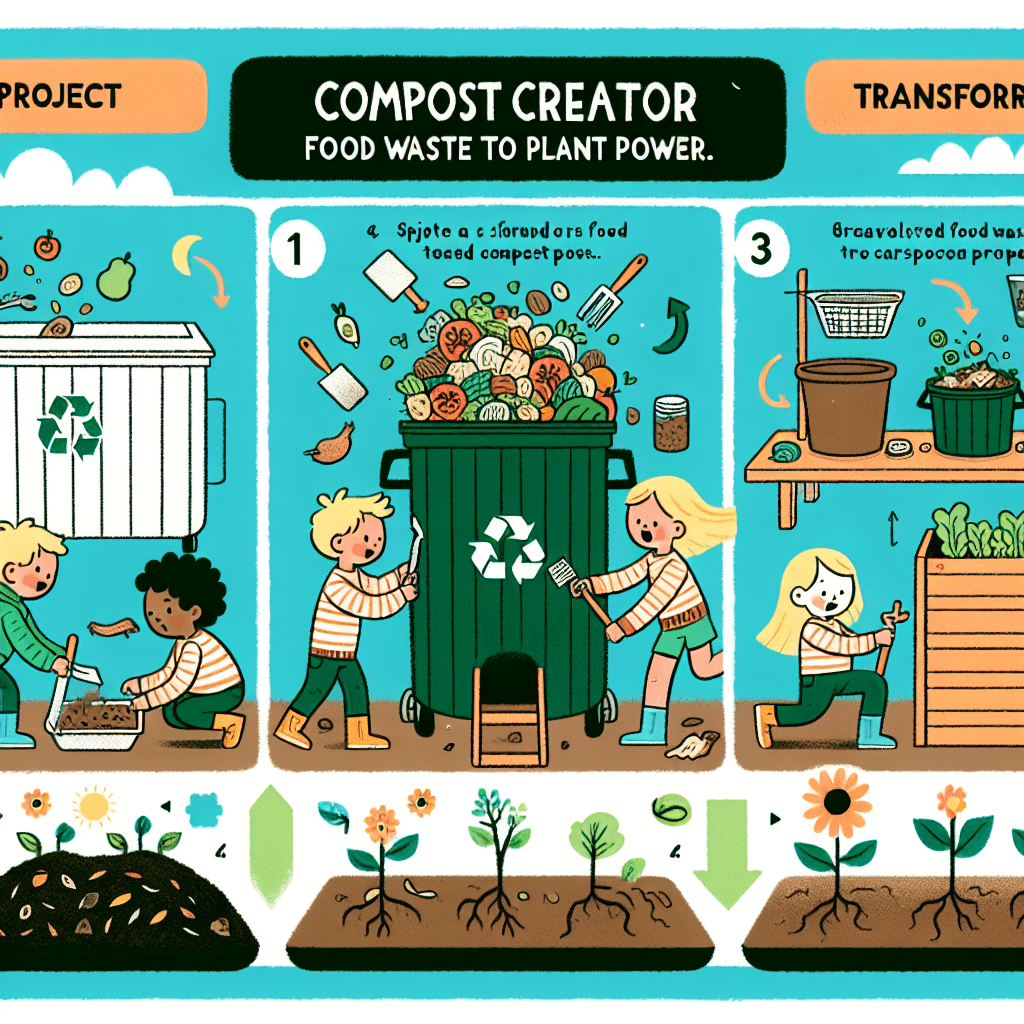
Compost Creators: Food Waste to Plant Power!
Inquiry Framework
Question Framework
Driving Question
The overarching question that guides the entire project.What can we do with our leftover food?Essential Questions
Supporting questions that break down major concepts.- What is food waste?
- Why should we not waste food?
- What can we do with food waste?
- What do plants need to grow?
- How does compost help plants?
Standards & Learning Goals
Learning Goals
By the end of this project, students will be able to:- Understand the concept of food waste and its impact on the environment.
- Learn the process of composting food waste, including the steps and materials needed.
- Understand the benefits of compost for plant growth.
- Develop skills in collecting and sorting food waste.
- Promote environmental awareness and responsibility.
Entry Events
Events that will be used to introduce the project to studentsWorm Café Mystery
A mysterious package arrives: a mini worm farm! Students investigate what worms eat, how they live, and their role in making soil, sparking curiosity about composting.Rotting Rainbow Reveal
Present a time-lapse video of colorful fruits and vegetables decomposing. Ask: What's happening? Where does it go? This visual spectacle introduces the concept of decomposition and its connection to composting.The Case of the Missing Lunch
A classroom 'detective' story unfolds: Where did the banana peel and apple core go from yesterday's lunch? Students track the journey of food waste, leading to the discovery of composting as a solution.Portfolio Activities
Portfolio Activities
These activities progressively build towards your learning goals, with each submission contributing to the student's final portfolio.Waste Watchers
Students begin by observing and documenting the food waste generated in their own homes or school environments. They will categorize the waste and reflect on its potential impact.Steps
Here is some basic scaffolding to help students complete the activity.Final Product
What students will submit as the final product of the activityA visual diary of collected food waste, categorized and annotated.Alignment
How this activity aligns with the learning objectives & standardsAddresses the learning goal: Understand the concept of food waste and its impact on the environment.Compost Creation Station
In this activity, students actively participate in creating a mini-compost bin. They layer different materials, and observe the decomposition process.Steps
Here is some basic scaffolding to help students complete the activity.Final Product
What students will submit as the final product of the activityA mini-compost bin, a drawing of the composting process and oral explanation.Alignment
How this activity aligns with the learning objectives & standardsAddresses the learning goal: Learn the process of composting food waste, including the steps and materials needed.Plant Power
Students use the compost they created to grow a small plant or seedling. They compare its growth to that of a plant grown without compost.Steps
Here is some basic scaffolding to help students complete the activity.Final Product
What students will submit as the final product of the activityTwo plants (one grown with compost, one without) and a comparative growth chart.Alignment
How this activity aligns with the learning objectives & standardsAddresses the learning goal: Understand the benefits of compost for plant growth.Waste-Free Heroes
Students design and implement a plan to reduce food waste in their classroom or home. They present their plan and its results to the class.Steps
Here is some basic scaffolding to help students complete the activity.Final Product
What students will submit as the final product of the activityA presentation on their waste-reduction plan and its impact.Alignment
How this activity aligns with the learning objectives & standardsAddresses the learning goals: Develop skills in collecting and sorting food waste and Promote environmental awareness and responsibility.Rubric & Reflection
Portfolio Rubric
Grading criteria for assessing the overall project portfolioKindergarten Composting Portfolio Rubric
Waste Watchers: Observation and Documentation
Assessment of the student's ability to observe, collect, categorize, and reflect on food waste.Observation and Collection
Ability to observe and collect various types of food waste.
Exemplary
4 PointsConsistently and accurately observes and collects a wide variety of food waste, demonstrating a keen eye for detail.
Proficient
3 PointsObserves and collects several types of food waste with accuracy.
Developing
2 PointsObserves and collects a limited variety of food waste with some inaccuracies.
Beginning
1 PointsStruggles to observe and collect food waste, showing limited awareness of different types.
Categorization
Ability to sort food waste into appropriate categories (e.g., fruits, vegetables, bread).
Exemplary
4 PointsAccurately categorizes all collected food waste and provides clear explanations for the categorization choices.
Proficient
3 PointsCategorizes most of the collected food waste accurately.
Developing
2 PointsCategorizes some food waste accurately, but with inconsistencies.
Beginning
1 PointsStruggles to categorize food waste and demonstrates limited understanding of different categories.
Reflection
Ability to draw or write about observations and reflect on the impact of food waste.
Exemplary
4 PointsProvides a detailed and insightful reflection on the impact of food waste, demonstrating a strong understanding of its environmental consequences.
Proficient
3 PointsReflects on the impact of food waste with some detail and understanding.
Developing
2 PointsProvides a basic reflection on food waste, but with limited detail or understanding.
Beginning
1 PointsStruggles to reflect on food waste or its impact, showing minimal awareness.
Compost Creation Station: Active Participation
Assessment of student engagement and understanding of the composting process through hands-on participation.Layering and Mixing
Ability to correctly layer green and brown materials in the compost bin and mix them appropriately.
Exemplary
4 PointsLayers green and brown materials perfectly, demonstrating an understanding of the correct proportions and mixing techniques. Provides clear rationale.
Proficient
3 PointsLayers green and brown materials correctly with minimal guidance.
Developing
2 PointsLayers green and brown materials with some errors, requiring some guidance.
Beginning
1 PointsStruggles to layer green and brown materials correctly, requiring significant guidance.
Observation and Documentation
Ability to observe the composting process and document it through drawings.
Exemplary
4 PointsCreates detailed and accurate drawings of the composting process, capturing key changes and stages over time. Includes labels and descriptions.
Proficient
3 PointsDraws the composting process with reasonable accuracy, showing the main stages.
Developing
2 PointsDraws the composting process with some inaccuracies or missing stages.
Beginning
1 PointsStruggles to draw the composting process, showing limited understanding of the changes taking place.
Oral Explanation
Ability to explain the composting process orally.
Exemplary
4 PointsProvides a clear, concise, and accurate oral explanation of the composting process, using appropriate vocabulary.
Proficient
3 PointsExplains the composting process orally with reasonable clarity and accuracy.
Developing
2 PointsExplains parts of the composting process orally, but with some confusion or omissions.
Beginning
1 PointsStruggles to explain the composting process orally, showing limited understanding.
Measurement
Ability to measure the height/volume of the compost using non-standard units.
Exemplary
4 PointsAccurately measures compost height/volume and keeps track of changes over time to show decomposition. Provides clear rationale for measurement choices.
Proficient
3 PointsMeasures the compost height/volume using non-standard units.
Developing
2 PointsAttempts to measure compost height/volume but struggles with accuracy.
Beginning
1 PointsUnable to measure compost height/volume even with assistance.
Plant Power: Comparative Analysis
Assessment of student's understanding of the benefits of compost for plant growth through observation and comparison.Planting and Care
Demonstrates appropriate care for both plants (with and without compost).
Exemplary
4 PointsConsistently waters and cares for both plants appropriately, ensuring their optimal growth and health.
Proficient
3 PointsWaters and cares for both plants regularly and appropriately.
Developing
2 PointsWaters and cares for both plants inconsistently, with occasional lapses.
Beginning
1 PointsRarely waters or cares for the plants, leading to neglect.
Observation and Recording
Ability to observe and record growth differences between the two plants.
Exemplary
4 PointsKeeps detailed and accurate records of growth differences, using drawings, measurements, and written descriptions to highlight the impact of compost.
Proficient
3 PointsObserves and records growth differences between the two plants with reasonable accuracy.
Developing
2 PointsObserves some growth differences, but records them inconsistently or inaccurately.
Beginning
1 PointsFails to observe or record any growth differences between the two plants.
Comparative Analysis
Ability to compare and contrast the plants with and without compost.
Exemplary
4 PointsClearly and accurately explains how the plant with compost grew better than the plant without. Uses evidence from their observations.
Proficient
3 PointsExplains that the plant with compost grew better, but does not provide reasoning.
Developing
2 PointsAttempts to describe the difference in plant growth, but the explanation is unclear.
Beginning
1 PointsUnable to describe the difference in plant growth.
Waste-Free Heroes: Action Plan
Assessment of student's ability to design and implement a waste-reduction plan and present its results.Plan Design
Quality and feasibility of the waste-reduction plan.
Exemplary
4 PointsDevelops a creative, feasible, and well-thought-out plan to reduce food waste, demonstrating a strong understanding of waste reduction strategies.
Proficient
3 PointsDesigns a reasonable plan to reduce food waste.
Developing
2 PointsDesigns a plan to reduce food waste, but it may be impractical or poorly defined.
Beginning
1 PointsStruggles to design a plan to reduce food waste, showing limited understanding of waste reduction strategies.
Implementation
Effectiveness of implementing the waste-reduction plan.
Exemplary
4 PointsImplements the waste-reduction plan effectively, consistently adhering to the strategies and demonstrating a commitment to reducing waste.
Proficient
3 PointsImplements the waste-reduction plan with reasonable effort.
Developing
2 PointsImplements the waste-reduction plan inconsistently, with some lapses in effort.
Beginning
1 PointsFails to implement the waste-reduction plan effectively.
Presentation
Clarity and effectiveness of the presentation on the plan and its results.
Exemplary
4 PointsPresents the plan and its results clearly, concisely, and engagingly, using visuals and demonstrating a thorough understanding of the project.
Proficient
3 PointsPresents the plan and its results clearly.
Developing
2 PointsPresents the plan and its results with some difficulty, lacking clarity or detail.
Beginning
1 PointsStruggles to present the plan and its results, showing limited understanding of the project.