
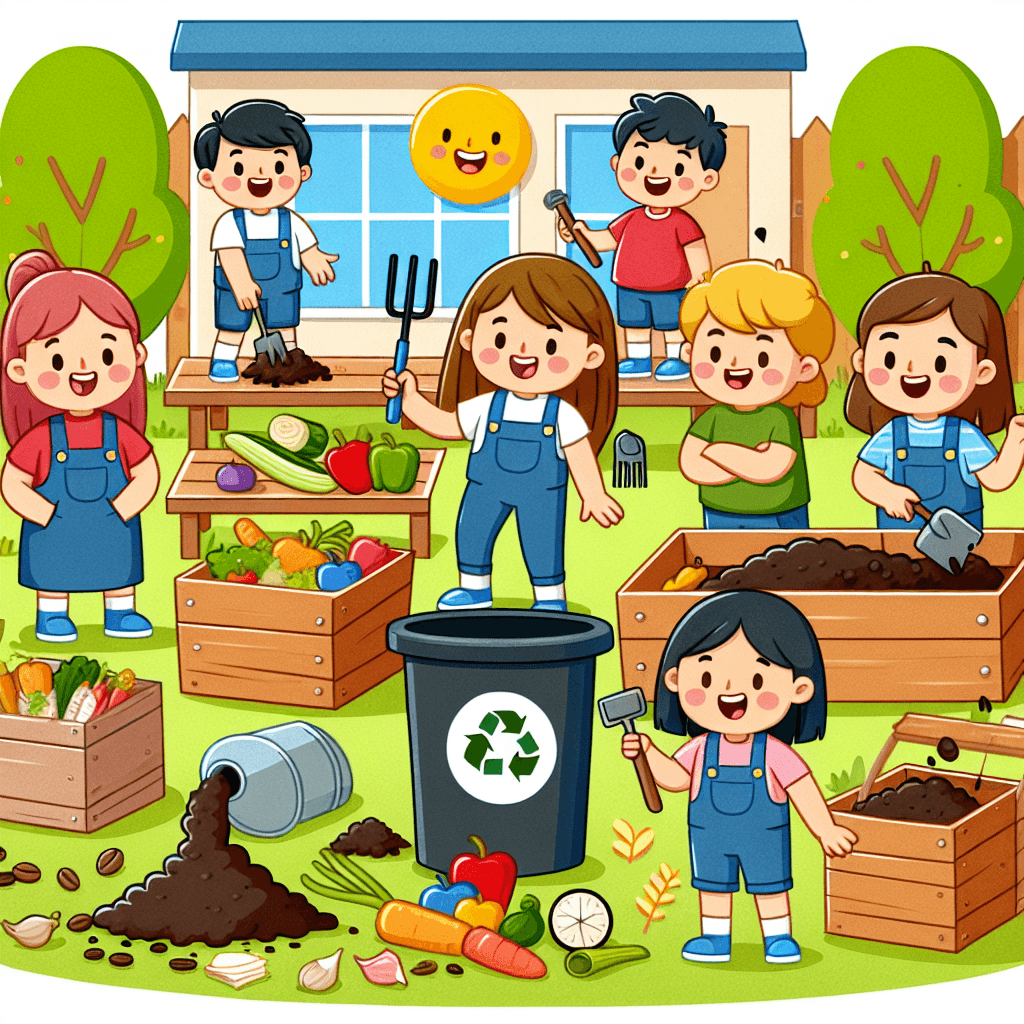
Composting Kitchen Waste: A Science Project
Inquiry Framework
Question Framework
Driving Question
The overarching question that guides the entire project.How can we, as environmental stewards, transform our kitchen food waste into a valuable resource that not only minimizes environmental impact but also enriches our understanding of decomposition, promotes sustainable practices, and cultivates healthier ecosystems?Essential Questions
Supporting questions that break down major concepts.- What are the environmental impacts of food waste?
- How does composting reduce waste and benefit the environment?
- What is the science behind decomposition and composting?
- What are the different methods of composting, and which is best for kitchen waste?
- How can we monitor and optimize the composting process?
- How does compost improve soil health and plant growth?
- How can we effectively communicate the benefits of composting to others?
Standards & Learning Goals
Learning Goals
By the end of this project, students will be able to:- Students will understand the environmental impacts of food waste.
- Students will learn the science behind decomposition and composting.
- Students will be able to monitor and optimize the composting process.
- Students will learn how compost improves soil health and plant growth.
Entry Events
Events that will be used to introduce the project to studentsThe Mystery of the Missing Food
Students arrive to find all the food in the cafeteria is 'missing,' replaced by alarming statistics about food waste. They must investigate where it went and propose a sustainable solution (composting) to prevent future disappearances.Portfolio Activities
Portfolio Activities
These activities progressively build towards your learning goals, with each submission contributing to the student's final portfolio.Waste Audit & Environmental Impact Assessment
Students conduct a thorough audit of their household's kitchen waste over a week to quantify the amount and types of food waste generated. They then research the environmental impacts of food waste in landfills, focusing on greenhouse gas emissions, land usage, and potential water contamination.Steps
Here is some basic scaffolding to help students complete the activity.Final Product
What students will submit as the final product of the activityA comprehensive waste audit report with data tables, charts, and a detailed analysis of the environmental impact of the student's household food waste.Alignment
How this activity aligns with the learning objectives & standardsAddresses the learning goal: 'Students will understand the environmental impacts of food waste.'Decomposition Science Deep Dive
Students delve into the science of decomposition by researching the roles of microorganisms (bacteria, fungi) in breaking down organic matter. They will investigate the chemical processes involved (e.g., oxidation, hydrolysis) and the factors that influence decomposition rates (e.g., temperature, moisture, oxygen levels).Steps
Here is some basic scaffolding to help students complete the activity.Final Product
What students will submit as the final product of the activityA detailed presentation explaining the science behind decomposition, including the roles of microorganisms, chemical processes, and influencing factors.Alignment
How this activity aligns with the learning objectives & standardsAddresses the learning goal: 'Students will learn the science behind decomposition and composting.'Composting Method Comparison & Selection
Students research different composting methods (e.g., backyard composting, vermicomposting, Bokashi composting) and evaluate their suitability for kitchen waste. They will consider factors such as space requirements, time commitment, odor control, and the types of waste that can be composted. Based on their research, they will select the most appropriate method for their needs and justify their choice.Steps
Here is some basic scaffolding to help students complete the activity.Final Product
What students will submit as the final product of the activityA comparative analysis of different composting methods and a written justification for selecting the most appropriate one.Alignment
How this activity aligns with the learning objectives & standardsAddresses the learning goal: 'Students will be able to monitor and optimize the composting process.'Compost Monitoring & Optimization Experiment
Students set up a small-scale composting system using their chosen method and conduct an experiment to monitor and optimize the composting process. They will track key parameters such as temperature, moisture levels, and pH, and adjust the compost mixture (e.g., adding water, turning the pile) to maintain optimal conditions. They will document their observations and analyze the data to draw conclusions about how to improve the composting process.Steps
Here is some basic scaffolding to help students complete the activity.Final Product
What students will submit as the final product of the activityA lab report documenting the compost monitoring and optimization experiment, including data tables, graphs, and an analysis of the results.Alignment
How this activity aligns with the learning objectives & standardsAddresses the learning goal: 'Students will be able to monitor and optimize the composting process.' and 'Students will learn how compost improves soil health and plant growth.'Rubric & Reflection
Portfolio Rubric
Grading criteria for assessing the overall project portfolioKitchen Compost Creation Portfolio Rubric
Waste Audit & Environmental Impact
Demonstrates understanding of food waste quantification and its environmental consequences.Data Collection & Accuracy
Accuracy and completeness of waste data collection and recording.
Exemplary
4 PointsMeticulously collects and accurately records detailed waste data with precise measurements and comprehensive categorization. Demonstrates excellent attention to detail.
Proficient
3 PointsCollects and accurately records waste data with appropriate measurements and categorization. Minor details may be missing.
Developing
2 PointsCollects and records some waste data, but with inaccuracies or incomplete categorization. Shows some effort but lacks consistency.
Beginning
1 PointsAttempts to collect waste data, but with significant inaccuracies and omissions. Fails to categorize waste effectively.
Environmental Impact Analysis
Depth and accuracy of environmental impact research and analysis.
Exemplary
4 PointsProvides a comprehensive and insightful analysis of the environmental impacts of food waste, including detailed explanations of methane emissions, landfill issues, and leachate production, supported by credible sources.
Proficient
3 PointsProvides a thorough analysis of the environmental impacts of food waste, including explanations of methane emissions, landfill issues, and leachate production, supported by sources.
Developing
2 PointsProvides a basic analysis of the environmental impacts of food waste, mentioning some of the key issues, but lacking depth and detail in explanations. Sources may be limited or less credible.
Beginning
1 PointsProvides a superficial or incomplete analysis of the environmental impacts of food waste. Fails to adequately explain key issues or provide supporting evidence.
Decomposition Science
Understanding of the scientific principles behind decomposition.Scientific Explanation
Clarity and accuracy of explaining the roles of microorganisms and chemical processes.
Exemplary
4 PointsProvides a clear, accurate, and comprehensive explanation of the roles of various microorganisms (bacteria, fungi, actinomycetes) and chemical processes (oxidation, hydrolysis) in decomposition, using precise scientific terminology and illustrative examples.
Proficient
3 PointsProvides a clear and accurate explanation of the roles of microorganisms and chemical processes in decomposition, using appropriate scientific terminology and examples.
Developing
2 PointsProvides a basic explanation of the roles of microorganisms and chemical processes in decomposition, but with some inaccuracies or omissions. May struggle with scientific terminology.
Beginning
1 PointsProvides a vague or inaccurate explanation of the roles of microorganisms and chemical processes in decomposition. Demonstrates limited understanding of the underlying science.
Factor Analysis
Understanding and explanation of factors affecting decomposition rates.
Exemplary
4 PointsDemonstrates a sophisticated understanding of the factors affecting decomposition rates (temperature, moisture, oxygen, C:N ratio) by providing detailed explanations of how each factor influences the process, including specific examples and quantitative relationships.
Proficient
3 PointsDemonstrates a thorough understanding of the factors affecting decomposition rates (temperature, moisture, oxygen, C:N ratio) by explaining how each factor influences the process.
Developing
2 PointsDemonstrates a basic understanding of some of the factors affecting decomposition rates, but may struggle to explain how each factor influences the process. May omit key factors or provide incomplete explanations.
Beginning
1 PointsDemonstrates a limited understanding of the factors affecting decomposition rates. Fails to adequately explain how these factors influence the decomposition process.
Composting Method Comparison
Evaluation and justification of chosen composting method.Method Evaluation
Thoroughness and accuracy of comparing different composting methods.
Exemplary
4 PointsProvides a comprehensive and insightful comparison of at least three composting methods, evaluating each method based on space requirements, time commitment, odor control, suitability for kitchen waste, and other relevant factors. Analysis is supported by research and demonstrates a deep understanding of the pros and cons of each method.
Proficient
3 PointsProvides a thorough comparison of at least three composting methods, evaluating each method based on space requirements, time commitment, odor control, and suitability for kitchen waste.
Developing
2 PointsProvides a basic comparison of different composting methods, but the evaluation is superficial or incomplete. May not consider all relevant factors or may include inaccuracies.
Beginning
1 PointsProvides a limited or inaccurate comparison of composting methods. Fails to adequately evaluate the pros and cons of each method.
Justification
Clarity and logic of justifying the selected composting method.
Exemplary
4 PointsProvides a compelling and well-reasoned justification for selecting a particular composting method, clearly explaining why it is the most suitable for their specific context, considering factors such as available space, time constraints, waste composition, and environmental concerns. Demonstrates a deep understanding of their own needs and constraints.
Proficient
3 PointsProvides a clear and logical justification for selecting a particular composting method, explaining why it is the most suitable for their specific context.
Developing
2 PointsProvides a basic justification for selecting a composting method, but the reasoning is weak or incomplete. May not adequately consider their specific context or constraints.
Beginning
1 PointsProvides a vague or illogical justification for selecting a composting method. Fails to adequately explain their reasoning or consider their specific context.
Compost Experiment & Optimization
Practical application of composting principles and data-driven optimization.Monitoring & Data Recording
Consistency and accuracy of monitoring and recording compost parameters.
Exemplary
4 PointsConsistently and accurately monitors and records temperature, moisture levels, and pH of the compost pile at regular intervals, using appropriate tools and techniques. Data is meticulously documented and organized in a clear and accessible format.
Proficient
3 PointsMonitors and records temperature, moisture levels, and pH of the compost pile regularly.
Developing
2 PointsMonitors and records some compost parameters, but with inconsistencies or inaccuracies. Data may be incomplete or poorly organized.
Beginning
1 PointsAttempts to monitor compost parameters, but with significant inconsistencies and inaccuracies. Data is largely incomplete or missing.
Optimization & Analysis
Effectiveness of adjusting compost conditions and analyzing data to improve the process.
Exemplary
4 PointsEffectively adjusts the compost mixture (adding water, turning the pile) based on data collected, demonstrating a proactive and data-driven approach to maintaining optimal conditions. Provides a thorough and insightful analysis of the data, drawing clear and well-supported conclusions about how to improve the composting process.
Proficient
3 PointsAdjusts the compost mixture based on data collected and analyzes data to draw conclusions about how to improve the composting process.
Developing
2 PointsMakes some adjustments to the compost mixture, but the rationale is unclear or inconsistent with the data. Analysis of the data is superficial or incomplete.
Beginning
1 PointsFails to adequately adjust the compost mixture or analyze the data. Demonstrates a limited understanding of how to optimize the composting process.