
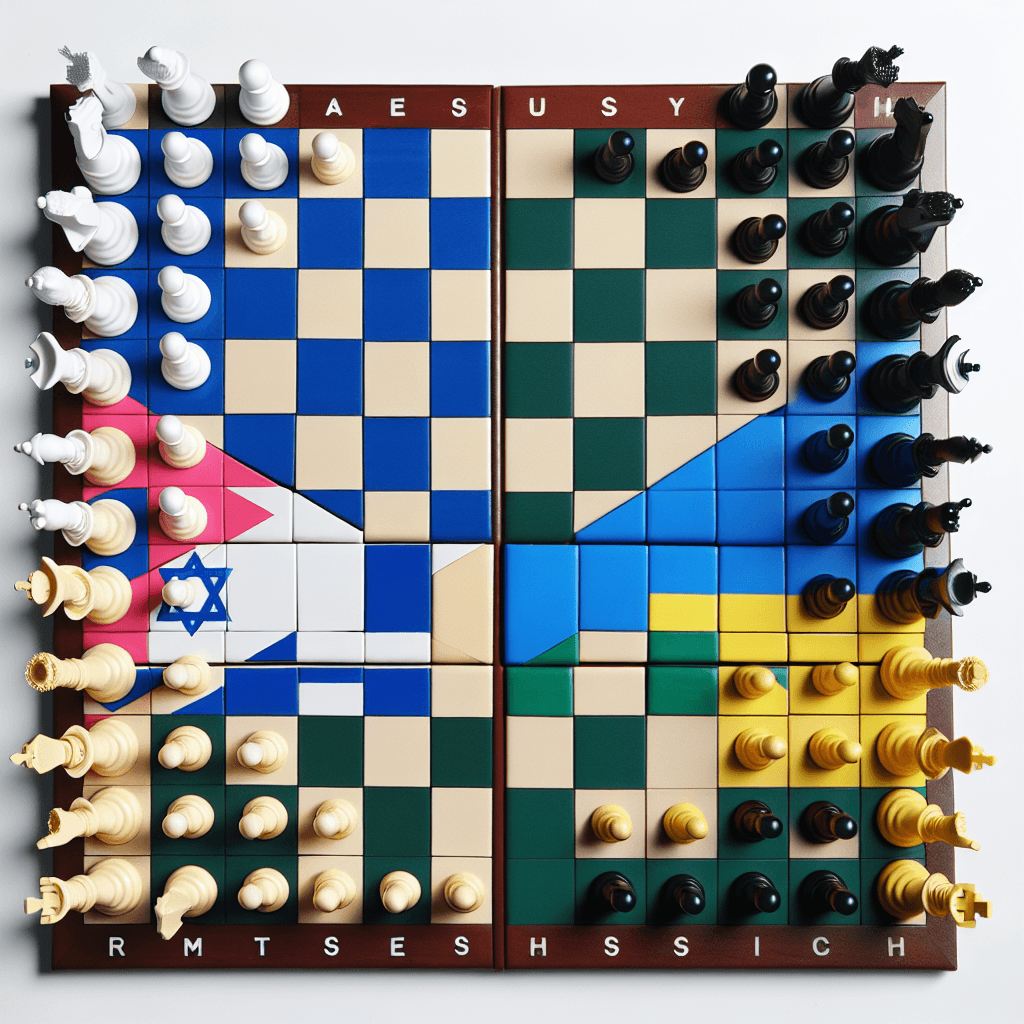
Conflict and Cooperation: Israel-Palestine and Russia-Ukraine
Inquiry Framework
Question Framework
Driving Question
The overarching question that guides the entire project.How do political, military, cultural, and economic forces fuel cooperation and conflict in the ongoing Israel-Palestine or Russia-Ukraine situation, and what impact do these forces have on the people involved?Essential Questions
Supporting questions that break down major concepts.- What are the main reasons for the conflict between Israel and Palestine/Russia and Ukraine?
- What political groups are involved in the Israel-Palestine/Russia-Ukraine conflict?
- What are the cultural differences between Israelis and Palestinians/Russians and Ukrainians?
- How do economic factors play a role in the Israel-Palestine/Russia-Ukraine conflict?
- What is the role of military actions in the Israel-Palestine/Russia-Ukraine conflict?
Standards & Learning Goals
Learning Goals
By the end of this project, students will be able to:- Analyze the political, military, cultural, and economic factors driving the Israeli-Palestinian conflict.
- Analyze the political, military, cultural, and economic factors driving the Russian-Ukrainian conflict.
- Compare and contrast the factors driving the Israeli-Palestinian and Russian-Ukrainian conflicts.
- Evaluate the impact of these conflicts on the affected populations.
- Develop well-supported arguments about the roles of cooperation and conflict in the conflicts.
Entry Events
Events that will be used to introduce the project to students"Global Conflict Simulation"
Students participate in a simplified simulation representing international relations, trade, and conflict. They represent different nations, negotiate resources, and respond to simulated events, creating immediate engagement with cooperation and conflict dynamics.Portfolio Activities
Portfolio Activities
These activities progressively build towards your learning goals, with each submission contributing to the student's final portfolio.Conflict Cause Analysis: Political Forces
Students will investigate the political factors that contribute to the Israeli-Palestinian or Russian-Ukrainian conflict. This involves researching the political systems, key political figures, government policies, and international relations involved in the conflict.Steps
Here is some basic scaffolding to help students complete the activity.Final Product
What students will submit as the final product of the activityA written report outlining the key political forces at play in the chosen conflict, including key actors, issues, and international involvement.Alignment
How this activity aligns with the learning objectives & standardsAddresses the learning goals of analyzing political factors driving the conflicts and developing well-supported arguments about the roles of cooperation and conflict.Military Engagements Timeline
Students will create a detailed timeline of the major military events in their chosen conflict (Israel-Palestine or Russia-Ukraine). This activity focuses on understanding the escalation and de-escalation of conflict through military actions.Steps
Here is some basic scaffolding to help students complete the activity.Final Product
What students will submit as the final product of the activityA visual timeline of military events with descriptions, highlighting key turning points and patterns of conflict.Alignment
How this activity aligns with the learning objectives & standardsAddresses the learning goals of analyzing military factors driving the conflicts and evaluating the impact of these conflicts on the affected populations.Cultural Identity Clash Essay
Students will explore the cultural and social factors that contribute to the conflict. This involves researching the cultural identities, historical narratives, and social grievances of the involved groups.Steps
Here is some basic scaffolding to help students complete the activity.Final Product
What students will submit as the final product of the activityAn essay analyzing the cultural dimensions of the conflict, including the role of identity, narratives, and social grievances.Alignment
How this activity aligns with the learning objectives & standardsAddresses the learning goals of analyzing cultural factors driving the conflicts and evaluating the impact of these conflicts on the affected populations.Economic Resources and Conflict Map
Students will investigate the economic factors that contribute to the conflict, such as control over natural resources, trade routes, and economic inequality.Steps
Here is some basic scaffolding to help students complete the activity.Final Product
What students will submit as the final product of the activityA map and accompanying report detailing the economic factors driving the conflict, including resource disputes and economic inequalities.Alignment
How this activity aligns with the learning objectives & standardsAddresses the learning goals of analyzing economic factors driving the conflicts and developing well-supported arguments about the roles of cooperation and conflict.Comparative Conflict Analysis
Students will compare and contrast the factors driving the Israeli-Palestinian and Russian-Ukrainian conflicts, drawing on their research from the previous activities.Steps
Here is some basic scaffolding to help students complete the activity.Final Product
What students will submit as the final product of the activityA comparative analysis essay that synthesizes their understanding of both conflicts and identifies common patterns and unique aspects.Alignment
How this activity aligns with the learning objectives & standardsAddresses the learning goals of comparing and contrasting the factors driving the Israeli-Palestinian and Russian-Ukrainian conflicts and developing well-supported arguments about the roles of cooperation and conflict.Rubric & Reflection
Portfolio Rubric
Grading criteria for assessing the overall project portfolioConflict Cause Analysis: Political Forces Rubric
Research and Identification of Political Factors
This category assesses the depth and accuracy of the student's research on political parties, leaders, issues, and international involvement.Identification of Key Political Actors
Accuracy and completeness in identifying and describing the major political parties, leaders, and organizations involved in the conflict.
Exemplary
4 PointsIdentifies and comprehensively describes all major political actors with nuanced understanding of their roles and motivations.
Proficient
3 PointsIdentifies and accurately describes most of the major political actors and their roles in the conflict.
Developing
2 PointsIdentifies some of the major political actors but provides limited description of their roles.
Beginning
1 PointsStruggles to identify the major political actors and provides minimal information about their roles.
Analysis of Key Political Issues and Disputes
Depth of analysis regarding the underlying political issues and disputes that fuel the conflict.
Exemplary
4 PointsProvides an in-depth analysis of the key political issues and disputes, demonstrating a sophisticated understanding of their complexities and interrelationships.
Proficient
3 PointsClearly identifies and explains the key political issues and disputes that fuel the conflict.
Developing
2 PointsIdentifies some of the political issues and disputes but provides a superficial explanation of their significance.
Beginning
1 PointsStruggles to identify the political issues and disputes and provides minimal explanation.
Examination of International Involvement
Extent to which the student examines the role of international organizations and other countries in the conflict.
Exemplary
4 PointsThoroughly examines the roles of international organizations and other countries, providing insightful analysis of their influence and impact.
Proficient
3 PointsExplains the roles of international organizations and other countries involved in the conflict.
Developing
2 PointsMentions the involvement of international organizations or other countries, but provides limited detail or analysis.
Beginning
1 PointsFails to adequately address the role of international organizations or other countries in the conflict.
Clarity and Organization of Written Report
This category assesses the clarity, organization, and overall quality of the written report.Structure and Organization
Logical flow of information and overall organization of the report.
Exemplary
4 PointsReport is exceptionally well-organized with a clear, logical flow of information that enhances understanding.
Proficient
3 PointsReport is well-organized and presents information in a logical manner.
Developing
2 PointsReport shows some organization, but the flow of information is occasionally unclear.
Beginning
1 PointsReport lacks clear organization and the flow of information is difficult to follow.
Clarity and Precision of Writing
Use of clear, concise, and precise language to effectively communicate ideas.
Exemplary
4 PointsWriting is exceptionally clear, concise, and precise, effectively conveying complex ideas with sophistication.
Proficient
3 PointsWriting is clear, concise, and uses appropriate language to communicate ideas effectively.
Developing
2 PointsWriting is understandable, but may lack clarity or precision in some areas.
Beginning
1 PointsWriting is unclear and difficult to understand, hindering the communication of ideas.
Use of Evidence and Sources
Appropriate use of evidence and credible sources to support claims and arguments.
Exemplary
4 PointsUses a wide range of credible sources effectively to support claims, demonstrating sophisticated source evaluation and integration.
Proficient
3 PointsUses credible sources to support claims and arguments effectively.
Developing
2 PointsUses some sources, but the evidence provided is limited or not always relevant.
Beginning
1 PointsFails to use credible sources or provide sufficient evidence to support claims.