
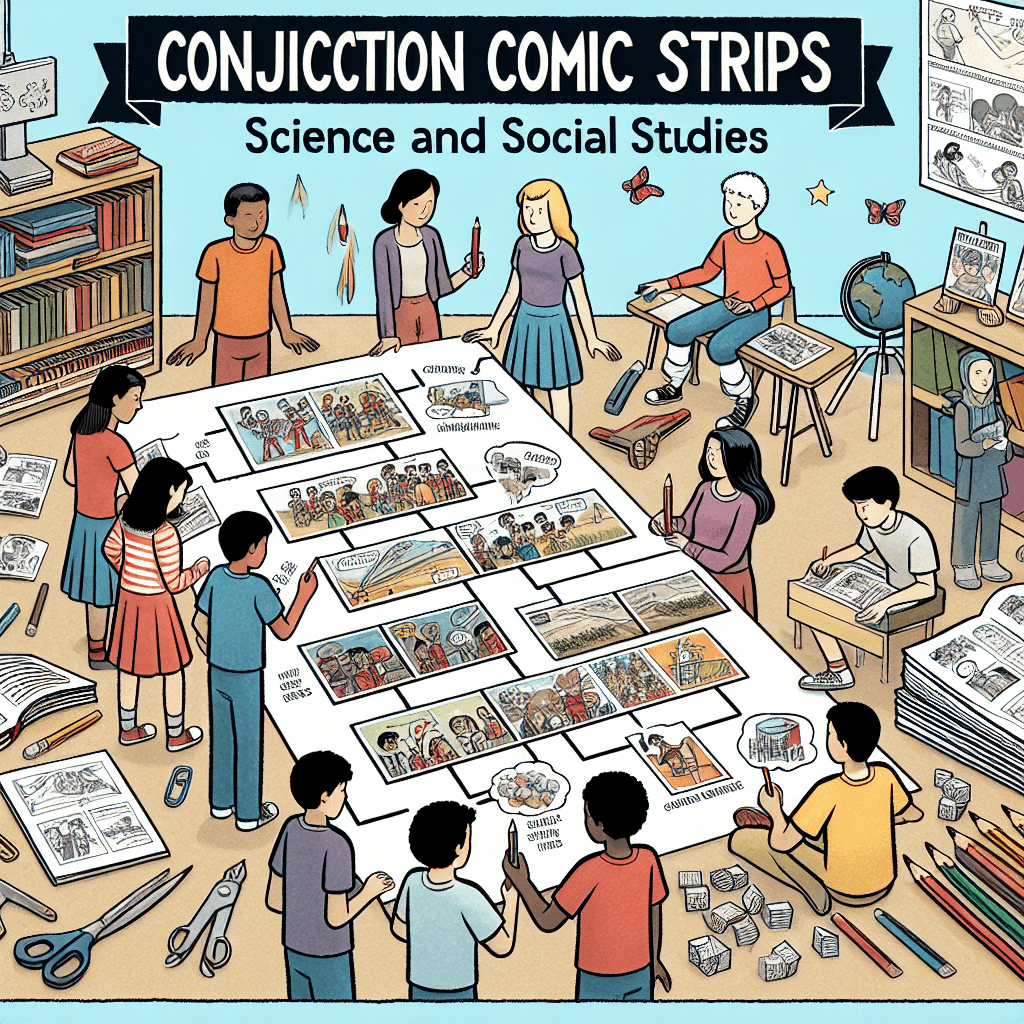
Conjunction Comic Strips: Science and Social Studies
Inquiry Framework
Question Framework
Driving Question
The overarching question that guides the entire project.How can we create engaging comic strips that use conjunctions to compare science concepts or explain cause and effect in historical events, making grammar fun and easy to understand?Essential Questions
Supporting questions that break down major concepts.- How do conjunctions combine ideas in sentences?
- How can conjunctions be used to compare and contrast different science concepts?
- How do conjunctions show cause and effect in historical events?
- How can comic strips effectively teach grammar concepts?
- How can art be combined with grammar to make learning fun?
Standards & Learning Goals
Learning Goals
By the end of this project, students will be able to:- Understand the role of conjunctions in combining ideas.
- Compare and contrast science concepts using conjunctions.
- Explain cause and effect relationships in historical events using conjunctions.
- Create engaging comic strips to teach grammar.
- Integrate art and grammar for a fun learning experience.
Entry Events
Events that will be used to introduce the project to students'Conjunction Junction' Challenge
Introduce a catchy 'Conjunction Junction' theme song (inspired by Schoolhouse Rock!). Challenge students to create their own verses connecting science or social studies facts, setting a creative and musical tone for the project.Portfolio Activities
Portfolio Activities
These activities progressively build towards your learning goals, with each submission contributing to the student's final portfolio.Conjunction Explorers
Students learn the basics of conjunctions and how they connect ideas. They will identify conjunctions in example sentences and practice using them in simple sentences related to science or social studies.Steps
Here is some basic scaffolding to help students complete the activity.Final Product
What students will submit as the final product of the activityA worksheet with identified conjunctions in example sentences and student-created sentences using conjunctions.Alignment
How this activity aligns with the learning objectives & standardsAddresses the learning goal: Understand the role of conjunctions in combining ideas.Science Showdown: Compare and Contrast with Conjunctions
Students use conjunctions to compare and contrast science concepts. They will choose two related science topics and write sentences that highlight their similarities and differences using conjunctions.Steps
Here is some basic scaffolding to help students complete the activity.Final Product
What students will submit as the final product of the activityA paragraph comparing and contrasting two science concepts, using conjunctions to connect ideas.Alignment
How this activity aligns with the learning objectives & standardsAddresses the learning goal: Compare and contrast science concepts using conjunctions.Historical Cause & Effect Comic
Students explore cause and effect relationships in historical events and use conjunctions to explain these relationships in a comic strip format.Steps
Here is some basic scaffolding to help students complete the activity.Final Product
What students will submit as the final product of the activityA comic strip illustrating a cause and effect relationship in a historical event, with sentences using conjunctions to explain the relationship.Alignment
How this activity aligns with the learning objectives & standardsAddresses the learning goal: Explain cause and effect relationships in historical events using conjunctions.Conjunction Comic Creator: Science and Social Studies Edition
Students design and create their own comic strips that teach how conjunctions are used in science and social studies contexts, combining their understanding of grammar with artistic expression. This activity encourages students to apply their knowledge of conjunctions in a creative and engaging way.Steps
Here is some basic scaffolding to help students complete the activity.Final Product
What students will submit as the final product of the activityA completed comic strip that effectively teaches the use of conjunctions in a science or social studies context.Alignment
How this activity aligns with the learning objectives & standardsAddresses the learning goals: Create engaging comic strips to teach grammar; Integrate art and grammar for a fun learning experience; Compare and contrast science concepts using conjunctions; Explain cause and effect relationships in historical events using conjunctions.Rubric & Reflection
Portfolio Rubric
Grading criteria for assessing the overall project portfolioConjunction Comic Strip Rubric: Science & Social Studies
Understanding and Application of Conjunctions
This category assesses the student's understanding of conjunctions and their correct application in sentences within the comic strip.Accuracy of Conjunction Usage
Evaluates the correct use of conjunctions to connect ideas, compare concepts, and explain cause-and-effect relationships.
Exemplary
4 PointsDemonstrates a sophisticated understanding of conjunctions and uses them accurately and effectively to connect complex ideas and relationships. Examples show nuanced understanding of grammar rules.
Proficient
3 PointsDemonstrates a thorough understanding of conjunctions and uses them correctly in most sentences to connect ideas and explain relationships effectively.
Developing
2 PointsShows an emerging understanding of conjunctions, but may misuse them or use them ineffectively in some sentences. Connections between ideas may be unclear.
Beginning
1 PointsShows a limited understanding of conjunctions and struggles to use them correctly in sentences. Connections between ideas are often missing or incorrect.
Variety of Conjunctions Used
Assesses the range of conjunctions used (e.g., and, but, or, so, because) to demonstrate comprehensive understanding.
Exemplary
4 PointsUses a wide variety of conjunctions accurately and purposefully to create complex and interesting sentences that enhance the comic strip's message. Demonstrates mastery.
Proficient
3 PointsUses a variety of conjunctions accurately to connect ideas and explain relationships effectively. Conjunction choices are appropriate for the context.
Developing
2 PointsUses a limited range of conjunctions, and some choices may be repetitive or not entirely appropriate for the context. Opportunities to expand vocabulary are missed.
Beginning
1 PointsUses only a few basic conjunctions, and struggles to vary sentence structure or create meaningful connections between ideas.
Integration of Science/Social Studies Content
This category evaluates how well the comic strip integrates relevant science or social studies content and uses conjunctions to explain concepts or events.Accuracy of Content
Assesses the accuracy of the science or social studies information presented in the comic strip.
Exemplary
4 PointsPresents accurate and detailed science or social studies content that enhances the comic strip's educational value. Demonstrates strong subject knowledge.
Proficient
3 PointsPresents accurate science or social studies content that is relevant to the comic strip's theme. Minor inaccuracies may be present but do not detract from overall understanding.
Developing
2 PointsPresents science or social studies content with some inaccuracies or oversimplifications. Content may be vague or lack sufficient detail.
Beginning
1 PointsPresents inaccurate or irrelevant science or social studies content. Significant misconceptions or omissions are evident.
Clarity of Explanation
Evaluates how effectively the comic strip uses conjunctions to explain science or social studies concepts or cause-and-effect relationships.
Exemplary
4 PointsUses conjunctions masterfully to create clear, concise, and insightful explanations of science or social studies concepts and relationships. Enhances understanding significantly.
Proficient
3 PointsUses conjunctions effectively to explain science or social studies concepts and relationships in a clear and understandable manner.
Developing
2 PointsUses conjunctions to explain science or social studies concepts, but explanations may be confusing, incomplete, or lack clarity. Connections may be weak.
Beginning
1 PointsFails to effectively use conjunctions to explain science or social studies concepts. Explanations are unclear, confusing, or missing.
Comic Strip Design and Creativity
This category assesses the overall design and creativity of the comic strip, including visual appeal, clarity, and engagement.Visual Appeal and Clarity
Evaluates the overall aesthetic quality of the comic strip, including the use of color, illustrations, and clear layout.
Exemplary
4 PointsThe comic strip is visually stunning and exceptionally clear, with engaging illustrations, a professional-looking layout, and thoughtful use of color. Enhances the message significantly.
Proficient
3 PointsThe comic strip is visually appealing and easy to understand, with clear illustrations and a well-organized layout.
Developing
2 PointsThe comic strip is somewhat visually appealing, but may lack clarity or organization. Illustrations may be rudimentary or difficult to understand.
Beginning
1 PointsThe comic strip is visually unappealing and difficult to understand, with poorly drawn illustrations and a disorganized layout.
Engagement and Storytelling
Assesses the ability of the comic strip to engage the audience and effectively tell a story that incorporates conjunctions and science/social studies content.
Exemplary
4 PointsThe comic strip is highly engaging and tells a compelling story that seamlessly integrates conjunctions and science/social studies content. Captures the audience's attention and promotes deep understanding.
Proficient
3 PointsThe comic strip is engaging and tells a clear story that effectively incorporates conjunctions and science/social studies content.
Developing
2 PointsThe comic strip is somewhat engaging, but the story may be confusing or lack clear connections between conjunctions and science/social studies content.
Beginning
1 PointsThe comic strip is unengaging and fails to tell a coherent story or effectively integrate conjunctions and science/social studies content.