
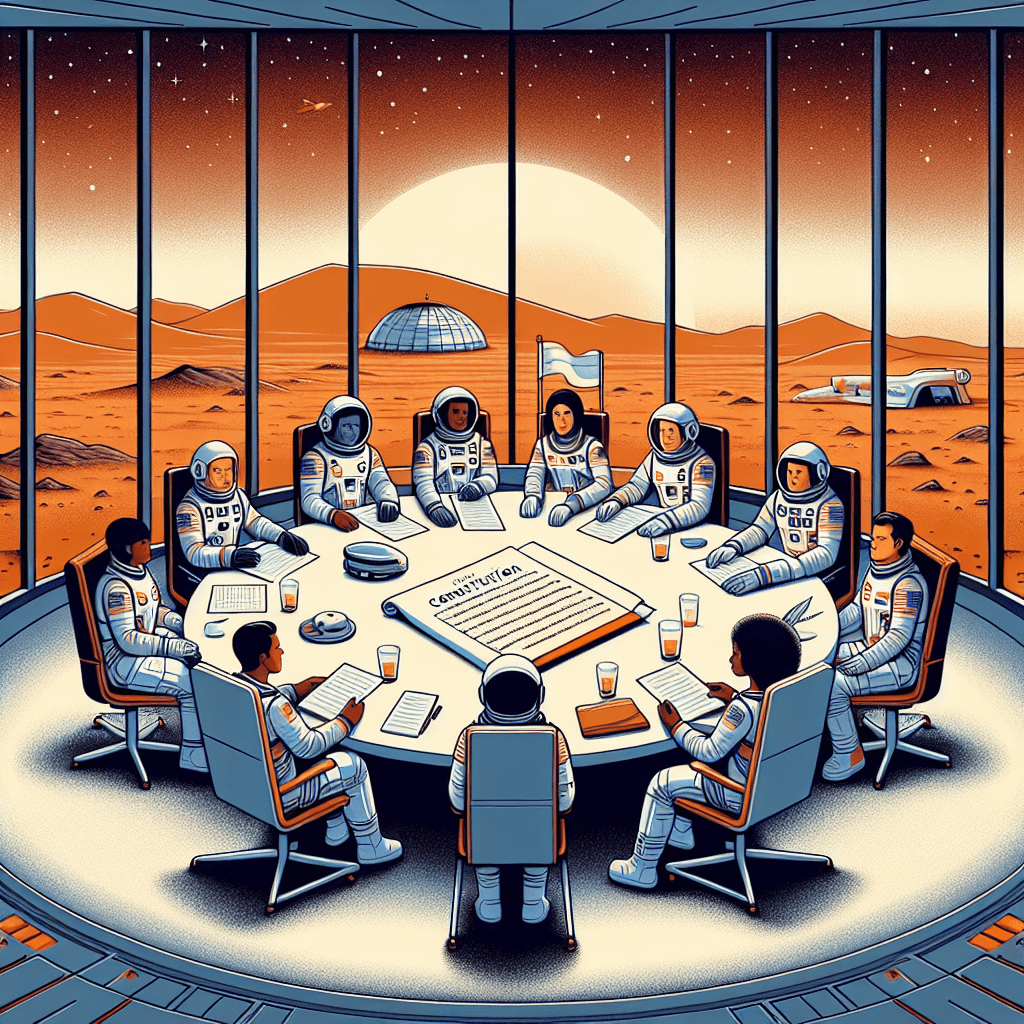
Constitution 2.0: Governing the First Colony on Mars
Inquiry Framework
Question Framework
Driving Question
The overarching question that guides the entire project.How can we, as founders of a new civilization, design a Martian governing charter that adapts U.S. constitutional principles to balance individual liberties with the collective survival of a frontier colony?Essential Questions
Supporting questions that break down major concepts.- What are the fundamental principles of American Constitutional Democracy, and which are essential for survival in a new society?
- How can a government balance the protection of individual liberties with the need for collective order in an extreme environment like Mars?
- In what ways do the rights, roles, and responsibilities of citizens change when living in a resource-scarce environment?
- How can we design a system of checks and balances that prevents the abuse of power while still allowing for efficient decision-making in a frontier colony?
- How does the U.S. Constitution serve as both a blueprint and a cautionary tale for creating a new governing document?
- How can a governing charter be designed to ensure justice and equality for all future Martian residents?
Standards & Learning Goals
Learning Goals
By the end of this project, students will be able to:- Evaluate the efficacy of foundational U.S. constitutional principles (e.g., separation of powers, individual rights) in the context of a resource-scarce, high-stakes Martian environment.
- Synthesize historical precedents and contemporary challenges to draft a comprehensive 'Martian Governing Charter' that defines the structure and limits of power.
- Analyze the inherent tension between collective survival (the common good) and individual liberties within a frontier setting, proposing specific legal mechanisms to balance both.
- Design a system of checks and balances that ensures government accountability and prevents the abuse of power while allowing for efficient crisis management.
- Develop and defend a reasoned argument for the inclusion of specific rights and responsibilities in the charter, using evidence from the U.S. Constitution and historical case studies.
Illinois Social Science Standards (Civics)
Illinois Social Science Standards (Inquiry)
Common Core State Standards (ELA-Literacy)
Entry Events
Events that will be used to introduce the project to studentsArtifact 1787: The Great Upgrade
The year is 2080, and Earth's institutions have collapsed; students are presented with a 'Scorched Earth' artifact—a partially destroyed U.S. Constitution. Their task is a 'Keep, Toss, or Upgrade' challenge, where they must identify which 18th-century principles still function for a high-tech survival colony and which ones are 'obsolete code' that needs a 2.0 rewrite.Portfolio Activities
Portfolio Activities
These activities progressively build towards your learning goals, with each submission contributing to the student's final portfolio.Artifact 1787: The Constitution Audit
Students act as 'Historical Analysts' for the new colony. They will deconstruct the U.S. Constitution to identify its core principles (e.g., popular sovereignty, limited government, federalism) and evaluate their applicability to a high-risk Martian environment. Using the 'Keep, Toss, or Upgrade' framework, they will justify which 18th-century ideas are essential for Mars and which require a 21st-century 'patch.'Steps
Here is some basic scaffolding to help students complete the activity.Final Product
What students will submit as the final product of the activityA 'Constitutional Upgrade Report' that lists five core principles with written justifications for why they are being kept, modified, or removed for the Martian colony.Alignment
How this activity aligns with the learning objectives & standardsAligns with SS.CV.7 (principles inherent to American Constitutional Democracy) and SS.CV.4 (explaining U.S. Constitution powers, responsibilities, and limits).Rubric & Reflection
Portfolio Rubric
Grading criteria for assessing the overall project portfolioConstitution 2.0: Martian Governing Charter Rubric
Foundational Principles & Logic
Evaluates the student's ability to deconstruct the U.S. Constitution and adapt its core principles to a new, extreme context.Constitutional Analysis & Adaptation (SS.CV.7, SS.CV.4)
Ability to analyze the seven basic principles of the U.S. Constitution and determine their relevance to a Martian environment through the 'Keep, Toss, or Upgrade' framework.
Exemplary
4 PointsDemonstrates a sophisticated understanding of constitutional principles by providing a nuanced 'patch' or 'upgrade' for each; justifications show deep insight into the tension between 18th-century ideals and 21st-century space survival.
Proficient
3 PointsDemonstrates a thorough understanding of constitutional principles; provides clear justifications for why principles are kept or modified for Mars, accurately reflecting the challenges of the new environment.
Developing
2 PointsShows emerging understanding of principles; justifications are present but may be inconsistent or lack a clear connection to the specific environmental challenges of Mars.
Beginning
1 PointsShows initial understanding; lists principles but provides minimal or superficial reasoning for their inclusion or modification in the Martian context.
Inquiry & Research Evidence
Focuses on the research process, the evaluation of historical and legal sources, and the application of evidence to the Martian scenario.Inquiry & Evidentiary Support (SS.IS.3, SS.IS.4)
Effectiveness in developing inquiry questions and using evidence from the U.S. Constitution, historical frontier societies, and space law to support the charter's provisions.
Exemplary
4 PointsFormulates complex, high-level inquiry questions and synthesizes multiple diverse sources (Outer Space Treaty, history, science) to create a compelling, evidence-backed argument for Martian law.
Proficient
3 PointsFormulates relevant inquiry questions and evaluates at least three sources effectively; uses evidence to provide clear support for the proposed 'Evidence Files.'
Developing
2 PointsDevelops basic inquiry questions and uses limited sources; evidence is present but may not clearly support the proposed Martian laws or responsibilities.
Beginning
1 PointsStruggles to develop inquiry questions or use evidence; sources are either missing, irrelevant, or not used to justify legal decisions.
Governance Structure & Blueprint
Assesses the student's ability to create a functional system of government with defined powers, responsibilities, and limits.Institutional Design & Fail-Safes (SS.CV.1, SS.CV.4)
The clarity and effectiveness of the designed governmental structure, including the distribution of power, emergency clauses, and fail-safe mechanisms.
Exemplary
4 PointsDesigns an innovative, highly functional system of checks and balances that specifically addresses Martian crises; the 'Blueprint' clearly illustrates a sophisticated flow of power and accountability.
Proficient
3 PointsDesigns a logical government structure with clear branches and defined powers; establishes effective checks and balances that prevent the abuse of power in the colony.
Developing
2 PointsShows a partial design of government structure; checks and balances are present but may be weak, or the distribution of power lacks clarity for certain roles.
Beginning
1 PointsStructure is incomplete or lacks clear limits on power; fails to define how the government would function during a crisis or emergency.
Civic Rights & Social Contract
Evaluates the creation of a Martian 'social contract' that defines the relationship between the individual and the state.Rights, Responsibilities, & The Common Good (SS.CV.1, SS.CV.3)
The ability to balance individual liberties with the collective needs of the colony, specifically through the drafting of 'Positive' and 'Negative' rights.
Exemplary
4 PointsDrafts a sophisticated Bill of Rights that expertly balances individual freedom with collective survival; the Preamble provides a powerful and reasoned defense of the 'Common Good.'
Proficient
3 PointsDrafts a clear set of rights and responsibilities; provides distinct articles that address both personal liberty and the obligations of citizens to the colony's survival.
Developing
2 PointsIdentifies rights and responsibilities, but the balance between individual liberty and collective need is inconsistent or poorly defined.
Beginning
1 PointsLists rights or responsibilities without a clear framework for justice or equality; provides insufficient evidence of how these promote the common good.
Communication & Defense
Focuses on the student's ability to communicate complex political conclusions and defend their work through reasoned argument.Argumentation & Ratification Defense (SS.IS.8, CCSS.W.9-10.1)
Effectiveness in presenting the final charter and defending its design against critiques, using written and oral argumentation.
Exemplary
4 PointsDelivers a compelling presentation and written defense; responds to hypothetical crises with high-level logic and evidence-based reasoning; shows leadership during the 'Ratification Council.'
Proficient
3 PointsDelivers a clear and organized presentation; provides a written argument that successfully uses evidence from the U.S. Constitution to justify Martian design choices.
Developing
2 PointsPresentation and written defense are present but lack depth; reasoning may be circular or fail to address how the charter solves specific problems like the 'Oxygen Standoff.'
Beginning
1 PointsPresentation or written defense is incomplete; struggles to communicate conclusions or justify why the proposed charter would maintain order and liberty.