
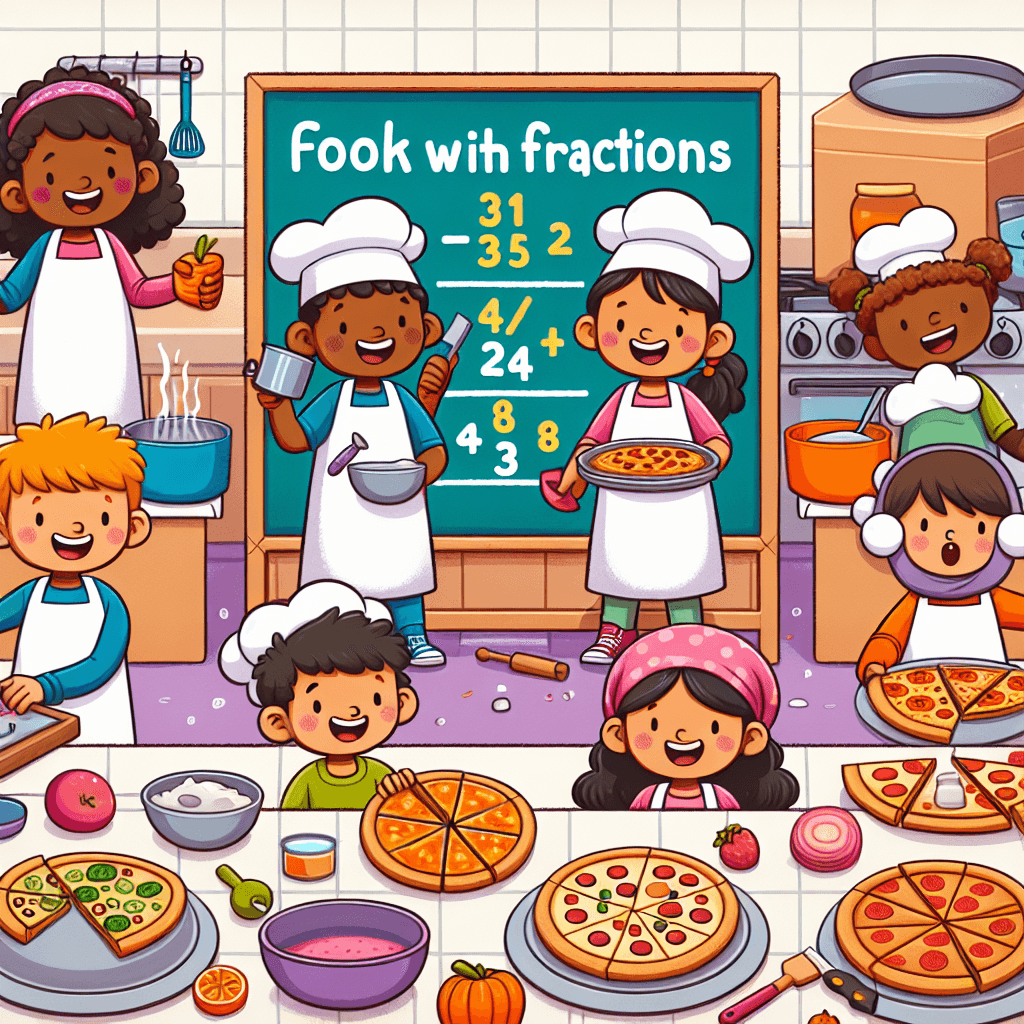
Cooking with Fractions: School Cookbook Project
Inquiry Framework
Question Framework
Driving Question
The overarching question that guides the entire project.How can we create recipes by dividing fractions, and what role do fractions play in cooking to ensure accurate and tasty school cookbook creations?Essential Questions
Supporting questions that break down major concepts.- What is a fraction and how is it used in cooking?
- How do the operations of division and multiplication relate to fractions?
- In what ways can we divide fractions to adjust a recipe's ingredients?
- How can changes in the quantity of ingredients affect the taste and outcome of a recipe?
- What strategies can be employed to accurately measure and divide ingredients when cooking?
Standards & Learning Goals
Learning Goals
By the end of this project, students will be able to:- Understand the concept of fractions and their application in real-world scenarios, specifically in cooking.
- Develop the ability to divide unit fractions by whole numbers and whole numbers by unit fractions.
- Gain skills in adjusting recipes to produce desired serving sizes by dividing fractions appropriately.
- Enhance problem-solving skills by tackling real-life situations involving fractions.
- Improve mathematical reasoning and calculation accuracy when working with fractions.
Common Core State Standards for Mathematics
Entry Events
Events that will be used to introduce the project to studentsFraction Picnic Planning
Organize a picnic event where students must plan the entire menu for different group sizes. They'll need to divide fractions to adjust the recipe quantities, making the activity relevant to planning real-life events and engaging their interest in event management.Fraction Feast Challenge
Invite a local chef to demonstrate how fractions play a crucial role in cooking. Students are then challenged to create their own unique dish by adjusting the recipe based on different serving sizes, showcasing their understanding of dividing fractions. This hands-on experience connects math to their everyday love of food and cooking shows.Portfolio Activities
Portfolio Activities
These activities progressively build towards your learning goals, with each submission contributing to the student's final portfolio.Fraction Recipe Designers
Students will select a simple recipe and analyze its ingredients to understand how fractions are used in cooking. They'll learn how to break down each ingredient into fractional parts to adjust for serving size changes.Steps
Here is some basic scaffolding to help students complete the activity.Final Product
What students will submit as the final product of the activityA breakdown of a chosen recipe into fractional parts ready for adjustment.Alignment
How this activity aligns with the learning objectives & standardsAligns with CCSS.Math.Content.5.NF.B.7 by applying fractional division to real-world contexts.Fraction Scale Chefs
Students will practice dividing fractions to adjust recipes, simulating the work of chefs who must cater to different group sizes. They'll solve problems involving the division of a unit fraction by a whole number and a whole number by a unit fraction.Steps
Here is some basic scaffolding to help students complete the activity.Final Product
What students will submit as the final product of the activityScaled recipe versions for different serving sizes.Alignment
How this activity aligns with the learning objectives & standardsSupports CCSS.Math.Content.5.NF.B.7a and 5.NF.B.7b by solving division problems with fractions.Taste Testing and Fraction Review
In this activity, students review and taste test the scaled recipes to understand how fraction adjustments impacted the taste and consistency of the dish.Steps
Here is some basic scaffolding to help students complete the activity.Final Product
What students will submit as the final product of the activityFeedback report on the taste and quality of scaled recipes, with insights into correct vs. incorrect fraction adjustments.Alignment
How this activity aligns with the learning objectives & standardsEnhances understanding of CCSS.Math.Content.5.NF.B.7 through real-world application and review of fraction division accuracy.Rubric & Reflection
Portfolio Rubric
Grading criteria for assessing the overall project portfolioFraction Division and Recipe Application Rubric
Fraction Understanding and Application
Assesses students' understanding of fractions and their application in dividing fractions for recipe adjustments.Conceptual Understanding of Fractions
Evaluates the student's comprehension of fractions and their role in adjusting recipes.
Exemplary
4 PointsShows profound understanding of fractions in recipes and innovatively adjusts ingredients for accurate servings.
Proficient
3 PointsDemonstrates thorough understanding of fractions and adjusts ingredients appropriately for recipe servings.
Developing
2 PointsShows basic understanding and some ability to adjust ingredients using fractions.
Beginning
1 PointsExhibits minimal understanding and struggles with adjusting ingredients using fractions.
Fraction Division Skills
Assesses the ability to divide fractions both in abstract problems and real-world recipe applications.
Exemplary
4 PointsSolves fraction division problems with exceptional accuracy and applies solutions to complex recipe scenarios.
Proficient
3 PointsAccurately solves fraction division problems and applies solutions to recipe adjustments consistently.
Developing
2 PointsSolves basic fraction division problems with some errors, inconsistently applying them to recipes.
Beginning
1 PointsStruggles with solving fraction division problems and applying them to recipes.
Product Quality and Execution
Evaluates the final recipe adjustments, product taste, and written reflection of learned concepts.Recipe Adjustment Accuracy
Assesses correctness and precision of recipe adjustments based on fractional division.
Exemplary
4 PointsExceptionally accurate ingredient adjustments resulting in excellent dish taste and consistency.
Proficient
3 PointsCorrect ingredient adjustments resulting in good taste and consistency.
Developing
2 PointsInconsistent or partially correct adjustments, affecting dish taste and consistency.
Beginning
1 PointsIncorrect ingredient adjustments resulting in poor dish taste and consistency.
Reflection and Understanding
Evaluates the depth of reflection on the taste test outcomes and understanding of fractions.
Exemplary
4 PointsProvides deep insights into adjustments and exhibits advanced understanding of fraction impact on recipes.
Proficient
3 PointsProvides clear reflection on recipe adjustments and understanding of fractions.
Developing
2 PointsOffers limited reflection or understanding of fraction impacts on recipes.
Beginning
1 PointsMinimal reflection on fraction adjustments and limited understanding.