
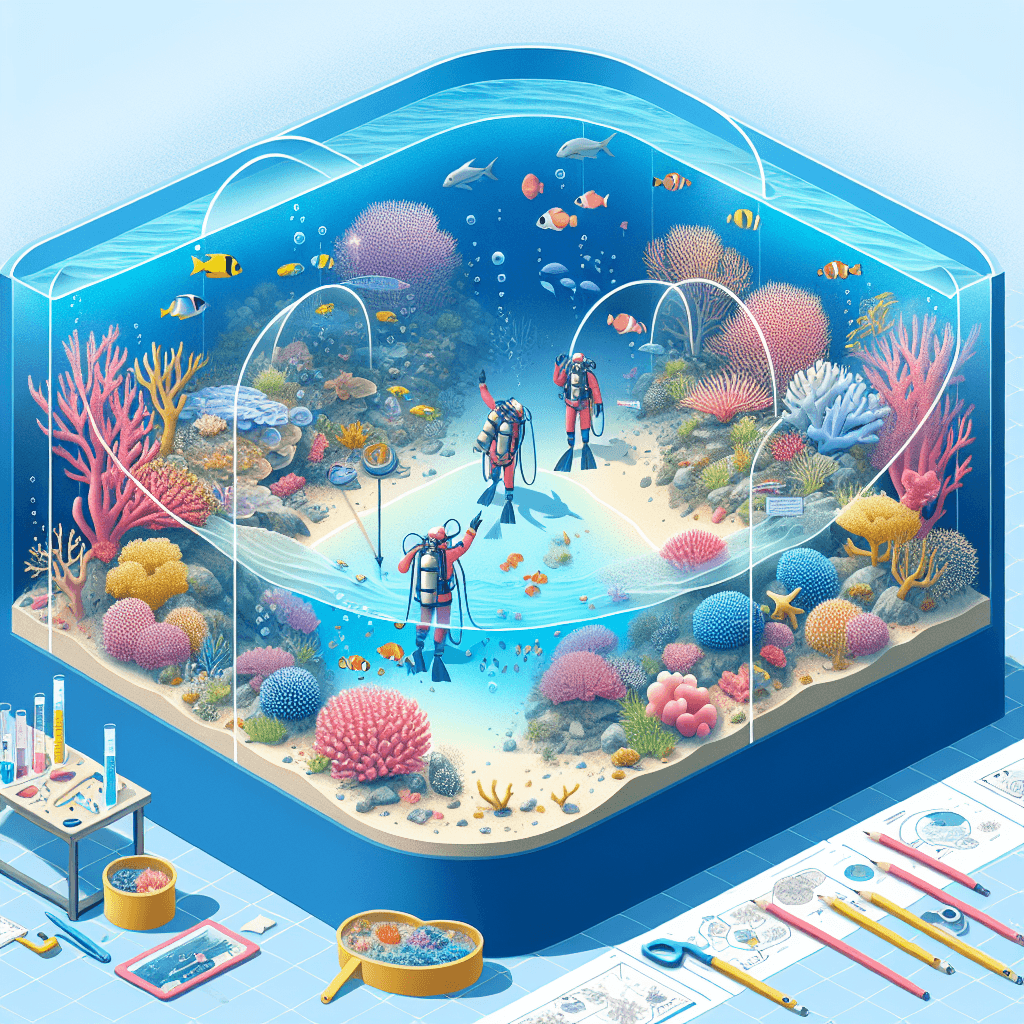
Inquiry Framework
Question Framework
Driving Question
The overarching question that guides the entire project.How can we create an interactive museum exhibit to educate the public about the impact of ocean acidification on coral reefs and inspire action to protect these vital ecosystems?Essential Questions
Supporting questions that break down major concepts.- How does ocean acidification affect coral reefs?
- What are the broader consequences of coral reef decline?
- What actions can individuals and communities take to mitigate ocean acidification and protect coral reefs?
- How can we design an interactive museum exhibit to effectively communicate the impact of ocean acidification on coral reefs?
Standards & Learning Goals
Learning Goals
By the end of this project, students will be able to:- Students will be able to explain the process of ocean acidification and its effects on coral reefs.
- Students will be able to describe the broader ecological and economic consequences of coral reef decline.
- Students will be able to identify individual and community actions to mitigate ocean acidification and protect coral reefs.
- Students will be able to design and create an interactive museum exhibit using various media and technologies to effectively communicate complex scientific information to a public audience.
Teacher-Provided Standard
Entry Events
Events that will be used to introduce the project to studentsMessage From the Future
A mysterious message in a bottle washes ashore near a vibrant coral reef, containing a desperate plea for help from the future. The message warns of a catastrophic event that has decimated the world's coral reefs due to unchecked ocean acidification.Portfolio Activities
Portfolio Activities
These activities progressively build towards your learning goals, with each submission contributing to the student's final portfolio.Ocean Acidification Investigation
Students will delve into the science behind ocean acidification, exploring the chemical reactions and biological impacts on coral reefs.Steps
Here is some basic scaffolding to help students complete the activity.Final Product
What students will submit as the final product of the activityA detailed scientific report explaining the process of ocean acidification and its detrimental effects on coral health, structure, and biodiversity.Alignment
How this activity aligns with the learning objectives & standardsStudents will be able to explain the process of ocean acidification and its effects on coral reefs, which directly addresses the standard of educating others about the effects of climate change.Coral Reef Ecosystem Impact Analysis
Students will broaden their understanding of coral reef ecosystems and analyze the far-reaching impacts of their decline.Steps
Here is some basic scaffolding to help students complete the activity.Final Product
What students will submit as the final product of the activityA visual presentation illustrating the interconnectedness of coral reefs within the marine ecosystem and the economic consequences of their decline.Alignment
How this activity aligns with the learning objectives & standardsStudents will be able to describe the broader ecological and economic consequences of coral reef decline, contributing to the understanding of climate change effects.Coral Reef Rescue Action Plan
Students will explore practical solutions and advocacy strategies to address the issue of ocean acidification and coral reef protection.Steps
Here is some basic scaffolding to help students complete the activity.Final Product
What students will submit as the final product of the activityAn action plan outlining specific steps individuals and communities can take to mitigate ocean acidification and support coral reef conservation.Alignment
How this activity aligns with the learning objectives & standardsStudents will be able to identify individual and community actions to mitigate ocean acidification and protect coral reefs, addressing the educational aspect of the standard.Interactive Museum Exhibit Design and Creation
Students will bring their learning together to design and create an interactive museum exhibit.Steps
Here is some basic scaffolding to help students complete the activity.Final Product
What students will submit as the final product of the activityA fully realized interactive museum exhibit prototype showcasing the impact of ocean acidification on coral reefs and inspiring action for their protection.Alignment
How this activity aligns with the learning objectives & standardsStudents will be able to design and create an interactive museum exhibit using various media and technologies to effectively communicate complex scientific information to a public audience, fulfilling the core requirement of the standard.Rubric & Reflection
Portfolio Rubric
Grading criteria for assessing the overall project portfolioCoral Reef Exhibit Project Rubric
Scientific Understanding and Communication
Assessment of students' understanding of ocean acidification and its effects on coral reefs, and the clarity of their communication in presenting scientific information.Knowledge of Ocean Acidification
Evaluation of students' understanding of the chemical processes of ocean acidification and its impact on coral reefs.
Exemplary
4 PointsDemonstrates comprehensive and sophisticated understanding of ocean acidification processes and their impacts on coral reefs, with detailed explanations and evidence.
Proficient
3 PointsIllustrates a thorough understanding of ocean acidification impacts on coral reefs with appropriate explanations and evidence.
Developing
2 PointsShows basic understanding of ocean acidification processes and their effects on coral reefs with some detail and evidence.
Beginning
1 PointsStruggles to explain ocean acidification processes and their effects on coral reefs with minimal evidence.
Clarity of Scientific Communication
Assessment of students' ability to clearly communicate complex scientific concepts related to coral reefs and ocean acidification.
Exemplary
4 PointsCommunicates complex scientific concepts with exceptional clarity and detail, using appropriate scientific language and supporting visuals.
Proficient
3 PointsEffectively communicates scientific concepts with clarity, using appropriate language and visuals.
Developing
2 PointsCommunicates scientific concepts with some clarity, but with incomplete or unclear language and visuals.
Beginning
1 PointsStruggles to communicate scientific concepts clearly, with unclear language and inadequate visuals.
Ecological and Economic Impact Analysis
Evaluation of students' ability to analyze and present the broader ecological and economic impacts of coral reef decline.Analysis of Ecological Impacts
Assessment of students' understanding and analysis of the ecological roles and consequences of coral reef decline.
Exemplary
4 PointsProvides an in-depth analysis of the ecological roles of coral reefs and extensive consequences of their decline, with robust evidence.
Proficient
3 PointsOffers a thorough analysis of the ecological roles and consequences of coral reef decline, with appropriate evidence.
Developing
2 PointsPresents a basic analysis of the ecological impact of coral reef decline with limited evidence.
Beginning
1 PointsStruggles to provide a clear analysis of the ecological roles and consequences of coral reef decline with minimal evidence.
Economic Impact Understanding
Evaluation of students' understanding of the economic consequences of coral reef decline.
Exemplary
4 PointsDemonstrates a comprehensive understanding of the economic impacts of coral reef decline on various industries, with detailed examples.
Proficient
3 PointsIllustrates thorough understanding of economic impacts with relevant examples.
Developing
2 PointsShows basic understanding of economic impacts with some examples.
Beginning
1 PointsStruggles to articulate economic impacts with minimal or no examples.
Mitigation Strategies and Action Plan
Assessment of students' ability to develop actionable strategies and plans for coral reef conservation.Creativity and Feasibility of Strategies
Evaluation of the innovativeness and practicality of proposed conservation strategies for coral reefs.
Exemplary
4 PointsProposes creative and highly feasible conservation strategies with clear goals, timelines, and resources.
Proficient
3 PointsDevelops feasible and appropriate conservation strategies with goals and timelines.
Developing
2 PointsSuggests basic conservation strategies with limited feasibility.
Beginning
1 PointsStruggles to propose practical conservation strategies with unclear elements.
Action Plan Implementation
Assessment of the practicality and clarity of the developed action plan for implementing conservation strategies.
Exemplary
4 PointsDevelops a comprehensive and well-organized action plan for conservation with clear implementation steps and resources.
Proficient
3 PointsCreates an organized action plan with clear steps and necessary resources.
Developing
2 PointsDevelops a basic action plan with limited clarity and resources.
Beginning
1 PointsStruggles to develop a clear action plan with minimal resources and unclear steps.
Exhibit Design and Engagement
Evaluation of students' ability to design and create an engaging and informative interactive exhibit.Engagement and Interactivity of Exhibit
Assessment of how well the exhibit engages visitors through interactive elements and multimedia.
Exemplary
4 PointsCreates a highly engaging and interactive exhibit with innovative multimedia elements that capture visitors' attention.
Proficient
3 PointsDevelops an engaging exhibit with effective interactive and multimedia elements.
Developing
2 PointsDesigns a basic exhibit with some interactive components.
Beginning
1 PointsStruggles to create an engaging exhibit with minimal interactivity.
Overall Exhibit Design and Quality
Evaluation of the overall quality and design of the final interactive museum exhibit.
Exemplary
4 PointsProduces a professionally designed and high-quality exhibit that effectively communicates its message.
Proficient
3 PointsProduces a well-designed and high-quality exhibit that communicates its message clearly.
Developing
2 PointsDesigns an exhibit with basic quality and satisfactory communication.
Beginning
1 PointsProduces a poorly designed exhibit with unclear communication.