
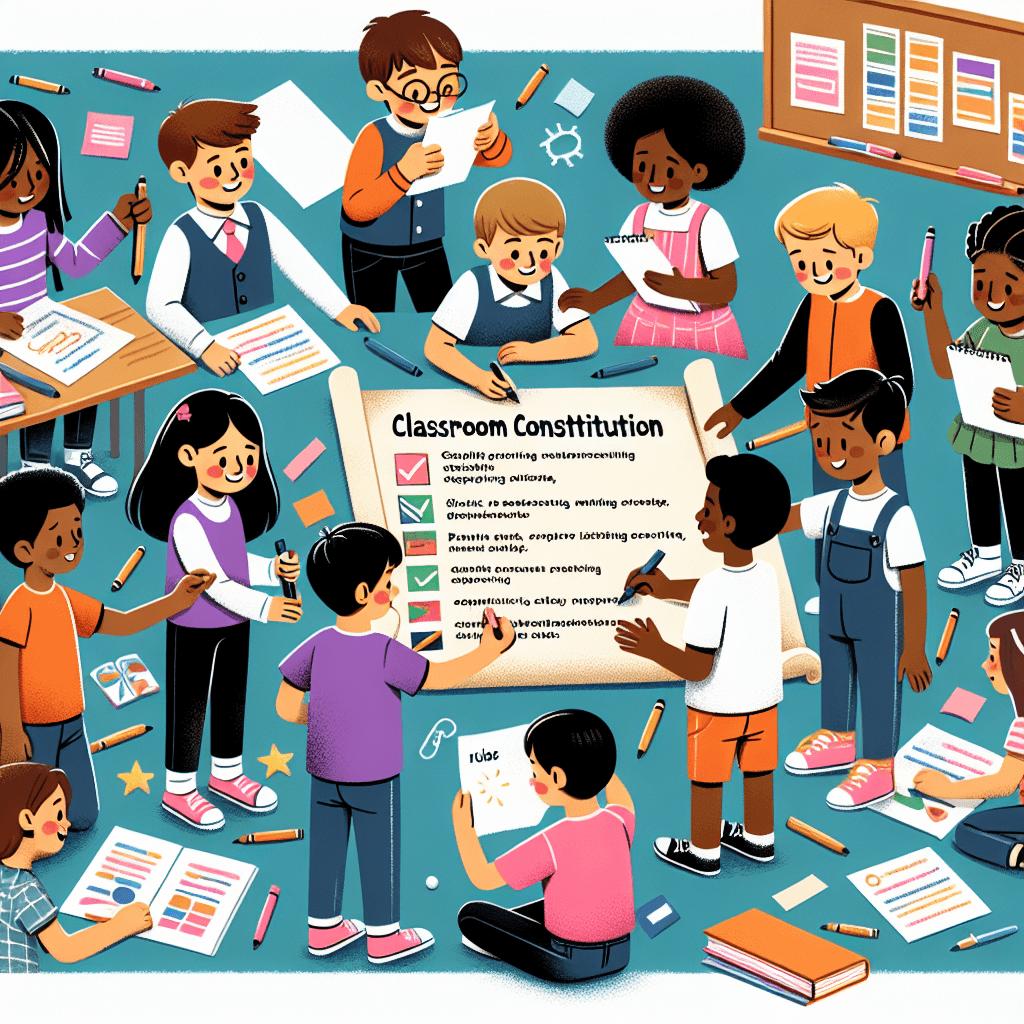
Crafting Our Classroom Constitution: Rules for Success
Inquiry Framework
Question Framework
Driving Question
The overarching question that guides the entire project.How can we, as a class, create a classroom constitution that reflects our values, promotes a positive learning environment, and ensures fairness and protects our individual rights and responsibilities as citizens?Essential Questions
Supporting questions that break down major concepts.- What is the purpose of rules and laws?
- What are the rights and responsibilities of citizens?
- How does a constitution ensure fairness and protect individual rights?
- How can we create a classroom constitution that reflects our values and promotes a positive learning environment?
Standards & Learning Goals
Learning Goals
By the end of this project, students will be able to:- Students will understand the purpose of rules and laws in a society.
- Students will identify and define the rights and responsibilities of citizens.
- Students will collaborate to create a classroom constitution that reflects their values.
- Students will apply principles of fairness and justice in the development of classroom rules.
Entry Events
Events that will be used to introduce the project to studentsA Day of 'Lawless Zone' Experiment
The classroom is declared a 'lawless zone' for a day, where typical rules are suspended (with safety as the only constraint). Students experience the consequences of a space without structure, then reflect on what rules are truly necessary for fairness and productivity, setting the stage for designing their own classroom constitution.Classroom Conflict Case Studies
Present students with several case studies of classroom conflicts or scenarios where existing rules are inadequate. Students analyze these cases from different perspectives (student, teacher, administrator) and propose solutions, highlighting the need for a comprehensive and collaboratively designed constitution.Portfolio Activities
Portfolio Activities
These activities progressively build towards your learning goals, with each submission contributing to the student's final portfolio.Rule Purpose Explorers
Students brainstorm and categorize the purposes of rules and laws, understanding their importance in maintaining order and fairness.Steps
Here is some basic scaffolding to help students complete the activity.Final Product
What students will submit as the final product of the activityA chart categorizing the purposes of rules and laws (e.g., safety, fairness, respect).Alignment
How this activity aligns with the learning objectives & standardsThis activity aligns with the learning goal: Students will understand the purpose of rules and laws in a society.Rights and Responsibilities Recorders
Students explore the concepts of rights and responsibilities in the context of citizenship, linking them to their own roles in the classroom.Steps
Here is some basic scaffolding to help students complete the activity.Final Product
What students will submit as the final product of the activityA T-chart comparing rights and responsibilities with specific examples relevant to the classroom.Alignment
How this activity aligns with the learning objectives & standardsThis activity aligns with the learning goal: Students will identify and define the rights and responsibilities of citizens.Rule Proposal Debate
Students propose and debate potential classroom rules, focusing on fairness, clarity, and alignment with their values.Steps
Here is some basic scaffolding to help students complete the activity.Final Product
What students will submit as the final product of the activityA list of proposed classroom rules with justifications for each, categorized by topic (e.g., respect, participation, responsibility).Alignment
How this activity aligns with the learning objectives & standardsThis activity aligns with the learning goals: Students will collaborate to create a classroom constitution that reflects their values and Students will apply principles of fairness and justice in the development of classroom rules.Constitution Crafters
Students draft the final classroom constitution, including a preamble, list of rights and responsibilities, and specific rules, ensuring clarity and coherence.Steps
Here is some basic scaffolding to help students complete the activity.Final Product
What students will submit as the final product of the activityA final Classroom Constitution document, including a preamble, list of rights and responsibilities, and a set of agreed-upon classroom rules.Alignment
How this activity aligns with the learning objectives & standardsThis activity aligns with the learning goals: Students will collaborate to create a classroom constitution that reflects their values and Students will apply principles of fairness and justice in the development of classroom rules.Rubric & Reflection
Portfolio Rubric
Grading criteria for assessing the overall project portfolioClassroom Constitution Rubric
Rule Purpose Explorers
This category assesses students' understanding of the purpose of rules and laws, their ability to categorize them effectively, and their collaborative skills.Understanding Rule Purpose
Demonstrates understanding of the purpose and importance of rules in various contexts.
Exemplary
4 PointsShows sophisticated understanding of why rules exist, with insightful examples from different settings (home, school, community). Demonstrates a nuanced grasp of the relationship between rules and societal well-being.
Proficient
3 PointsClearly understands the purpose of rules and provides relevant examples. Explains how rules contribute to order and fairness in different situations.
Developing
2 PointsShows emerging understanding of the purpose of rules, but examples may be limited or unclear. Can identify some reasons why rules are important.
Beginning
1 PointsStruggles to understand the purpose of rules and provides few or irrelevant examples. Has difficulty explaining why rules are needed.
Rule Categorization and Justification
Effectively categorizes rules based on their purpose and provides clear justifications for each category.
Exemplary
4 PointsCategorizes rules with insightful analysis and provides comprehensive justifications. Categories are well-defined and demonstrate a deep understanding of their underlying principles.
Proficient
3 PointsCategorizes rules accurately and provides clear justifications for each category. Demonstrates a solid understanding of the different purposes of rules.
Developing
2 PointsShows some ability to categorize rules, but categories may be overlapping or unclear. Justifications may be incomplete or lack detail.
Beginning
1 PointsStruggles to categorize rules and provides minimal or irrelevant justifications. Categories are poorly defined and lack clarity.
Collaboration and Teamwork
Demonstrates the ability to collaborate effectively with peers to brainstorm and categorize rules.
Exemplary
4 PointsLeads the group in brainstorming and categorization, fostering a collaborative environment. Actively listens to and incorporates diverse perspectives.
Proficient
3 PointsContributes actively to brainstorming and categorization, working effectively with peers. Listens to and respects different viewpoints.
Developing
2 PointsParticipates in brainstorming and categorization, but may struggle to collaborate effectively with peers. Sometimes has difficulty understanding or respecting different viewpoints.
Beginning
1 PointsShows limited participation in brainstorming and categorization, requiring significant support to collaborate with peers. Struggles to understand or respect different viewpoints.
Rights and Responsibilities Recorders
This category assesses students' understanding of rights and responsibilities, their ability to identify relevant examples, and their effective use of a T-chart.Understanding Rights and Responsibilities
Demonstrates a clear understanding of the concepts of rights and responsibilities and their interconnectedness.
Exemplary
4 PointsShows a sophisticated understanding of rights and responsibilities, providing insightful examples and demonstrating a nuanced grasp of their reciprocal relationship.
Proficient
3 PointsClearly understands the concepts of rights and responsibilities and provides relevant examples. Explains how rights and responsibilities are interconnected.
Developing
2 PointsShows emerging understanding of rights and responsibilities, but examples may be limited or unclear. Can identify some connections between them.
Beginning
1 PointsStruggles to understand the concepts of rights and responsibilities and provides few or irrelevant examples. Has difficulty explaining their relationship.
Relevance and Specificity of Examples
Identifies relevant rights and responsibilities in the classroom context and provides specific examples for each.
Exemplary
4 PointsIdentifies a wide range of relevant rights and responsibilities with insightful and specific examples that demonstrate a deep understanding of the classroom context.
Proficient
3 PointsIdentifies relevant rights and responsibilities and provides clear and specific examples for each. Examples are appropriate for the classroom context.
Developing
2 PointsShows some ability to identify rights and responsibilities, but examples may be limited or general. Some examples may not be relevant to the classroom context.
Beginning
1 PointsStruggles to identify rights and responsibilities and provides minimal or irrelevant examples. Examples are often inappropriate for the classroom context.
T-Chart Effectiveness
Effectively uses a T-chart to compare and contrast rights and responsibilities, demonstrating a clear understanding of their differences and similarities.
Exemplary
4 PointsUses the T-chart format innovatively to highlight subtle nuances and complex relationships between rights and responsibilities.
Proficient
3 PointsUses the T-chart effectively to clearly compare and contrast rights and responsibilities. The chart is well-organized and easy to understand.
Developing
2 PointsShows some ability to use a T-chart, but the comparison of rights and responsibilities may be incomplete or unclear. The chart may lack organization.
Beginning
1 PointsStruggles to use a T-chart effectively to compare rights and responsibilities. The chart is poorly organized and difficult to understand.
Rule Proposal Debate
This category assesses students' ability to propose well-reasoned rules, provide clear justifications, and participate actively and respectfully in class discussions and debates.Quality of Rule Proposals
Generates well-reasoned rule proposals that address specific needs and challenges in the classroom.
Exemplary
4 PointsGenerates innovative and insightful rule proposals that demonstrate a deep understanding of classroom dynamics and address complex needs with creativity and foresight.
Proficient
3 PointsGenerates well-reasoned rule proposals that address specific needs and challenges in the classroom. Proposals are clear, relevant, and practical.
Developing
2 PointsShows some ability to generate rule proposals, but proposals may be general or lack specific connections to classroom needs.
Beginning
1 PointsStruggles to generate rule proposals and proposals are often irrelevant or impractical.
Justification of Rule Proposals
Provides clear and logical justifications for proposed rules, demonstrating a strong understanding of fairness, clarity, and alignment with classroom values.
Exemplary
4 PointsProvides compelling and insightful justifications for proposed rules, demonstrating a nuanced understanding of fairness, clarity, and alignment with classroom values. Justifications anticipate potential challenges and offer proactive solutions.
Proficient
3 PointsProvides clear and logical justifications for proposed rules, demonstrating a strong understanding of fairness, clarity, and alignment with classroom values.
Developing
2 PointsShows some ability to provide justifications for proposed rules, but justifications may be incomplete or lack detail. Understanding of fairness, clarity, and alignment with classroom values may be limited.
Beginning
1 PointsStruggles to provide justifications for proposed rules and justifications are often illogical or irrelevant. Shows little understanding of fairness, clarity, and alignment with classroom values.
Participation in Discussions and Debates
Participates actively and respectfully in class discussions and debates, considering different perspectives and contributing constructively to the refinement of rules.
Exemplary
4 PointsLeads class discussions and debates with exceptional skill, fostering a respectful and inclusive environment. Actively solicits and values diverse perspectives, guiding the group towards consensus and innovative solutions.
Proficient
3 PointsParticipates actively and respectfully in class discussions and debates, considering different perspectives and contributing constructively to the refinement of rules.
Developing
2 PointsParticipates in class discussions and debates, but may struggle to consider different perspectives or contribute constructively. May sometimes be disrespectful or dismissive of others' viewpoints.
Beginning
1 PointsShows limited participation in class discussions and debates, requiring significant support to consider different perspectives or contribute constructively. May be disrespectful or disruptive.
Constitution Crafters
This category assesses students' ability to collaborate in drafting a comprehensive constitution, ensure clarity and coherence, and incorporate principles of fairness and justice.Collaboration in Constitution Drafting
Collaborates effectively with peers to draft a comprehensive and coherent Classroom Constitution, including a preamble, list of rights and responsibilities, and a set of agreed-upon classroom rules.
Exemplary
4 PointsDemonstrates exceptional leadership in guiding the class towards consensus in drafting the constitution. Ensures that all voices are heard and that the final document reflects the values and priorities of the entire class.
Proficient
3 PointsCollaborates effectively with peers to draft a comprehensive and coherent Classroom Constitution, including all required components.
Developing
2 PointsShows some ability to collaborate with peers, but the resulting Classroom Constitution may be incomplete or lack coherence. Some required components may be missing or poorly developed.
Beginning
1 PointsStruggles to collaborate with peers and the resulting Classroom Constitution is poorly developed and lacks essential components.
Clarity and Coherence of the Constitution
Ensures that the Classroom Constitution is clearly written, easily understood, and free of ambiguities or inconsistencies.
Exemplary
4 PointsDemonstrates exceptional attention to detail, ensuring that the Classroom Constitution is a model of clarity, precision, and coherence. Actively identifies and resolves potential ambiguities or inconsistencies.
Proficient
3 PointsEnsures that the Classroom Constitution is clearly written, easily understood, and free of ambiguities or inconsistencies.
Developing
2 PointsShows some attention to clarity and coherence, but the Classroom Constitution may contain some ambiguities or inconsistencies. Some sections may be difficult to understand.
Beginning
1 PointsStruggles to ensure clarity and coherence and the Classroom Constitution is often ambiguous, inconsistent, and difficult to understand.
Fairness and Justice in the Constitution
Demonstrates a strong understanding of the principles of fairness and justice in the development of classroom rules and ensures that the Classroom Constitution reflects these principles.
Exemplary
4 PointsDemonstrates a profound understanding of fairness and justice, ensuring that the Classroom Constitution not only reflects these principles but also promotes equity and inclusivity for all students.
Proficient
3 PointsDemonstrates a strong understanding of the principles of fairness and justice in the development of classroom rules.
Developing
2 PointsShows some understanding of fairness and justice, but the Classroom Constitution may not fully reflect these principles. Some rules may be perceived as unfair or biased.
Beginning
1 PointsStruggles to understand the principles of fairness and justice and the Classroom Constitution reflects little or no consideration of these principles.