
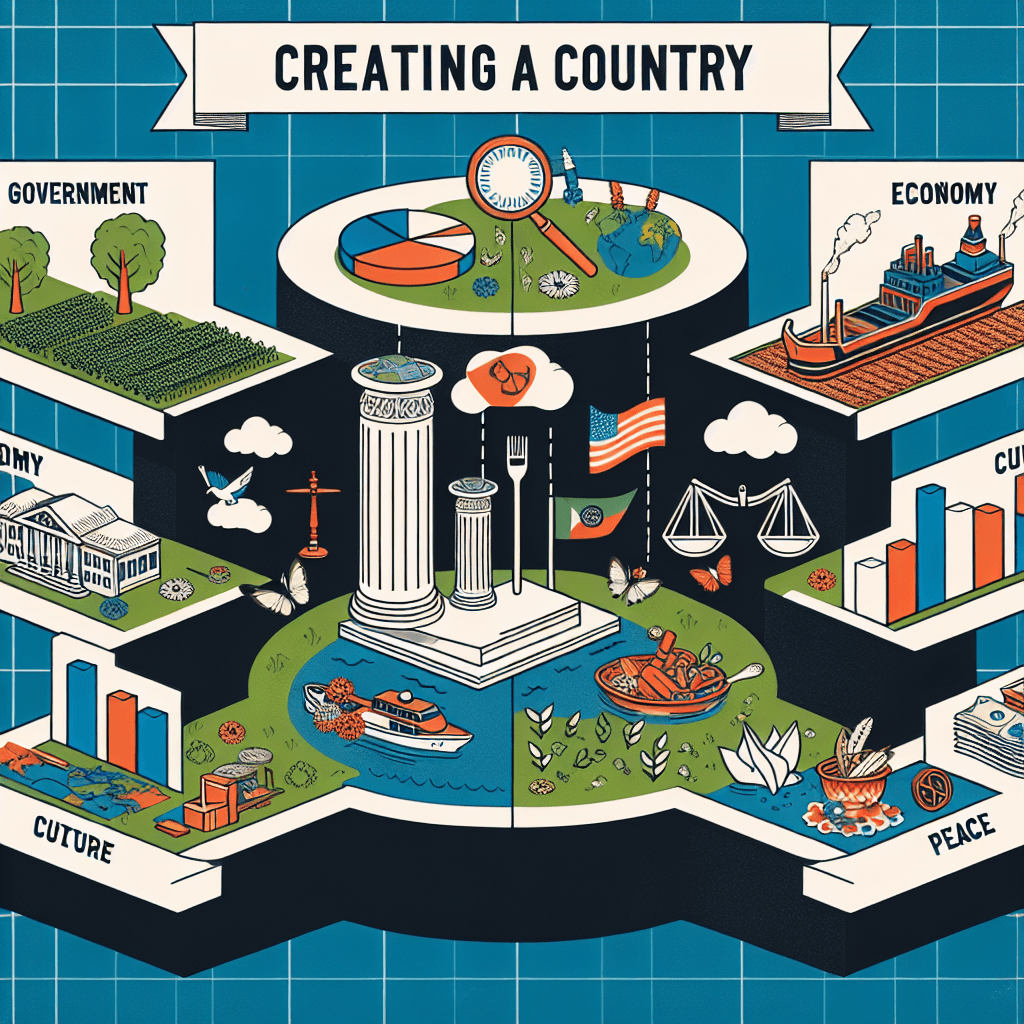
Create-A-Country: Government, Economy, Culture & Global Issues
Inquiry Framework
Question Framework
Driving Question
The overarching question that guides the entire project.How can we, as world leaders of a newly formed nation, create a thriving and sustainable society that addresses global challenges and fosters cooperation with other cultures?Essential Questions
Supporting questions that break down major concepts.- How does a country's geography shape its culture, economy, and government?
- What are the essential components of a successful and sustainable nation?
- How can cooperation and collaboration between different cultures solve global issues?
- How do governments balance the needs of their citizens with the needs of the environment?
- In what ways do cultural traditions impact a country's interactions with the global community?
Standards & Learning Goals
Learning Goals
By the end of this project, students will be able to:- Students will be able to design a functional government for their newly created nation, incorporating elements of culture, economy, and trade.
- Students will be able to analyze and propose solutions for real-world problems such as climate change, utilizing a Model UN framework.
- Students will be able to describe the interplay between a country's geography, culture, economy, and government.
- Students will be able to identify and explain factors that contribute to cooperation and conflict between cultural groups in a global context.
Social Studies Standards
Entry Events
Events that will be used to introduce the project to studentsGlobal Trade Challenge
Introduce a scenario where the students' town is cut off from essential resources due to a global trade disruption. Students must form 'nations' and negotiate trade agreements, develop local industries, and manage resources to ensure their community's survival, mirroring the challenges and opportunities in their own country-building project.U.N. Urgent Briefing
Students receive an 'urgent briefing' from the United Nations regarding a pressing global issue (climate change, refugee crisis, etc.) that requires the creation of new nations to address. Each student team represents a newly formed country and must propose solutions, considering their nation's unique resources, values, and geopolitical position, directly linking to the country-creation project.'Failed State' Simulation
Present students with a simulation of a country facing imminent collapse due to economic, environmental, and social crises. Students, acting as newly appointed leaders, must collaborate to rebuild the nation, making critical decisions about government, economy, and resource management – directly feeding into their own country-creation project.Portfolio Activities
Portfolio Activities
These activities progressively build towards your learning goals, with each submission contributing to the student's final portfolio.'Nation's DNA: Unveiling Cultural Identity'
Students will explore and define the unique cultural characteristics of their newly formed nation, including languages, religions, traditions, and artistic expressions. This activity sets the foundation for understanding how culture influences other aspects of their nation.Steps
Here is some basic scaffolding to help students complete the activity.Final Product
What students will submit as the final product of the activityA comprehensive cultural profile with a visual presentation that embodies the nation's unique identity.Alignment
How this activity aligns with the learning objectives & standardsAligns with standard SS6.G.2.1 by describing the cultural traditions, languages, and religions of the region under study.'Governing Guidelines: Designing a Nation's Government'
Students will delve into the structure and function of their nation's government, determining how it will operate, make decisions, and interact with its citizens. They will consider different forms of government and how they align with their nation's cultural values and needs.Steps
Here is some basic scaffolding to help students complete the activity.Final Product
What students will submit as the final product of the activityA detailed outline of their nation's governmental system, including a constitution or set of governing principles.Alignment
How this activity aligns with the learning objectives & standardsAligns with standard SS6.C.2.8 by analyzing how people organize and accomplish the purposes of government.'Resourceful Realms: Mapping Environmental Impact'
Students will investigate how their nation utilizes and modifies its environment, considering the impact of these actions on sustainability and climate change. They will propose strategies for responsible resource management and environmental protection.Steps
Here is some basic scaffolding to help students complete the activity.Final Product
What students will submit as the final product of the activityA comprehensive environmental impact report and a sustainability plan that outlines responsible resource management and climate change mitigation strategies.Alignment
How this activity aligns with the learning objectives & standardsAligns with standard SS6.G.4.3 by describing how humans use and modify the environment.'Global Challenge Think Tank: Solving World Problems'
Students will participate in a Model UN simulation, representing their newly formed nation and collaborating with other nations to address a contemporary global issue. They will apply their understanding of geography, culture, government, and economy to propose solutions and negotiate agreements.Steps
Here is some basic scaffolding to help students complete the activity.Final Product
What students will submit as the final product of the activityA position paper outlining their nation's stance on a global issue and their contributions to the Model UN simulation.Alignment
How this activity aligns with the learning objectives & standardsAligns with standard SS6.G.4.1 by investigating a contemporary global issue by applying the skills of geographic inquiry.Rubric & Reflection
Portfolio Rubric
Grading criteria for assessing the overall project portfolioCountry Creation Portfolio Rubric
Cultural Identity
Demonstrates understanding of cultural elements and their impact on national identity.Cultural Profile
Quality and depth of the created cultural profile, including languages, religions, traditions, and artistic expressions.
Exemplary
4 PointsDemonstrates a sophisticated understanding of cultural elements and their interconnectedness, creating a rich and nuanced cultural profile with compelling visual representation.
Proficient
3 PointsDemonstrates a thorough understanding of cultural elements, creating a well-developed cultural profile with a clear and engaging visual representation.
Developing
2 PointsShows an emerging understanding of cultural elements, creating a basic cultural profile with a limited visual representation.
Beginning
1 PointsShows a limited understanding of cultural elements, creating an incomplete or superficial cultural profile with a weak visual representation.
Governmental System
Effectiveness and feasibility of the designed governmental system.Governmental Structure
Clarity, organization, and suitability of the proposed governmental system, including a constitution or governing principles.
Exemplary
4 PointsDesigns an innovative and highly functional governmental system with a clear, comprehensive constitution that addresses the nation's unique needs and promotes civic engagement.
Proficient
3 PointsDesigns a well-structured and functional governmental system with a clear constitution that aligns with the nation's cultural values and needs.
Developing
2 PointsProposes a basic governmental system with a partially developed constitution, showing some consideration of the nation's values and needs.
Beginning
1 PointsPresents an incomplete or poorly defined governmental system with a minimal or absent constitution, lacking consideration of the nation's values and needs.
Environmental Impact
Analysis of environmental impact and sustainability planning.Sustainability Plan
Completeness, feasibility, and innovation of the proposed sustainability plan, including resource management and climate change mitigation.
Exemplary
4 PointsDevelops a highly innovative and comprehensive sustainability plan that demonstrates a deep understanding of environmental challenges and proposes effective, long-term solutions for resource management and climate change mitigation.
Proficient
3 PointsDevelops a comprehensive sustainability plan that addresses key environmental challenges and proposes realistic solutions for resource management and climate change mitigation.
Developing
2 PointsPresents a basic sustainability plan that identifies some environmental challenges but lacks detailed solutions for resource management and climate change mitigation.
Beginning
1 PointsOffers an incomplete or superficial sustainability plan with minimal consideration of environmental challenges, resource management, or climate change mitigation.
Global Problem-Solving
Effectiveness in addressing a global issue within the Model UN simulation.Model UN Contribution
Quality of the position paper, collaboration in the Model UN simulation, and proposed solutions to the chosen global issue.
Exemplary
4 PointsDemonstrates exceptional leadership and collaboration in the Model UN simulation, presenting a well-researched position paper and proposing innovative solutions that significantly contribute to addressing the global issue.
Proficient
3 PointsActively participates in the Model UN simulation, presenting a clear position paper and contributing effectively to the development of solutions for the global issue.
Developing
2 PointsParticipates in the Model UN simulation, presenting a basic position paper and contributing to discussions, but with limited impact on the development of solutions.
Beginning
1 PointsShows limited participation in the Model UN simulation, presenting an incomplete position paper and struggling to contribute to the development of solutions.