
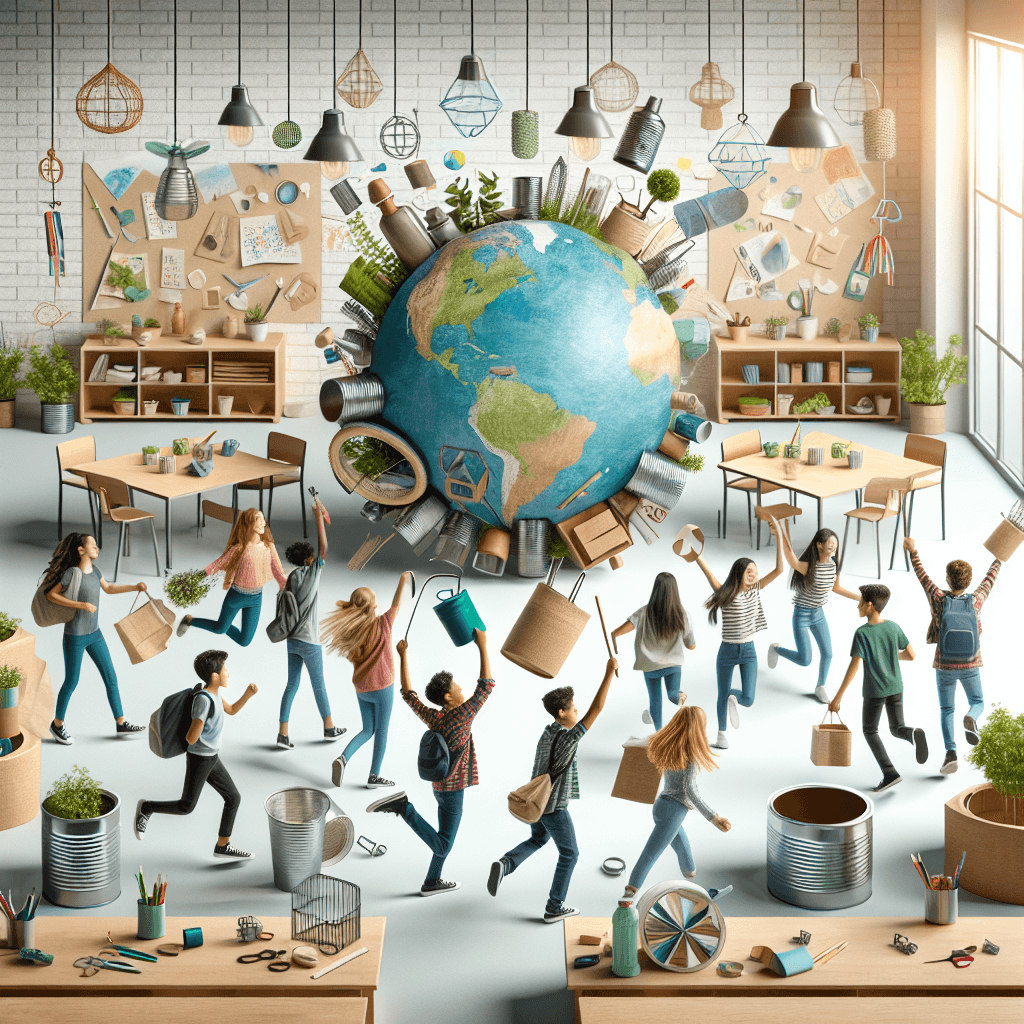
Creative Climate Solutions: Repurpose Byproducts Through Innovation
Inquiry Framework
Question Framework
Driving Question
The overarching question that guides the entire project.How can we creatively repurpose daily and industrial byproducts to positively impact our environment, using insights from science, art, and communication?Essential Questions
Supporting questions that break down major concepts.- How do our daily actions affect the environment and contribute to climate change?
- What are the effects of industrial byproducts on our planet?
- How can different academic disciplines help us understand and solve environmental problems?
- What are some creative ways to reduce, reuse, or recycle to help the environment?
- How can art be used to communicate solutions to environmental problems?
Standards & Learning Goals
Learning Goals
By the end of this project, students will be able to:- Understand the impact of daily human actions on the environment and climate change.
- Identify and describe industrial byproducts and their effects on the planet.
- Explore how different academic disciplines can contribute to solving environmental problems.
- Develop creative ideas for reducing, reusing, or recycling waste materials.
- Use art to effectively communicate environmental issues and potential solutions.
Next Generation Science Standards
Common Core Standards
Entry Events
Events that will be used to introduce the project to studentsMystery Box Investigation
Students are presented with a sealed mystery box filled with various items representing pollutants and byproducts. Their task is to identify the items through touch and sound and then brainstorm potential uses or solutions. This hands-on activity ignites curiosity about hidden environmental challenges and solutions.Pollution Detective: A Day in Your Life
Students jot down everything they use and the waste they produce in one day. Examining this list, they then role-play as detectives to trace how these items impact the environment, sparking discussions on how to repurpose or eliminate waste entirely using cross-disciplinary innovations.Art from Waste: The Sculpture Challenge
Invite students to create a piece of art from waste materials they collect at home or in school. This entry event connects their personal experiences with the broader environmental impact while stimulating artistic expression and critical thinking.Animated Stories of Waste Transformation
Kick-off with a short, animated story showing the journey of a piece of waste from consumption to regeneration into a useful item. Students will be sparked to imagine and sketch their stories, exploring the narratives of waste and innovation.Superhero Science: Save the Planet
Position students as superheroes tasked with creating solutions for environmental issues. This imaginative approach connects their love for superheroes with scientific inquiry as they design tools, powers, or plans to combat pollution creatively.Portfolio Activities
Portfolio Activities
These activities progressively build towards your learning goals, with each submission contributing to the student's final portfolio.Mystery Box Brainstorm
This activity ignites curiosity by allowing students to use their senses to identify mystery items that represent pollutants and byproducts. They brainstorm uses and solutions, introducing them to environmental challenges.Steps
Here is some basic scaffolding to help students complete the activity.Final Product
What students will submit as the final product of the activityA list of identified items and proposed uses or solutions.Alignment
How this activity aligns with the learning objectives & standardsAligns with NGSS-1-ESS3-1 by fostering an understanding of how pollutants impact environments.Daily Impact Detective
Students act as detectives tracing how their daily actions affect the environment. This involves listing daily items used and their waste products, understanding their environmental impact, and brainstorming cross-disciplinary solutions.Steps
Here is some basic scaffolding to help students complete the activity.Final Product
What students will submit as the final product of the activityA detective report outlining the items used, their impact, and potential solutions.Alignment
How this activity aligns with the learning objectives & standardsSupports NGSS-1-ESS3-3 by developing solutions for human environmental impacts.Artistic Waste Creation
Students create sculptures using waste materials, connecting personal experiences with environmental impact through art.Steps
Here is some basic scaffolding to help students complete the activity.Final Product
What students will submit as the final product of the activityA sculpture made from waste materials and a presentation on its environmental significance.Alignment
How this activity aligns with the learning objectives & standardsAligns with CCSS.ELA-Literacy.SL.1.5 by using art to communicate ideas and solutions.Animated Storyboard of Change
Students create storyboards that illustrate the journey of a waste item from consumption to transformation into usefulness, enhancing narrative skills.Steps
Here is some basic scaffolding to help students complete the activity.Final Product
What students will submit as the final product of the activityA complete storyboard presenting the journey of waste transformation.Alignment
How this activity aligns with the learning objectives & standardsSupports CCSS.ELA-Literacy.W.1.2 by developing narrative and explanatory skills through storytelling.Superhero Solution Showcase
Students position themselves as superheroes tasked with creating innovative solutions to solve environmental issues, linking imaginative and scientific inquiry.Steps
Here is some basic scaffolding to help students complete the activity.Final Product
What students will submit as the final product of the activityA superhero character and visual display illustrating their solution to an environmental issue.Alignment
How this activity aligns with the learning objectives & standardsSupports NGSS-1-ESS3-3 by focusing on developing creative solutions for environmental challenges.Rubric & Reflection
Portfolio Rubric
Grading criteria for assessing the overall project portfolioCreative Environmental Solutions Rubric
Understanding of Environmental Impact
Assesses students' grasp of how daily actions and industrial byproducts affect the environment and climate. Involves identifying pollutants and proposing educational responses.Pollutant Identification
Measures ability to identify pollutants and understanding of their environmental impact.
Exemplary
4 PointsIdentifies pollutants accurately and explains their impact comprehensively, including connections to wider environmental challenges.
Proficient
3 PointsAccurately identifies most pollutants and explains their basic impact on the environment.
Developing
2 PointsIdentifies some pollutants with a basic understanding of their impact but lacks depth.
Beginning
1 PointsStruggles to identify pollutants and shows minimal understanding of their environmental impact.
Cross-Disciplinary Connections
Measures ability to connect science, art, and communication to understand and solve environmental issues.
Exemplary
4 PointsDemonstrates insightful connections across disciplines to propose innovative environmental solutions.
Proficient
3 PointsConnects ideas from multiple disciplines to propose effective environmental solutions.
Developing
2 PointsMakes some connections between disciplines but solutions are underdeveloped or unclear.
Beginning
1 PointsStruggles to connect disciplinary ideas to environmental solutions.
Creativity and Innovation
Assesses creativity in proposing solutions to environmental problems through inventive thinking and artistic expression.Originality of Ideas
Measures the creativity and originality in proposed solutions or artistic expressions.
Exemplary
4 PointsProposes highly original and imaginative solutions or artistic expressions that effectively address environmental issues.
Proficient
3 PointsProposes creative solutions or artistic expressions that address environmental issues.
Developing
2 PointsProposes solutions or artistic expressions with limited creativity or originality.
Beginning
1 PointsStruggles to propose original solutions, relying heavily on examples or common ideas.
Artistic Communication
Assesses the ability to effectively use visual art to communicate ideas and solutions for environmental problems.
Exemplary
4 PointsArtistic pieces are highly effective, conveying clear and impactful environmental messages.
Proficient
3 PointsArtistic pieces effectively communicate environmental messages.
Developing
2 PointsArtistic pieces convey simple messages but lack clarity or impact.
Beginning
1 PointsArtistic communication is unclear and fails to convey the intended message.
Quality of Final Product
Evaluates the completeness, organization, and presentation of the final product, including ideas lists, reports, sculptures, storyboards, or designs presented.Completeness and Organization
Assesses the thoroughness and logical organization of the final work.
Exemplary
4 PointsThe final product is complete, well-organized, and presents a detailed and logical flow of ideas or solutions.
Proficient
3 PointsThe final product is complete and organized, presenting ideas or solutions coherently.
Developing
2 PointsThe final product is partially complete with limited organization of ideas.
Beginning
1 PointsThe final product is incomplete and poorly organized, with fragmented ideas.
Clarity and Presentation
Evaluates the clarity and articulation of ideas and solutions presented in the final product.
Exemplary
4 PointsPresentation is clear, engaging, and effectively communicates ideas and solutions with confidence.
Proficient
3 PointsPresentation is clear and communicates ideas and solutions adequately.
Developing
2 PointsPresentation is somewhat clear but lacks engagement or thorough communication of ideas.
Beginning
1 PointsPresentation is unclear and fails to communicate ideas effectively.