
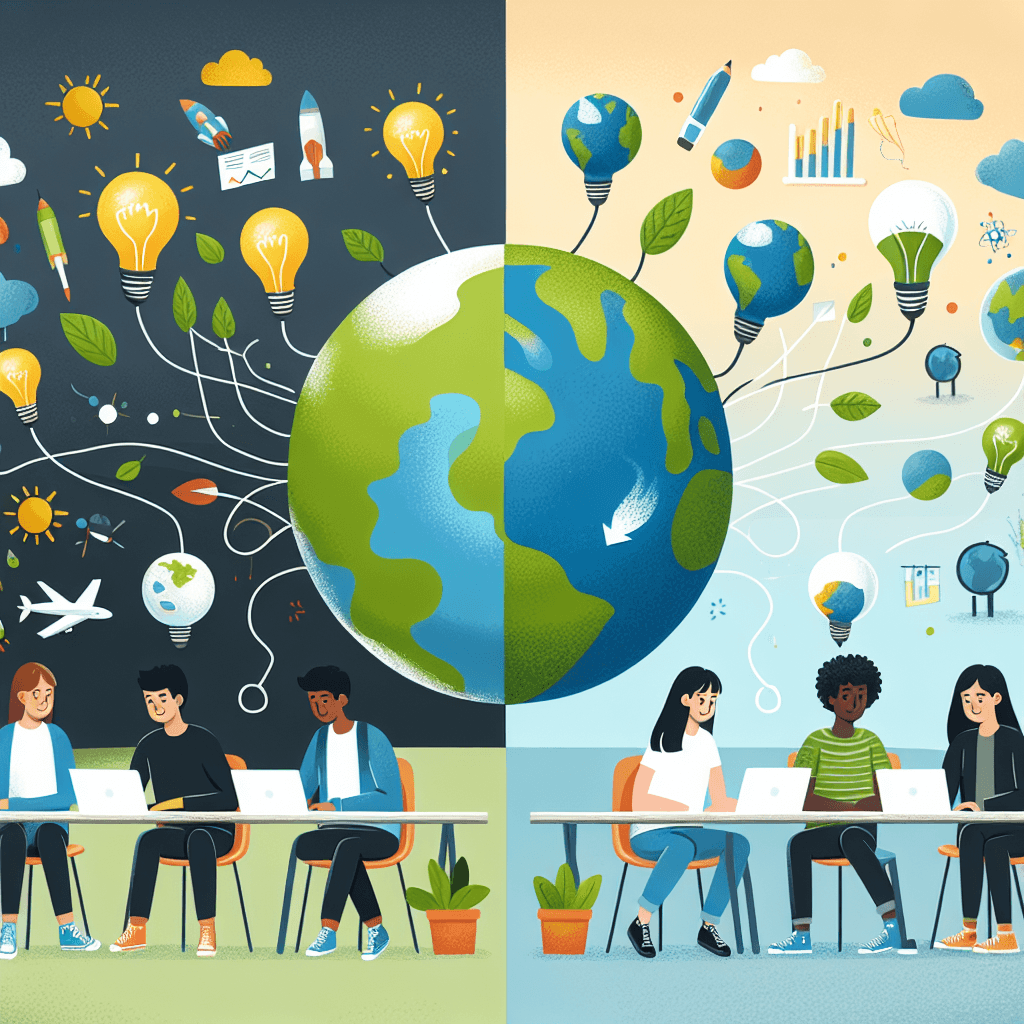
Creative Solutions for Climate Change Byproducts
Inquiry Framework
Question Framework
Driving Question
The overarching question that guides the entire project.How can we creatively transform daily life byproducts into solutions that reduce climate impact, considering perspectives from history, science, and art?Essential Questions
Supporting questions that break down major concepts.- How do our daily actions impact the environment, and what unseen consequences might they have on the climate?
- What are some examples of products or byproducts in our daily lives that could impact the climate, and how?
- How has the Industrial Revolution contributed to the creation of new chemical compounds and pollutants?
- How might different academic disciplines like biology, chemistry, and art contribute to solving environmental problems?
- What creative strategies could we use to remove, reuse, or repurpose byproducts of climate change?
Standards & Learning Goals
Learning Goals
By the end of this project, students will be able to:- Students will understand the impact of daily human activities on the climate and identify specific byproducts involved.
- Students will learn about the interdisciplinary approach to solving environmental issues, incorporating history, science, and art.
- Students will develop creative and practical solutions to transform climate change byproducts into useful products or processes.
- Students will enhance their communication skills by presenting their ideas and solutions effectively through oral, written, and artistic means.
Common Core Standards
Next Generation Science Standards
Common Core Standards for Art
Entry Events
Events that will be used to introduce the project to studentsThe Carbon Capture Auction
Start with a mock auction where students bid on everyday items like plastic water bottles, paper bags, and food packaging. Each item comes with a description of its carbon footprint. Challenge students to brainstorm creative methods to offset or reduce this footprint through inventive recycling or repurposing ideas.Pollution Treasure Hunt
Organize a treasure hunt around the school or local community where students identify sources of waste and pollution. Each 'discovered' item can spark discussions and group brainstorms on innovative ways to turn pollution or trash into 'treasure', fostering interdisciplinary solutions that incorporate science, art, and English language skills.Virtual Time Machine Experience
Invite students to take a virtual 'journey' to the Industrial Revolution via VR or a creative video, allowing them to witness the origins of today's pollution. When they 'return', challenge them to conceptualize futuristic solutions by blending past inventions with modern technology and environmental needs, thus stimulating creative and critical thinking.Microbe Intervention Challenge
Start with a surprising demonstration of microbes breaking down waste (e.g., using yeast to demonstrate fermentation). Then, challenge students to research and imagine new microbes or biological processes that could address current climate challenges and pollutions. Promote cross-disciplinary thinking by integrating art to visualize concepts.Climate Change Comic Strip
Engage students with storytelling by having them create comic strips illustrating the journey of an industrial byproduct from creation to repurposing. Incorporate science facts, artistic techniques, and narrative skills to highlight how interdisciplinary approaches can creatively solve environmental issues.Portfolio Activities
Portfolio Activities
These activities progressively build towards your learning goals, with each submission contributing to the student's final portfolio.Byproduct Detective!
Begin exploring the concept of byproducts and their impact on the environment. Students will discuss how relatable daily activities contribute to climate change and identify possible byproducts around them.Steps
Here is some basic scaffolding to help students complete the activity.Final Product
What students will submit as the final product of the activityA chart listing identified byproducts and their potential environmental impact, fostering awareness.Alignment
How this activity aligns with the learning objectives & standardsAligns with NGSS.3-ESS2-2 by helping students understand climates and environmental impacts, and CCSS.ELA-LITERACY.W.3.2 by enabling them to organize information.Carbon Footprint Challenge
Engage students in a mock auction where they learn to assess everyday items' carbon footprints and think critically about minimizing their impact.Steps
Here is some basic scaffolding to help students complete the activity.Final Product
What students will submit as the final product of the activityA group poster with creative methods to offset carbon footprints for everyday items.Alignment
How this activity aligns with the learning objectives & standardsSupports NGSS.3-ESS3-1 by creating solutions for environmental issues and CCSS.ELA-LITERACY.SL.3.1 by fostering collaborative discussions.Pollution Hunters: Trash to Treasure
Empower students to become environmental detectives through a treasure hunt around the school, identifying pollution sources and hypothesizing creative solutions.Steps
Here is some basic scaffolding to help students complete the activity.Final Product
What students will submit as the final product of the activityInfographics showing how pollution or waste can be creatively reused, combining art and science.Alignment
How this activity aligns with the learning objectives & standardsTies to CCSS.ART.3.VA.CN.10 by expressing ideas through art, and NGSS.3-ESS3-1 through proposing environmental solutions.From Steam to Green: A Time Travelling Journey
Enable students to understand historical contributions to pollution via a virtual tour of the Industrial Revolution. Equip them to creatively envision future solutions.Steps
Here is some basic scaffolding to help students complete the activity.Final Product
What students will submit as the final product of the activityA storyboard or concept drawing that envisions a solution merging historical and futuristic ideas.Alignment
How this activity aligns with the learning objectives & standardsAligns with NGSS.3-ESS3-1 by addressing environmental solutions, and CCSS.ELA-LITERACY.W.3.2 through conveying ideas.Comics for Climate: Telling Stories with Impact
Leverage the power of storytelling by having students create a comic strip that narrates the life cycle of a byproduct from its creation to repurposing.Steps
Here is some basic scaffolding to help students complete the activity.Final Product
What students will submit as the final product of the activityA comic strip that illustrates a byproduct's life cycle and proposes a sustainable solution.Alignment
How this activity aligns with the learning objectives & standardsMeets CCSS.ELA-LITERACY.W.3.2 by organizing and conveying ideas, and CCSS.ART.3.VA.CN.10 by using creative art to express ideas.Rubric & Reflection
Portfolio Rubric
Grading criteria for assessing the overall project portfolioClimate Impact Solution Design Assessment
Understanding of Environmental Impact
Assesses students' comprehension of how daily activities contribute to environmental issues and the identification of byproducts.Identification of Byproducts
Ability to identify and list byproducts from daily activities and their potential environmental impacts.
Exemplary
4 PointsAccurately identifies multiple byproducts, providing detailed analysis of their environmental impacts using relevant examples.
Proficient
3 PointsIdentifies several byproducts with a clear understanding of their potential environmental impacts.
Developing
2 PointsIdentifies some byproducts with basic understanding; explanations of impacts are minimal.
Beginning
1 PointsLists a few or incorrect byproducts without clear understanding of their impacts.
Understanding of Climate Concepts
Measures understanding of climate systems and how they are affected by human activities.
Exemplary
4 PointsDemonstrates advanced understanding of climate systems and human impact with comprehensive explanations.
Proficient
3 PointsShows thorough understanding with clear descriptions of climate systems and potential impacts.
Developing
2 PointsExhibits basic knowledge of climate systems, with limited explanations of human impact.
Beginning
1 PointsShows initial understanding with incomplete or inaccurate climate system descriptions.
Creativity and Innovation
Evaluates the originality and feasibility of proposed creative solutions for environmental problems.Originality of Solutions
Creativity in proposing original and effective solutions to reuse or repurpose byproducts.
Exemplary
4 PointsProposes innovative solutions that are highly original and demonstrate significant creativity and resourcefulness.
Proficient
3 PointsProposes creative solutions that are original and feasible.
Developing
2 PointsProposes solutions that show some originality but are not well-developed or feasible.
Beginning
1 PointsProposals lack originality or are impractical and underdeveloped.
Feasibility of Solutions
Assessment of how practical and implementable the designed solutions are.
Exemplary
4 PointsDesigns highly feasible, practical solutions that are clearly implementable with explained mechanisms.
Proficient
3 PointsDesigns feasible and practical solutions with basic implementation outlined.
Developing
2 PointsProposes solutions that are partially feasible with vague or limited implementation ideas.
Beginning
1 PointsDesigns impractical solutions with no clear implementation plan.
Communication and Collaboration
Assesses how effectively students communicate their ideas and collaborate with peers.Effective Communication
Clarity and coherence in conveying solutions and ideas through oral, written, or artistic means.
Exemplary
4 PointsCommunicates ideas with exceptional clarity, coherence, and creativity across various formats (oral, written, artistic).
Proficient
3 PointsEffectively communicates ideas with clarity and coherence across different formats.
Developing
2 PointsConveys ideas with partial clarity and coherence, demonstrating some organization.
Beginning
1 PointsStruggles to convey ideas clearly and coherently, with poor organization.
Teamwork and Collaboration
Contribution and cooperation in group discussions and activities.
Exemplary
4 PointsDemonstrates leadership and facilitates group dynamics, significantly contributing to team efforts.
Proficient
3 PointsContributes effectively to team discussions and activities, helping to achieve group goals.
Developing
2 PointsParticipates in team discussions with limited contribution, lacking initiative.
Beginning
1 PointsRarely participates in group activities, contributing minimally to team discussions or goals.
Interdisciplinary Integration
Reflects the integration of knowledge and skills from different subjects, including history, science, and art, to address climate issues.Use of Cross-Disciplinary Knowledge
Integration of concepts from different subjects to inform solutions.
Exemplary
4 PointsSeamlessly integrates diverse disciplinary insights, demonstrating deep understanding and coherent application.
Proficient
3 PointsSuccessfully integrates knowledge from multiple disciplines with clear application.
Developing
2 PointsIntegrates knowledge from different disciplines with basic application and understanding.
Beginning
1 PointsShows limited integration of cross-disciplinary insights, with unclear application.