
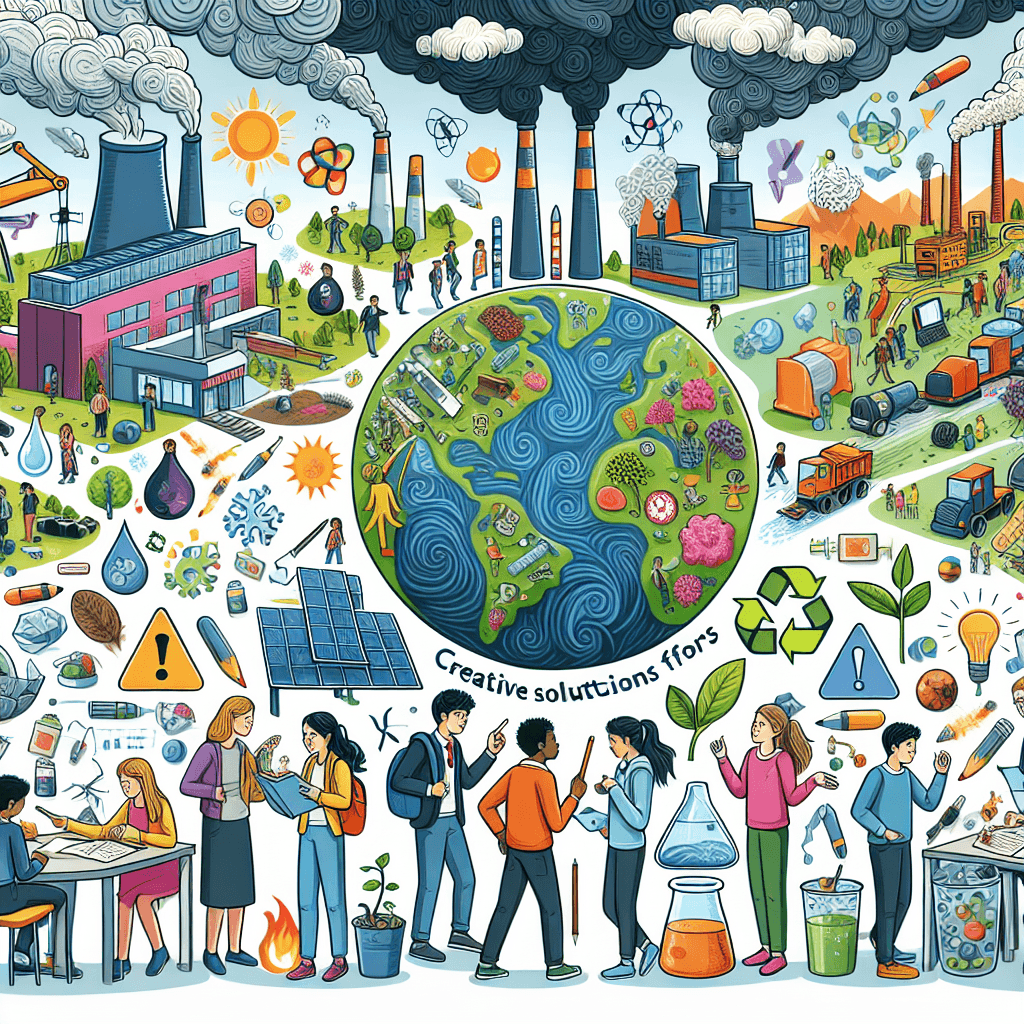
Creative Solutions for Climate Change Byproducts
Inquiry Framework
Question Framework
Driving Question
The overarching question that guides the entire project.How can we creatively design, implement, and communicate interdisciplinary solutions to repurpose the byproducts of human activities that contribute to climate change, and what role can different academic disciplines and organisms play in this process?Essential Questions
Supporting questions that break down major concepts.- How do daily human activities contribute to climate change and its byproducts?
- What are some ways different academic disciplines can intersect to address environmental problems?
- How might the industrial revolution have contributed to the creation of new pollutants?
- What creative methods can be explored to remove or repurpose byproducts of human activity?
- How can we design and test prototype solutions to address climate change issues?
- What role do microbes and organisms play in mitigating pollution?
- In what ways can we communicate solutions to climate change through art and media?
- Why is it important to consider the life cycle of products and their environmental impact?
Standards & Learning Goals
Learning Goals
By the end of this project, students will be able to:- Students will understand the impact of daily human activities on climate change.
- Students will identify how different academic disciplines intersect to address environmental issues.
- Students will explore the role of the industrial revolution in creating new pollutants.
- Students will develop creative methods to remove or repurpose byproducts of human activity.
- Students will design and test prototype solutions to address climate change issues.
- Students will understand the role of microbes and organisms in mitigating pollution.
- Students will communicate solutions to climate change using art and media.
- Students will analyze the life cycle of products and their environmental impact.
Common Core Standards
Next Generation Science Standards
National Core Arts Standards
Entry Events
Events that will be used to introduce the project to studentsPlastic to Possibilities
Kick off with a captivating guest video chat with an artist who creates installations from plastic waste and a scientist developing biodegradable materials. Let students handle samples of common plastic items and brainstorm uses for them as a segue into their own innovative ideas.Exhausting Design Lab
Begin with an interactive simulation showing real-time car exhaust emissions. Invite a local engineer to discuss catalytic converters and challenge students to design their versions using basic materials, sparking a cross-disciplinary inquiry into chemistry and engineering.Planet in a Lunchbox
Initiate a school-wide audit exploring how much lunch waste is created daily. Students survey and analyze waste types, laying the groundwork for them to consider inventive reuse or recycling strategies tied to a tangible example from their student life.Virtual Field Trip to Trash Island
Launch with an immersive virtual reality tour of the Great Pacific Garbage Patch. Pair this with data analysis exercises using current environmental impact statistics, urging students to conceptualize novel solutions that could apply locally or globally.Art with Impact
Start by examining provocative art pieces that highlight industrial pollution. Hold a gallery walk with descriptions and personal reactions, followed by a challenge for students to create their art that highlights the unseen impact of daily pollution, fostering an intersection of arts and sciences.Portfolio Activities
Portfolio Activities
These activities progressively build towards your learning goals, with each submission contributing to the student's final portfolio.From Waste to Art Wonders
Students will transform everyday plastic waste into an art installation. This activity promotes creative thinking and brings awareness to the abundance and impact of plastic waste.Steps
Here is some basic scaffolding to help students complete the activity.Final Product
What students will submit as the final product of the activityAn art installation made from plastic waste, accompanied by a presentation about its environmental implications.Alignment
How this activity aligns with the learning objectives & standardsAligns with Visual Arts Anchor Standard 1 and NGSS.MS-ESS3-4 by promoting creativity in art to communicate environmental issues.Eco-Solution Brainstorm
Engage students in identifying potential interdisciplinary solutions for reducing human impact on the climate through group discussions and innovative thinking.Steps
Here is some basic scaffolding to help students complete the activity.Final Product
What students will submit as the final product of the activityA comprehensive list of potential innovative solutions that can be investigated for feasibility.Alignment
How this activity aligns with the learning objectives & standardsAddresses NGSS.MS-ESS3-3 by applying scientific principles to the brainstorming of methods to reduce human impact.Pollution Problem Posters
Create informative visual posters that highlight pollutants introduced during the industrial revolution and their impact on the environment.Steps
Here is some basic scaffolding to help students complete the activity.Final Product
What students will submit as the final product of the activityAn informative poster presenting the impact of industrial pollutants and a class presentation of the findings.Alignment
How this activity aligns with the learning objectives & standardsSupports NGSS.MS-ESS3-4 and CCSS.ELA-LITERACY.SL.7.4 by developing students' ability to research, synthesize information, and present findings clearly.Microbe Magic Investigators
Discover the role of microbes in mitigating pollution by investigating microbial solutions to break down pollutants.Steps
Here is some basic scaffolding to help students complete the activity.Final Product
What students will submit as the final product of the activityA model or diagram portraying microbial activity and a report on how microbes contribute to pollution mitigation.Alignment
How this activity aligns with the learning objectives & standardsAligns with NGSS.MS-ESS3-3 by focusing on natural solutions to environmental problems through scientific study.Prototype Pioneers
Design, develop, and test a small-scale prototype aimed at reusing or reducing an industrial byproduct.Steps
Here is some basic scaffolding to help students complete the activity.Final Product
What students will submit as the final product of the activityA working prototype and a presentation discussing its potential impact and scalability.Alignment
How this activity aligns with the learning objectives & standardsCovers CCSS.ELA-LITERACY.W.7.1 and NGSS.MS-ESS3-3 by supporting claims with evidence through real-world testing and scientific design.Rubric & Reflection
Portfolio Rubric
Grading criteria for assessing the overall project portfolioInterdisciplinary Climate Impact Solutions Rubric
Interdisciplinary Integration
Evaluation of student's ability to intersect and apply knowledge of different academic disciplines to solve environmental problems.Disciplinary Knowledge
Measures the application of knowledge from multiple disciplines to address environmental challenges.
Exemplary
4 PointsDemonstrates a deep and insightful integration of multiple disciplinary knowledge, showcasing advanced understanding and application to complex environmental issues.
Proficient
3 PointsApplies knowledge from several disciplines effectively, demonstrating a solid understanding and connection of relevant principles to solve environmental issues.
Developing
2 PointsShows an emerging ability to connect concepts from various disciplines, but the integration may lack depth or consistency across different areas.
Beginning
1 PointsStruggles to apply knowledge from multiple disciplines, with limited connections made to solve environmental problems.
Innovative Thinking
Assesses creativity and innovation in proposing interdisciplinary solutions.
Exemplary
4 PointsExhibits exceptional originality and creativity in developing innovative solutions, with clearly defined and thoughtful interdisciplinary approaches.
Proficient
3 PointsDevelops creative solutions and demonstrates sound interdisciplinary thinking, contributing thoughtful and viable ideas.
Developing
2 PointsProposes solutions that show some level of creativity and standard interdisciplinary connections, but are not fully developed.
Beginning
1 PointsStruggles to generate creative ideas and interdisciplinary solutions, often relying on traditional approaches.
Research and Evidence
Assessment of the student's research skills and ability to support claims with relevant evidence.Research Depth
Evaluates the thoroughness and relevance of research conducted in understanding environmental impacts.
Exemplary
4 PointsPresents well-rounded, in-depth research with a wide variety of reputable sources supporting innovative environmental impact solutions.
Proficient
3 PointsProvides solid research evidence using multiple sources to support environmental claims effectively.
Developing
2 PointsResearch is basic, with limited sources and details, providing minimal support for environmental claims.
Beginning
1 PointsResearch is shallow and insufficient, offering little to no support for the environmental claims being made.
Evidence Use
Assesses the use of evidence to construct and support arguments and solutions proposed.
Exemplary
4 PointsOutstanding use of evidence that is consistently integrated to substantiate claims, showcasing a mature and critical approach.
Proficient
3 PointsEffectively uses evidence that supports claims and solutions, demonstrating clear and logical connections.
Developing
2 PointsUses evidence inconsistently, with some attempts to support claims that may lack logical coherence.
Beginning
1 PointsLacks relevant evidence to support claims, with little to no logical connections presented.
Communication and Presentation
Evaluation of how clearly and effectively the student communicates their ideas and findings through various forms of presentation.Clarity of Expression
Assesses the student's clarity and coherence in verbal and written communications.
Exemplary
4 PointsCommunicates ideas clearly and eloquently, with highly organized and compelling presentations that engage the audience.
Proficient
3 PointsCommunicates effectively, with organized presentations and arguments that are easy to follow.
Developing
2 PointsCommunicates ideas with some clarity, but parts of the presentation may be disorganized or unclear in places.
Beginning
1 PointsStruggles to communicate ideas clearly, with presentations that are often confusing and disorganized.
Engagement with Audience
Measures the ability to engage and interact with the audience during presentations.
Exemplary
4 PointsEngages actively with the audience, fostering dialogue and effectively responding to questions and feedback.
Proficient
3 PointsEngages the audience well, providing clear responses to questions and encouraging interaction.
Developing
2 PointsEngages minimally with the audience, with limited responses to questions and interaction.
Beginning
1 PointsStruggles to engage the audience, often failing to respond adequately to questions or encourage discussion.
Artistic and Prototyping Skills
Assessment of artistic skills and the practical implementation of prototype designs to address environmental issues.Artistic Quality
Evaluates the creativity and quality in artistic endeavors related to presenting environmental solutions.
Exemplary
4 PointsDisplays exceptional artistic quality and creativity, effectively conveying complex environmental messages.
Proficient
3 PointsDemonstrates good artistic quality with clear and well-thought-out environmental themes.
Developing
2 PointsShows basic artistic ability, but the project may lack depth or creativity in portraying themes.
Beginning
1 PointsPresents limited artistic quality with unclear or underdeveloped environmental messages.
Prototyping Effectiveness
Assesses the practical execution and testing of prototypes designed as solutions.
Exemplary
4 PointsOutstanding execution and testing of prototypes, demonstrating high potential for real-world application.
Proficient
3 PointsSuccessfully creates and tests prototypes, showcasing the feasibility of solutions.
Developing
2 PointsCreates and tests prototypes with limited effectiveness and real-world application potential.
Beginning
1 PointsStruggles with the creation and testing of prototypes, with minimal real-world application considerations.