
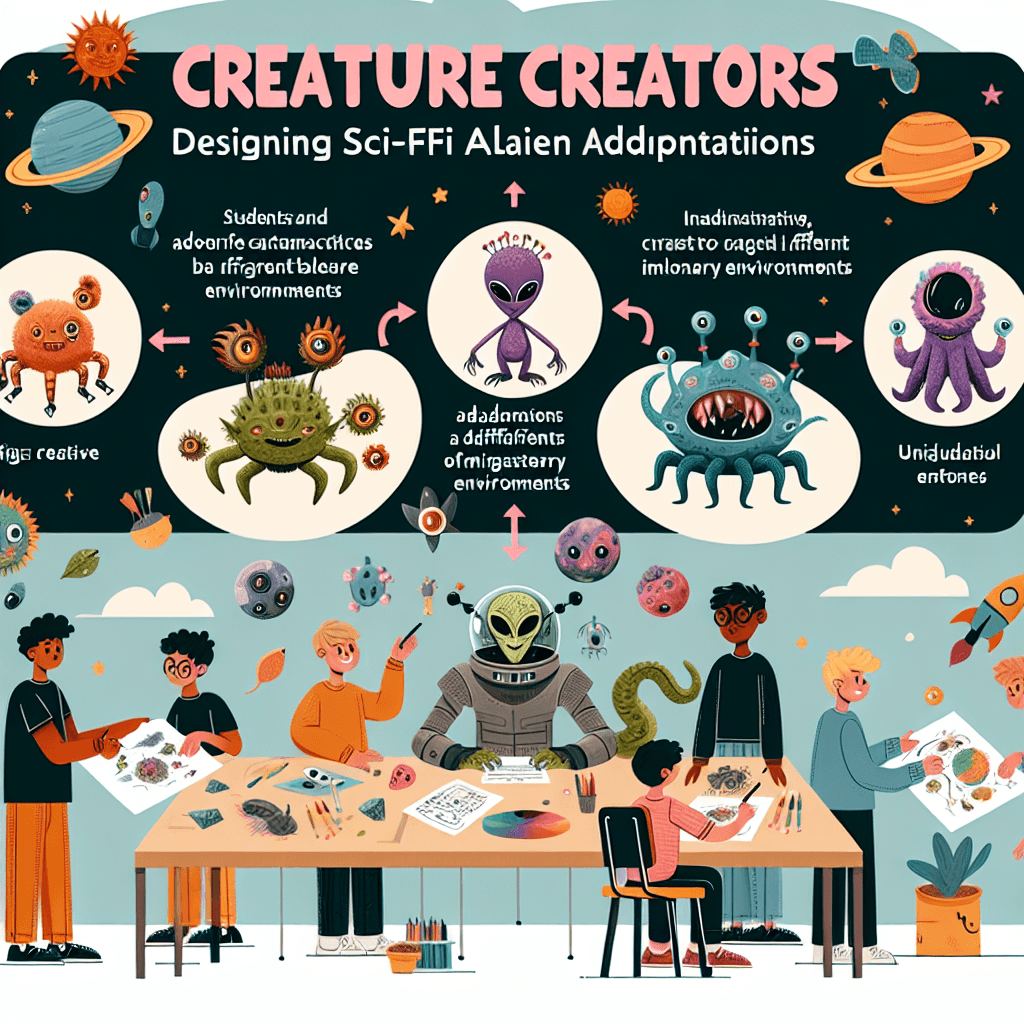
Creature Creators: Designing Sci-Fi Alien Adaptations
Inquiry Framework
Question Framework
Driving Question
The overarching question that guides the entire project.How can we, as movie creature designers, create friendly alien characters for a kindergarten audience that use realistic physical adaptations to survive the unique challenges of a fictional planet?Essential Questions
Supporting questions that break down major concepts.- How do physical features of animals on Earth help them survive in their specific environments?
- How can we use our knowledge of animal structures and functions to imagine the environments of a fictional planet?
- In what ways can an organism’s appearance tell a story about where it lives and what it eats?
- How can we balance scientific 'realism' with 'friendliness' to create characters that appeal to a younger audience?
- What is the relationship between an organism's physical adaptation and its ability to survive a change in its habitat?
Standards & Learning Goals
Learning Goals
By the end of this project, students will be able to:- Identify and describe how specific internal and external structures (e.g., limbs, skin, sensory organs) function to support an organism's survival and growth in a specific environment.
- Design an original creature that features physical adaptations tailored to overcome environmental challenges on a fictional planet.
- Explain the relationship between environmental changes and the necessity for physical adaptations in organisms.
- Communicate complex scientific concepts (adaptations) through creative media designed for a specific target audience (kindergarten students).
- Collaborate as 'creature designers' to synthesize scientific realism with aesthetic appeal, justifying design choices with biological evidence.
Next Generation Science Standards (NGSS)
Common Core State Standards for English Language Arts
Next Generation Science Standards (NGSS) - Engineering Design
Entry Events
Events that will be used to introduce the project to studentsThe Wrong-Planet Rescue Mission
A simulated 'Emergency Transmission' shows a friendly, fuzzy alien stranded in a biome that doesn't match its body (e.g., a thick-furred creature in a desert). Students must quickly brainstorm what physical features it would need to 'evolve' or change to survive the night, sparking a project-long quest to design creatures perfectly adapted to their sci-fi environments.Portfolio Activities
Portfolio Activities
These activities progressively build towards your learning goals, with each submission contributing to the student's final portfolio.Planet X: The World-Building Brief
Creature designers need a world for their characters to live in! In this activity, students work in 'Design Studios' to create the fictional planet where their alien will reside. They must determine the planet's climate, terrain, and available food sources, ensuring these challenges will require specific physical adaptations for any creature living there.Steps
Here is some basic scaffolding to help students complete the activity.Final Product
What students will submit as the final product of the activityA 'Planet X Environmental Brief' featuring a map, a description of the climate, and a list of three major survival challenges (e.g., high gravity, purple flora, or extreme wind).Alignment
How this activity aligns with the learning objectives & standardsThis activity aligns with 3-5-ETS1-2 by establishing the 'problem' (the environmental challenges) and the constraints (the specific conditions of the planet) that the creature's design must eventually solve.The Alien Architect’s Sketchbook
Now the real design begins! Using their Planet X Brief, students will brainstorm and sketch multiple versions of their alien. They must balance two goals: the creature must look like it can realistically survive its harsh planet, but it must also look 'friendly' enough for a 5-year-old audience. This involves iterating on limb shapes, eye sizes, and textures.Steps
Here is some basic scaffolding to help students complete the activity.Final Product
What students will submit as the final product of the activityA 'Creature Concept Gallery' showing three different 'evolutionary' versions of their alien, leading to one final selected design.Alignment
How this activity aligns with the learning objectives & standardsThis activity aligns with NGSS 4-LS1-1 and 3-5-ETS1-2 as students generate multiple design solutions (alien features) to solve survival problems while balancing the aesthetic constraint of being 'kindergarten-friendly.'The Creature Dossier: Science Meets Sci-Fi
In this writing-heavy activity, students act as lead scientists for the movie studio. They must write a formal 'Dossier' that explains the biology of their creature. This document moves beyond just 'what' the creature looks like and explains the 'why'—linking every weird alien feature back to a scientific survival need.Steps
Here is some basic scaffolding to help students complete the activity.Final Product
What students will submit as the final product of the activityThe 'Intergalactic Species Dossier'—a formal 3-paragraph report explaining the alien’s physical adaptations.Alignment
How this activity aligns with the learning objectives & standardsThis activity aligns with CCSS W.4.2 by requiring students to write an informative text that explains their scientific reasoning, and NGSS 4-LS1-1 by constructing an argument about how structures support survival.The Kinder-Alien Movie Pitch
It’s showtime! Students prepare a pitch for the 'Studio Executives' (and their kindergarten buddies). They must explain their alien’s adaptations using simplified language that a younger child can understand, while still proving to their teacher that they understand the science of survival. They will use their final illustration and dossier to support their presentation.Steps
Here is some basic scaffolding to help students complete the activity.Final Product
What students will submit as the final product of the activityA 'Movie Pitch Presentation' delivered with a visual aid, including a 'Kindergarten-Friendly Fact Sheet.'Alignment
How this activity aligns with the learning objectives & standardsThis activity aligns with CCSS SL.4.4 by requiring students to report on their design in an organized manner with descriptive details, speaking clearly at an understandable pace for a specific audience.Rubric & Reflection
Portfolio Rubric
Grading criteria for assessing the overall project portfolioThe Intergalactic Creature Designer Portfolio Rubric
Scientific Argumentation & Adaptations
Assesses the student's understanding of how organisms' features change and adapt to survive in specific environments.Structure and Function Linkage (NGSS 4-LS1-1)
How well the student connects the alien's physical features (external structures) to survival needs on their created planet.
Exemplary
4 PointsThe design includes sophisticated, highly original physical structures that are explicitly and logically linked to specific environmental challenges. The argument for survival is undeniable and uses advanced biological reasoning.
Proficient
3 PointsPhysical features are clearly designed to address environmental obstacles. The student provides a logical explanation for how each structure supports the alien’s survival and growth.
Developing
2 PointsThe creature has some unique features, but the connection between the structure and its survival function is inconsistent or requires more explanation.
Beginning
1 PointsPhysical features appear random or purely decorative, with little to no explanation of how they help the creature survive in its environment.
Environmental Context & World-Building
The ability to create a fictional environment with clear, logical constraints and 'obstacles' that necessitate specific biological adaptations.
Exemplary
4 PointsThe planet brief is exceptionally detailed, featuring complex interactions between terrain, climate, and survival obstacles that create a rich context for the creature's design.
Proficient
3 PointsThe planet brief includes a clear map and a logical list of three major survival challenges that directly inform the creature's design.
Developing
2 PointsThe environment is described, but the 'obstacles' are vague or don't clearly require the creature to adapt in specific ways.
Beginning
1 PointsThe environment description is incomplete or lacks specific challenges, making it difficult to justify any physical adaptations.
Engineering Design & Iteration
Evaluates the process of generating, testing, and refining solutions based on project criteria and constraints.Balancing Constraints (NGSS 3-5-ETS1-2)
The ability to balance the 'problem' of survival with the 'constraint' of appealing to a kindergarten audience.
Exemplary
4 PointsThe final design perfectly integrates complex survival features with a high level of aesthetic appeal for young children. The student shows clear evidence of multiple iterations and thoughtful refinement.
Proficient
3 PointsThe student successfully balances scientific realism with a 'friendly' appearance. The design reflects an intentional choice of colors, shapes, and textures suitable for the target audience.
Developing
2 PointsThe student attempted to make the creature friendly, but it may still be too scary or the survival features might be lost in the 'cute' design. Only basic iteration is evident.
Beginning
1 PointsThe design fails to address one of the two constraints: it is either completely unrealistic for survival or significantly too frightening/complex for the target audience.
Scientific Communication (Written)
Assesses the student's ability to convey complex scientific ideas through clear and organized writing.Informative Writing: The Dossier (CCSS W.4.2)
The clarity, organization, and scientific accuracy of the written 'Intergalactic Species Dossier.'
Exemplary
4 PointsThe dossier is a professional-quality report with distinct sections, precise scientific vocabulary, and vivid descriptive language that makes the alien's biology feel real.
Proficient
3 PointsThe dossier is well-organized into three paragraphs, explaining the alien’s adaptations clearly and accurately using informative text structures.
Developing
2 PointsThe dossier contains the required information but may be disorganized, have repetitive language, or lack specific scientific reasoning for the adaptations.
Beginning
1 PointsThe dossier is incomplete, lacks the 3-paragraph structure, or provides little scientific explanation for the creature's features.
Oral Presentation & Audience Engagement
Evaluates the student's ability to present their work and 'pitch' their design to a specific target audience.Audience Adaptation & Speaking (CCSS SL.4.4)
How effectively the student translates complex scientific concepts into language and visuals that engage and inform a kindergarten audience.
Exemplary
4 PointsThe pitch is exceptionally engaging, using clever metaphors (like 'fur like a sleeping bag') and a stunning visual aid to make high-level science accessible and fun for young children.
Proficient
3 PointsThe student speaks clearly at an understandable pace, uses appropriate facts, and presents a visual aid that helps the younger audience understand the alien's adaptations.
Developing
2 PointsThe presentation is delivered, but the language may be too technical for kindergarteners, or the visual aid does not clearly support the explanation of adaptations.
Beginning
1 PointsThe presentation is disorganized, the speaker is difficult to understand, or there is no clear attempt to adapt the information for a younger audience.