
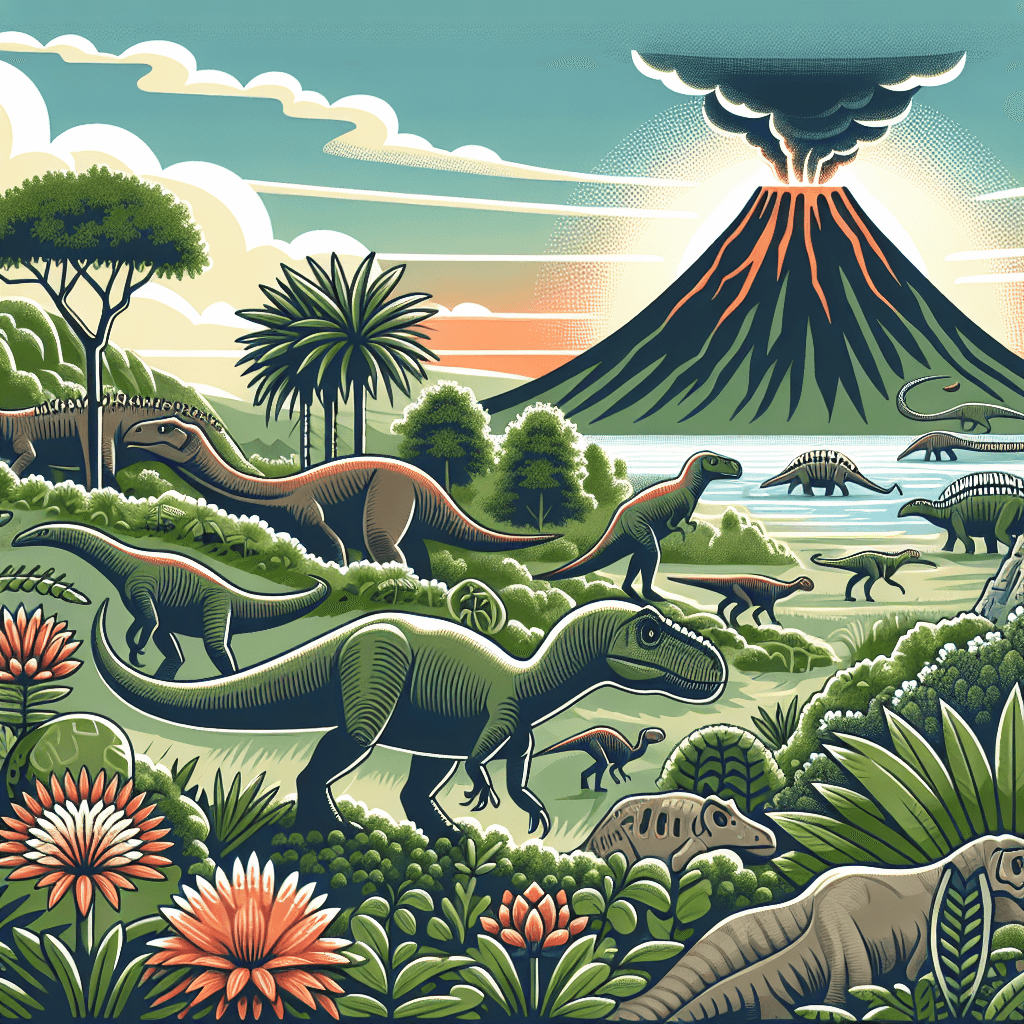
Cretaceous Curators: An Exhibit of Innovation and Survival
Inquiry Framework
Question Framework
Driving Question
The overarching question that guides the entire project.How can we, as museum curators, design an interactive exhibit that uses scientific evidence and mathematical scale to tell the story of how Cretaceous dinosaurs innovated and adapted to survive in a changing world?Essential Questions
Supporting questions that break down major concepts.- How do the physical characteristics and behaviors of Cretaceous dinosaurs help them survive or adapt to changes in their environment?
- How can we use mathematical measurements and scale to accurately represent the size and space requirements of dinosaurs in a museum exhibit?
- How do museum curators use evidence from the past (fossils and artifacts) to tell a compelling story about innovation and survival?
- How can we design an informational exhibit that effectively teaches our community about the impact of environmental change on prehistoric life?
Standards & Learning Goals
Learning Goals
By the end of this project, students will be able to:- Analyze the physical structures and functions of Cretaceous dinosaurs to explain how these adaptations supported their survival in specific environments.
- Apply mathematical measurement and scale techniques to design a proportionally accurate representation of a dinosaur and its exhibit space.
- Synthesize information from multiple research sources to write clear, engaging informational text for a museum exhibit that explains environmental change and dinosaur innovation.
- Evaluate fossil evidence to draw conclusions about how prehistoric life responded to environmental shifts over time.
- Collaborate as museum curators to design and present a cohesive interactive exhibit that communicates scientific and historical findings to the school community.
Texas Essential Knowledge and Skills (TEKS) - Science
Texas Essential Knowledge and Skills (TEKS) - Math
Texas Essential Knowledge and Skills (TEKS) - ELAR
Texas Essential Knowledge and Skills (TEKS) - Social Studies
Entry Events
Events that will be used to introduce the project to studentsPrehistoric Shark Tank: The Survival Pitch
Transform the classroom into a high-stakes 'Investor Pitch' room where students represent different Cretaceous species competing for a spot in the 'Hall of Ultimate Survivors.' Students are shown a series of 'Environmental Disaster' cards (volcanic activity, changing sea levels, new predators) and must argue why their dinosaur’s specific biological 'innovations' make it the most worthy of a featured exhibit. This sparks immediate debate about adaptation and survival of the fittest.The Innovation Time-Capsule
Students are presented with a 'Time-Capsule' from 66 million years ago containing soil samples (different colored sands/rocks), leaf impressions, and a 'broken' piece of technology (like a modern compass). They are asked to investigate the 'History of Innovation' by comparing how dinosaurs 'solved' problems like hunger, defense, and climate change without any tools other than their own bodies. This shifts the perspective of dinosaurs from 'lumbering monsters' to 'innovative biological machines.'Portfolio Activities
Portfolio Activities
These activities progressively build towards your learning goals, with each submission contributing to the student's final portfolio.The Bio-Innovation Dossier
In this first activity, students take on their role as Lead Curators. They must select a specific Cretaceous dinosaur and investigate its biological 'innovations.' Instead of just listing facts, they will treat the dinosaur like a piece of advanced technology, identifying specific physical structures and explaining the function of those structures in the context of survival against environmental challenges.Steps
Here is some basic scaffolding to help students complete the activity.Final Product
What students will submit as the final product of the activityA 'Bio-Innovation Dossier' which includes a detailed profile of the dinosaur, a labeled anatomical diagram, and a research log of survival traits.Alignment
How this activity aligns with the learning objectives & standardsAligns with TEKS 112.15.b.10(A) (Explore how structures and functions allow animals to survive) and TEKS 110.6.b.13(A) (Generate a research plan for gathering relevant information).The Shrink-Ray Schematic
To build an accurate exhibit, curators must understand the true scale of their subjects. In this activity, students translate massive prehistoric dimensions into manageable museum scales. Students will use multiplication and division to convert real-life dinosaur measurements into 'exhibit size' (e.g., a scale of 1 inch to 2 feet) to ensure their final model fits within the museum's walls.Steps
Here is some basic scaffolding to help students complete the activity.Final Product
What students will submit as the final product of the activityA Scale Schematic Poster that shows the 'Life-Size' vs. 'Model-Size' measurements, including calculated conversions for length and height.Alignment
How this activity aligns with the learning objectives & standardsAligns with TEKS 111.6.b.8(C) (Solve problems dealing with measurements of length) and TEKS 112.15.b.10(A) (Understanding physical characteristics).The Curator’s Layout Blueprint
A curator must ensure the exhibit flows well and provides enough space for both the 'artifacts' and the visitors. Students will apply geometry to design the physical layout of their exhibit booth. They must calculate the area needed for their dinosaur model and the perimeter of the 'safety zone' around it, ensuring the design is both functional and educational.Steps
Here is some basic scaffolding to help students complete the activity.Final Product
What students will submit as the final product of the activityA 'Curator's Floor Plan'—a birds-eye view map of the exhibit space with labeled dimensions for the display, the visitor path, and the information kiosk.Alignment
How this activity aligns with the learning objectives & standardsAligns with TEKS 111.6.b.5(D) (Solve problems related to perimeter and area of rectangles) and TEKS 113.15.b.21(B) (Interpret information acquired from a variety of sources).The Voice of the Past: Exhibit Panels
The final step in curation is telling the story. Students will synthesize their scientific and historical research to create the 'Voice' of the exhibit. This includes writing professional information plaques that explain the dinosaur's innovations and survival story, as well as citing their evidence to prove their exhibit is scientifically accurate.Steps
Here is some basic scaffolding to help students complete the activity.Final Product
What students will submit as the final product of the activityA Professional Exhibit Panel and Bibliography, featuring a compelling narrative of innovation and a list of sources.Alignment
How this activity aligns with the learning objectives & standardsAligns with TEKS 110.6.b.13(B-C) (Develop a bibliography and use a multi-modal delivery to present results) and TEKS 112.15.b.10(B) (Inherited vs. learned likenesses/adaptations).Rubric & Reflection
Portfolio Rubric
Grading criteria for assessing the overall project portfolioCretaceous Curator: Innovation & Survival Rubric
Scientific Inquiry & Biological Innovation
Evaluates the student's ability to apply scientific inquiry to biological adaptations and the fossil record (TEKS 112.15.b.10A/B).Biological Analysis: Structure and Function
The ability to analyze physical structures of dinosaurs and explain how they function as 'innovations' for survival within the Cretaceous environment.
Exemplary
4 PointsProvides a sophisticated analysis of dinosaur structures as 'biological innovations.' Explanations offer deep insight into how specific traits (e.g., hollow bones, armor) solved environmental challenges, showing an exceptional understanding of survival strategies.
Proficient
3 PointsThoroughly identifies physical structures and explains their functions. Clearly connects dinosaur traits to survival outcomes in the Cretaceous environment with consistent accuracy.
Developing
2 PointsIdentifies physical structures but provides inconsistent or basic explanations of their functions. Connections to survival are present but lack detail or specific environmental context.
Beginning
1 PointsIdentifies few structures and struggles to explain their functions. Provides minimal or no connection between physical traits and survival in the Cretaceous era.
Evolutionary Insight: Adaptation and Inheritance
Demonstration of the difference between inherited traits and learned behaviors as they relate to prehistoric adaptation and environmental change.
Exemplary
4 PointsExhibits advanced integration of concepts by distinguishing between inherited and learned traits through innovative examples and clear evidence from the fossil record.
Proficient
3 PointsCorrectly identifies and distinguishes between inherited traits and learned behaviors within the exhibit narrative. Provides clear examples aligned with standards.
Developing
2 PointsShows emerging understanding of the difference between inherited and learned traits, but may confuse concepts or provide incomplete examples.
Beginning
1 PointsShows limited understanding of inherited vs. learned traits; struggles to apply these concepts to the dinosaur's survival story.
Mathematical Application & Spatial Design
Assess the application of mathematical operations, scale, and geometry to design the physical exhibit (TEKS 111.6.b.8C, 111.6.b.5D).Scale Accuracy & Conversion
The accuracy of converting real-life dinosaur dimensions to a specific scale for the 'Shrink-Ray Schematic' using multiplication and division.
Exemplary
4 PointsDemonstrates flawless mathematical precision in scale conversions. Includes complex comparisons and applies the scale innovatively to create a perfectly proportional model representation.
Proficient
3 PointsAccurately calculates scaled dimensions using the provided ratio. Conversions between feet/meters and inches/centimeters are consistently correct.
Developing
2 PointsPerforms most scale calculations correctly but contains minor errors in multiplication or division. Shows basic understanding of the 'Life-Size' vs. 'Model-Size' relationship.
Beginning
1 PointsStruggles significantly with scale calculations. Dimensions are largely inaccurate or do not follow a consistent scale ratio.
Spatial Geometry & Layout Blueprint
The application of area and perimeter formulas to design a functional and proportionally accurate museum exhibit floor plan.
Exemplary
4 PointsProduces an outstanding floor plan with complex spatial reasoning. Correctly calculates area and perimeter for multiple zones and justifies layout based on visitor flow and model size.
Proficient
3 PointsCorrectly calculates the area and perimeter of rectangular exhibit zones. The floor plan is functional and clearly labeled with accurate dimensions.
Developing
2 PointsCalculates area or perimeter with some errors. The blueprint shows a partial understanding of how to manage space for a physical model.
Beginning
1 PointsFails to calculate area or perimeter accurately. The floor plan lacks specific dimensions or does not account for the size of the dinosaur model.
Research Synthesis & Curatorial Literacy
Evaluates the synthesis of research into written and oral communication for a public audience (TEKS 110.6.b.13A/B/C).Research Process & Evidence Gathering
The ability to conduct research using multiple sources, organize evidence, and document findings in a research log and bibliography.
Exemplary
4 PointsSynthesizes information from a wide variety of sophisticated sources. Research log is exhaustive, and the bibliography is professionally formatted and flawlessly executed.
Proficient
3 PointsGathers relevant information from at least three valid sources. Develops a clear research plan and a complete, accurate bibliography.
Developing
2 PointsConducts basic research using limited sources. Research log or bibliography is present but may be disorganized or incomplete.
Beginning
1 PointsProvides insufficient evidence of research. Fails to document sources or follow a research plan.
Informational Synthesis & Narrative Voice
The quality of the 'Innovation Narrative' and exhibit panels, focusing on clarity, engagement, and the use of evidence-based storytelling.
Exemplary
4 PointsWrites a compelling, professional-grade narrative that masterfully blends science and history. The 'Voice' of the exhibit is highly engaging and educational for the community.
Proficient
3 PointsWrites clear and engaging informational text that effectively explains dinosaur innovations. Successfully integrates scientific facts into a narrative format.
Developing
2 PointsProduces informative text that is basic or list-like. The narrative is present but lacks a strong 'curatorial voice' or engaging flow.
Beginning
1 PointsText is incomplete, confusing, or lacks scientific accuracy. Fails to tell a cohesive story about innovation or survival.
Curatorial Communication & Public Exhibit
Focuses on the curation and delivery of the final exhibit products (TEKS 113.15.b.21B, 110.6.b.13C).Multi-Modal Delivery & Presentation
The use of oral, written, and visual elements to present the final exhibit findings to the school community.
Exemplary
4 PointsDelivers an exceptional multi-modal presentation. The audio guide is professional and persuasive, and the visual exhibit components are of museum-quality.
Proficient
3 PointsSuccessfully uses an appropriate mode of delivery (oral, written, and visual) to present results. The audio guide and exhibit panels are clear and professional.
Developing
2 PointsPresentation uses multiple modes but with varying quality. The audio guide or visual elements may be unpolished or difficult to follow.
Beginning
1 PointsPresentation is incomplete or relies on only one mode of delivery. Requires significant support to communicate the project's main findings.