
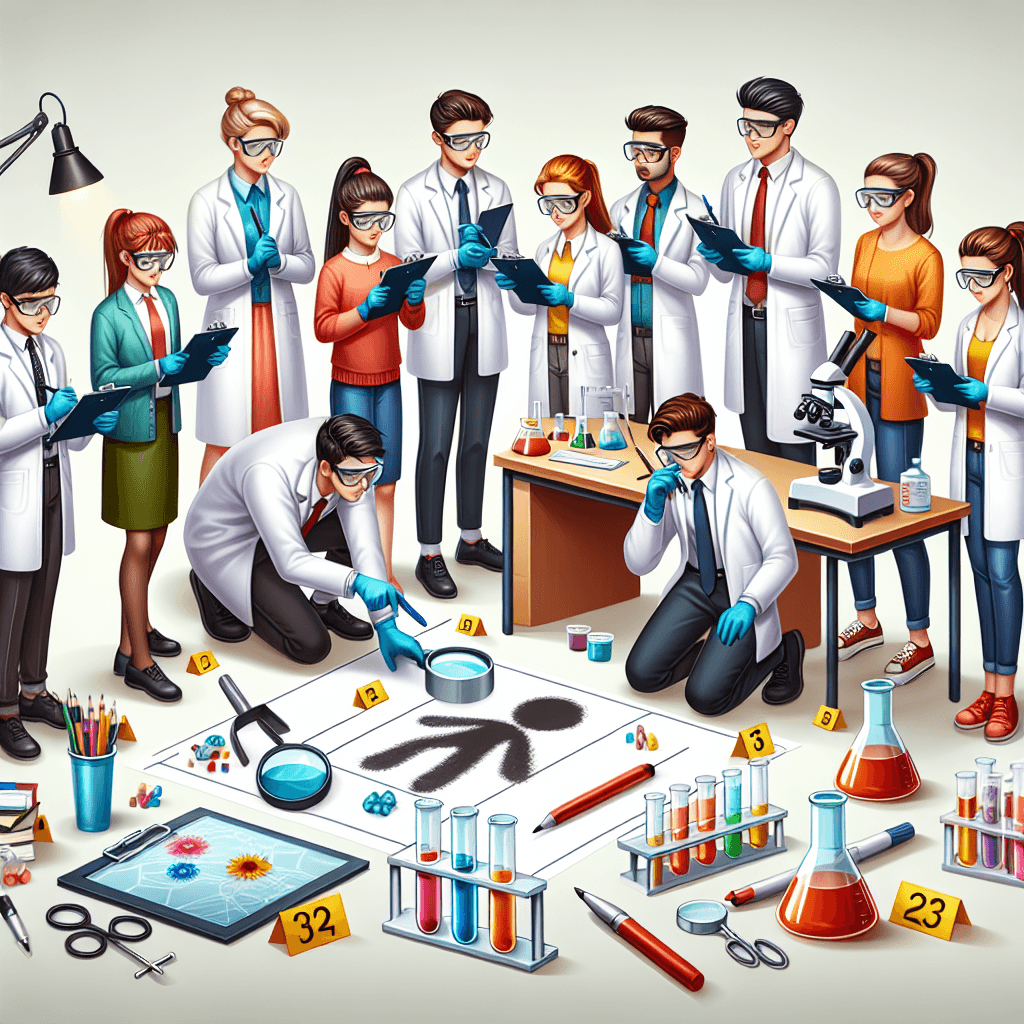
Crime Scene Investigators: A Forensic Science Investigation
Inquiry Framework
Question Framework
Driving Question
The overarching question that guides the entire project.How can forensic science techniques, grounded in the scientific method, be used to analyze evidence, design controlled experiments, and solve crimes, while also considering the evolving nature of scientific knowledge in this field?Essential Questions
Supporting questions that break down major concepts.- How do forensic scientists use the scientific method to solve crimes?
- How is evidence collected and analyzed in forensic science?
- What are the different types of forensic evidence, and how are they used in investigations?
- How can a controlled experiment be designed to test a hypothesis related to forensic science?
- How does scientific knowledge about forensic science evolve and change over time?
Standards & Learning Goals
Learning Goals
By the end of this project, students will be able to:- Apply the scientific method to analyze evidence.
- Describe the development and revision of scientific knowledge.
- Design and execute controlled experiments.
- Use forensic science techniques to solve crimes.
- Collect and analyze evidence effectively.
- Identify and utilize different types of forensic evidence in investigations.
- Explain how scientific knowledge in forensic science evolves over time.
- Explain the importance of controlled variables in forensic experiments.
- Explain the importance of a valid sample size in forensic experiments.
- Explain the importance of accurate data collection and analysis in forensic experiments.
- Explain the importance of valid inferences and predictions in forensic experiments.
- Apply the scientific method in the context of forensic science to analyze evidence and solve crimes.
- Demonstrate the ability to design and conduct controlled experiments to test hypotheses related to forensic science.
- Describe the processes for collecting, preserving, and analyzing forensic evidence.
- Distinguish the various types of forensic evidence and their applications in investigations.
- Explain how scientific knowledge in forensic science is subject to change and refinement over time as new discoveries and technologies emerge.
- Identify the essential elements of a controlled experiment (independent variable, dependent variable, control group, constants) and describe their roles.
- Explain the importance of replication, controls, and sample size in ensuring the validity of experimental results.
- Apply appropriate techniques for accurate data collection and analysis to ensure the reliability and validity of experimental findings.
- Make logical inferences and predictions based on forensic evidence and experimental results, while acknowledging the limitations and uncertainties inherent in scientific investigations.
- Critique forensic science techniques to solve crimes, while also considering the evolving nature of scientific knowledge in this field
Entry Events
Events that will be used to introduce the project to studentsUnlocking a Cold Case
Present students with a cold case file with conflicting evidence and witness testimonies. Students must evaluate the existing data, identify gaps in the investigation, and propose additional experiments or analyses that could help solve the case. This emphasizes the iterative nature of scientific inquiry and the importance of critical thinking in forensic science.Portfolio Activities
Portfolio Activities
These activities progressively build towards your learning goals, with each submission contributing to the student's final portfolio.The Scientific Method Flowchart: Forensic Edition
Students will document their understanding of the scientific method and its application to forensic science by creating a detailed flowchart. This activity reinforces the iterative nature of the scientific method and its importance in forensic investigations.Steps
Here is some basic scaffolding to help students complete the activity.Final Product
What students will submit as the final product of the activityA detailed flowchart illustrating the steps of the scientific method with forensic science examples for each step.Alignment
How this activity aligns with the learning objectives & standardsLearning Goal: Apply the scientific method to analyze evidence. Standard: Identify steps of the scientific method.Experimental Design: Forensic Evidence Analysis
Students will design a controlled experiment to analyze a specific type of forensic evidence. This hands-on activity will allow them to apply the principles of experimental design, including identifying variables, controls, and appropriate sample sizes, and will lead them to refine their experimental design based on feedback.Steps
Here is some basic scaffolding to help students complete the activity.Final Product
What students will submit as the final product of the activityA detailed experimental design proposal that includes a clear hypothesis, identified variables, control group, materials, and step-by-step procedures.Alignment
How this activity aligns with the learning objectives & standardsLearning Goal: Design and execute controlled experiments. Standard: Design a controlled experiment with clear procedures.The Evolution of Forensic Techniques: A Historical Perspective
Students will research a specific forensic science technique, tracing its historical development, significant milestones, and revisions based on new scientific discoveries. This activity emphasizes the dynamic and evolving nature of scientific knowledge and its application in forensic science.Steps
Here is some basic scaffolding to help students complete the activity.Final Product
What students will submit as the final product of the activityA written report that outlines the historical development of a chosen forensic science technique, including key milestones, challenges, and revisions.Alignment
How this activity aligns with the learning objectives & standardsLearning Goal: Describe the development and revision of scientific knowledge. Standard: Describe how scientific knowledge is developed and revised.Rubric & Reflection
Portfolio Rubric
Grading criteria for assessing the overall project portfolioScientific Method in Forensic Science Flowchart
Application of Scientific Method
This category assesses the student's understanding and application of the scientific method in the context of forensic science.Accuracy of Scientific Method Representation
Accuracy and thoroughness of the flowchart in representing the scientific method.
Exemplary
4 PointsThe flowchart accurately and thoroughly represents all steps of the scientific method, providing clear and detailed forensic science examples for each step. Demonstrates a sophisticated understanding of the iterative nature of the scientific method.
Proficient
3 PointsThe flowchart accurately represents most steps of the scientific method, providing relevant forensic science examples for each step. Demonstrates a thorough understanding of the scientific method.
Developing
2 PointsThe flowchart represents some steps of the scientific method but may contain inaccuracies or lack detail in the forensic science examples. Demonstrates an emerging understanding of the scientific method.
Beginning
1 PointsThe flowchart is incomplete or inaccurate, with minimal or irrelevant forensic science examples. Demonstrates a beginning understanding of the scientific method.
Relevance of Forensic Examples
Clarity and relevance of forensic science examples provided for each step.
Exemplary
4 PointsExamples are exceptionally clear, highly relevant to forensic science, and demonstrate a deep understanding of the practical application of the scientific method in investigations.
Proficient
3 PointsExamples are clear, relevant to forensic science, and demonstrate a good understanding of the practical application of the scientific method in investigations.
Developing
2 PointsExamples are somewhat clear and relevant to forensic science, but may lack depth or demonstrate a limited understanding of the practical application of the scientific method in investigations.
Beginning
1 PointsExamples are unclear, irrelevant, or missing, indicating a lack of understanding of the practical application of the scientific method in forensic investigations.
Clarity of Explanations
Quality and clarity of the written explanation detailing the significance of each step in the forensic process.
Exemplary
4 PointsExplanations are exceptionally well-written, clear, concise, and insightful, demonstrating a sophisticated understanding of the significance of each step in the forensic process.
Proficient
3 PointsExplanations are well-written, clear, and concise, demonstrating a good understanding of the significance of each step in the forensic process.
Developing
2 PointsExplanations are somewhat clear but may lack depth or clarity, demonstrating an emerging understanding of the significance of each step in the forensic process.
Beginning
1 PointsExplanations are unclear, incomplete, or missing, indicating a lack of understanding of the significance of each step in the forensic process.