
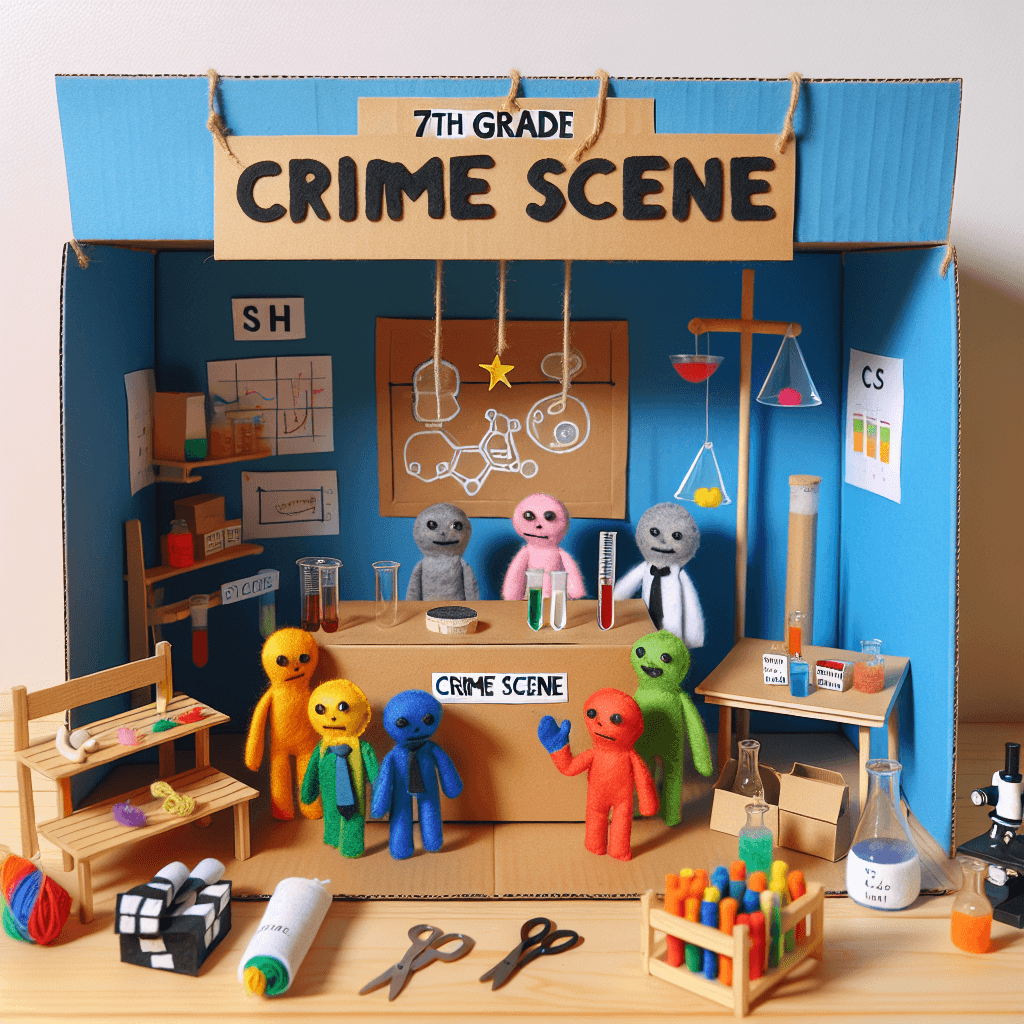
Crime Scene Puppet Show: A 7th Grade Science Project
Inquiry Framework
Question Framework
Driving Question
The overarching question that guides the entire project.How can we create a puppet show that accurately depicts a crime scene investigation, highlighting the roles of forensic scientists, the methods of evidence collection and analysis, and the process of presenting evidence in court?Essential Questions
Supporting questions that break down major concepts.- What is crime scene investigation?
- What are the roles of forensic scientists?
- How to collect evidence?
- How to analyze evidence?
- How to present evidence in court?
Standards & Learning Goals
Learning Goals
By the end of this project, students will be able to:- Students will be able to describe the role of forensic scientists.
- Students will be able to explain how to collect evidence.
- Students will be able to explain how to analyze evidence.
- Students will be able to explain how to present evidence in court.
- Students will be able to create a puppet show that accurately depicts a crime scene investigation.
Entry Events
Events that will be used to introduce the project to studentsThe Cold Case Challenge
A local detective arrives in class to present a 'cold case' involving a mysterious footprint and fiber evidence. Students examine the evidence, brainstorm possible scenarios, and formulate initial hypotheses about the crime, sparking their interest in crime scene investigation techniques.The Classroom Crime Scene
Students participate in a mock 'crime scene' setup in the classroom, complete with evidence markers and a staged scenario. They take on roles of forensic investigators to collect initial observations and evidence. This hands-on experience immediately immerses them in the world of crime scene investigation.The Community Crime Mystery
Present students with a fictional news report about a crime in their local community that lacks crucial evidence. Challenge them to identify what's missing and how a thorough crime scene investigation could help solve the case, connecting the project to their own experiences and surroundings.Portfolio Activities
Portfolio Activities
These activities progressively build towards your learning goals, with each submission contributing to the student's final portfolio.Forensic Scientist Spotlight
Students research different forensic scientists and their roles. They will write a short biography for their chosen scientist.Steps
Here is some basic scaffolding to help students complete the activity.Final Product
What students will submit as the final product of the activityA one-page biography of a forensic scientist.Alignment
How this activity aligns with the learning objectives & standardsLearning Goal: Students will be able to describe the role of forensic scientists.Evidence Collection Handbook
Students create a guide on how to properly collect and document evidence at a crime scene.Steps
Here is some basic scaffolding to help students complete the activity.Final Product
What students will submit as the final product of the activityAn illustrated guide to evidence collection.Alignment
How this activity aligns with the learning objectives & standardsLearning Goal: Students will be able to explain how to collect evidence.Lab Analysis Unveiled
Students will investigate how different types of evidence are analyzed in a lab setting.Steps
Here is some basic scaffolding to help students complete the activity.Final Product
What students will submit as the final product of the activityA presentation explaining evidence analysis techniques.Alignment
How this activity aligns with the learning objectives & standardsLearning Goal: Students will be able to explain how to analyze evidence.Evidence on Trial
Students will prepare a script for how forensic evidence is presented and defended in court.Steps
Here is some basic scaffolding to help students complete the activity.Final Product
What students will submit as the final product of the activityA mock trial script focusing on evidence presentation.Alignment
How this activity aligns with the learning objectives & standardsLearning Goal: Students will be able to explain how to present evidence in court.Crime Scene Puppet Show
Students work in groups to combine their individual work into a cohesive puppet show that tells the story of a crime scene investigation.Steps
Here is some basic scaffolding to help students complete the activity.Final Product
What students will submit as the final product of the activityA complete crime scene investigation puppet show.Alignment
How this activity aligns with the learning objectives & standardsLearning Goals: Students will be able to describe the role of forensic scientists. Students will be able to explain how to collect evidence. Students will be able to explain how to analyze evidence. Students will be able to explain how to present evidence in court. Students will be able to create a puppet show that accurately depicts a crime scene investigation.Rubric & Reflection
Portfolio Rubric
Grading criteria for assessing the overall project portfolioCrime Scene Puppet Show Rubric
Puppet Show Performance
Focuses on the scientific accuracy, narrative clarity, visual design, and collaborative teamwork demonstrated in the crime scene puppet show.Content Accuracy
Accuracy of the forensic science concepts and processes portrayed in the puppet show.
Exemplary
4 PointsDemonstrates sophisticated understanding of forensic science concepts, with innovative and accurate portrayal of processes. The puppet show reflects a deep understanding of the complexities involved in crime scene investigation.
Proficient
3 PointsDemonstrates thorough understanding of forensic science concepts, with appropriate application of processes. The puppet show accurately reflects the steps and roles involved in a crime scene investigation.
Developing
2 PointsShows emerging understanding of forensic science concepts, with inconsistent application of processes. The puppet show includes some inaccuracies or oversimplifications in the portrayal of crime scene investigation.
Beginning
1 PointsShows initial understanding of forensic science concepts, but struggles with the application of processes. The puppet show contains significant inaccuracies or omissions in the portrayal of crime scene investigation.
Narrative Clarity
Clarity and organization of the puppet show's narrative and presentation.
Exemplary
4 PointsThe narrative is exceptionally clear, logical, and engaging, creating a compelling and easily understandable storyline. The presentation is polished and maintains audience interest throughout.
Proficient
3 PointsThe narrative is clear, logical, and generally engaging, providing a coherent storyline. The presentation is well-organized and maintains audience interest.
Developing
2 PointsThe narrative is somewhat unclear or disorganized, making the storyline difficult to follow at times. The presentation lacks some organization and may lose audience interest.
Beginning
1 PointsThe narrative is unclear, illogical, and difficult to follow. The presentation is disorganized and fails to maintain audience interest.
Visual Design
Creativity and craftsmanship in the design and construction of the puppets and set.
Exemplary
4 PointsDemonstrates exceptional creativity and craftsmanship in the design and construction of the puppets and set. The visual elements are innovative, aesthetically pleasing, and enhance the storytelling.
Proficient
3 PointsDemonstrates creativity and craftsmanship in the design and construction of the puppets and set. The visual elements are well-made and contribute to the storytelling.
Developing
2 PointsShows some creativity in the design of the puppets and set, but the craftsmanship is inconsistent. The visual elements may not fully contribute to the storytelling.
Beginning
1 PointsShows limited creativity in the design of the puppets and set, and the craftsmanship is lacking. The visual elements are poorly made and detract from the storytelling.
Collaboration
Effective teamwork and collaboration among group members in the development and performance of the puppet show.
Exemplary
4 PointsExhibits outstanding teamwork and collaboration, with all group members actively engaged and contributing their unique skills and perspectives. The group demonstrates leadership and effectively resolves conflicts.
Proficient
3 PointsExhibits effective teamwork and collaboration, with all group members contributing to the development and performance of the puppet show. The group works well together and resolves conflicts constructively.
Developing
2 PointsShows some teamwork and collaboration, but there may be uneven participation among group members. The group may struggle to resolve conflicts effectively.
Beginning
1 PointsShows limited teamwork and collaboration, with one or more group members not actively participating. The group struggles to work together and resolve conflicts.