
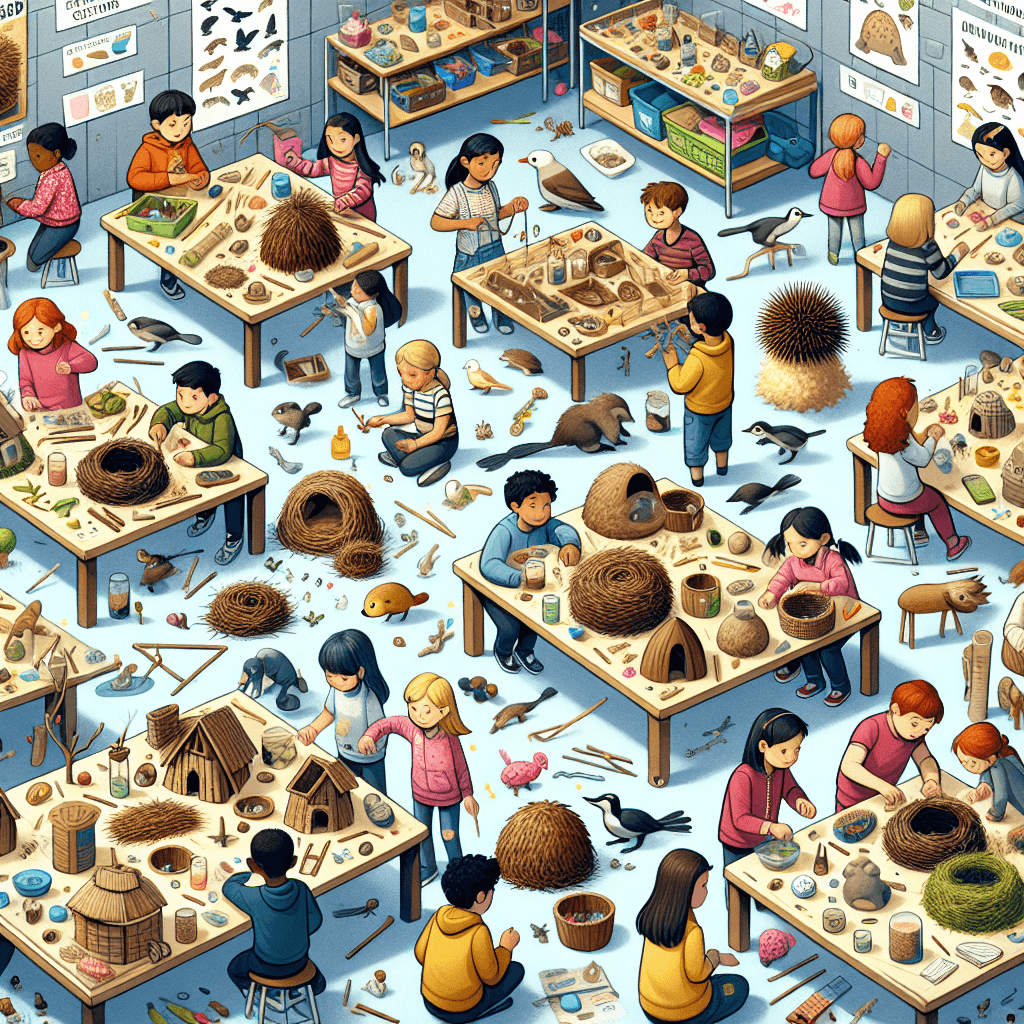
Critter Construction: Animal Homes Project
Inquiry Framework
Question Framework
Driving Question
The overarching question that guides the entire project.How can we design and build models of animal shelters that demonstrate how different animals use unique adaptations and materials to create homes suited to their environments?Essential Questions
Supporting questions that break down major concepts.- What is a habitat and why is it important for animals?
- How do animals adapt their shelters to their environments?
- What materials do animals use to build their homes, and why do they choose those materials?
- In what ways do animal homes provide protection?
- How can we model the unique features of animal shelters in our constructions?
Standards & Learning Goals
Learning Goals
By the end of this project, students will be able to:- Students will understand what habitats are and their importance to animals.
- Students will learn how different animals adapt their shelters to their environments.
- Students will identify materials used by animals to build homes and explain the reasons for these choices.
- Students will explore how animal homes provide protection.
- Students will apply knowledge of animal adaptations to design and build models of animal shelters.
NGSS: Next Generation Science Standards
Entry Events
Events that will be used to introduce the project to studentsMystery Animal Arrival
A mysterious 'animal' package is delivered to the classroom containing 'evidence' of animal life such as fur, feathers, or footprints. Students must use their inferencing skills to determine what animal it could belong to, encouraging them to think about shelter needs and adaptations.Habitat Construction Challenge
Presenting a challenge scenario where a new zoo exhibit requires student-designed animal habitats. This entry event invites students to use their creativity and problem-solving skills to build a model that will best suit the needs of the featured animal, emphasizing adaptation and environmental factors.Virtual Reality Habitat Tour
Students are immediately immersed in a virtual reality experience exploring different animal habitats. They will explore various animal homes around the world, sparking curiosity about how different creatures have adapted their shelters to survive in diverse environments.Portfolio Activities
Portfolio Activities
These activities progressively build towards your learning goals, with each submission contributing to the student's final portfolio.Habitat Helpers
In this activity, students explore diverse animal habitats and determine how certain behaviors and adaptations help animals survive. The focus is on understanding why and how animals construct their homes to fit their environments.Steps
Here is some basic scaffolding to help students complete the activity.Final Product
What students will submit as the final product of the activityA poster presentation detailing an animal's habitat and the adaptations of its shelter to the environment.Alignment
How this activity aligns with the learning objectives & standardsSupports 1-LS1-2, as students read texts and use media to determine patterns in animal behavior aiding survival.Material Masters
Students learn about the various materials animals use to build shelters and why they choose these specific materials. They investigate which materials provide protection and support survival through hands-on experiments.Steps
Here is some basic scaffolding to help students complete the activity.Final Product
What students will submit as the final product of the activityA science journal entry recording findings about material properties and a theoretical shelter design for a chosen animal.Alignment
How this activity aligns with the learning objectives & standardsCorresponds with 1-LS3-1 as students observe and account for similarities/differences in materials used by different animals and their parents.Shelter Showcase
For the culminating project, students use their acquired knowledge to design and build a physical model of an animal shelter. They will demonstrate understanding of animal adaptations and material choices.Steps
Here is some basic scaffolding to help students complete the activity.Final Product
What students will submit as the final product of the activityA physical model of an animal shelter with a presentation demonstrating the animal’s adaptations and survival strategies.Alignment
How this activity aligns with the learning objectives & standardsFully aligns with 1-LS1-2 as the project reflects understanding of how adaptations aid survival, and with K-LS1-1 as it involves using observations to model animal shelter needs.Animal Detectives
Students assume the role of animal detectives to investigate and identify the mystery animal delivered to the classroom. This activity helps them connect evidence of animal life to potential shelter needs and adaptations.Steps
Here is some basic scaffolding to help students complete the activity.Final Product
What students will submit as the final product of the activityA class presentation hypothesizing the identity of the mystery animal and its potential shelter needs.Alignment
How this activity aligns with the learning objectives & standardsAligns with standard K-LS1-1 as students use observations to describe patterns in animal needs and adaptations for survival.Rubric & Reflection
Portfolio Rubric
Grading criteria for assessing the overall project portfolioCritter Construction Project Evaluation Rubric
Understanding of Animal Habitats and Adaptations
This category evaluates students' grasp of the fundamental concepts related to animal habitats and the adaptations that assist in their survival.Habitat Comprehension
Assessing students' understanding of animal habitats and their importance for survival.
Exemplary
4 PointsDemonstrates a sophisticated understanding of habitats and clearly explains their role in animal survival using detailed examples.
Proficient
3 PointsShows thorough understanding of habitats and their importance, providing clear examples.
Developing
2 PointsShows emerging understanding with some unclear connections between habitats and survival.
Beginning
1 PointsShows initial understanding with limited connection between habitats and their importance for survival.
Adaptations Insight
Evaluating the understanding of animal adaptations and their application to shelters.
Exemplary
4 PointsProvides an in-depth exploration of animal adaptations and effectively links them to shelter functions.
Proficient
3 PointsShows clear understanding of adaptations with apt connections to animal shelters.
Developing
2 PointsShows basic comprehension of adaptations with inconsistent connections to shelters.
Beginning
1 PointsStruggles to identify adaptations and connect them to shelter use.
Material Selection and Usage
This category focuses on the selection, evaluation, and application of materials in constructing animal shelter models.Material Testing and Analysis
Assessing the method and insight applied when testing and choosing suitable materials.
Exemplary
4 PointsConducts insightful analysis and exhibits exceptional understanding of material suitability through testing.
Proficient
3 PointsPerforms thorough analysis with clear understanding and application in material selection.
Developing
2 PointsShows basic analysis with some understanding and application inconsistencies.
Beginning
1 PointsLacks analytical insight and struggles with material selection.
Creative Application of Materials
Evaluating creativity and appropriateness in selecting and using materials for shelter models.
Exemplary
4 PointsInnovatively applies materials, demonstrating creative problem-solving and suitability.
Proficient
3 PointsApplies materials appropriately and shows creative thinking.
Developing
2 PointsShows attempt at creativity but lacks complete suitability in material choice.
Beginning
1 PointsStruggles to apply materials creatively and appropriately.
Presentation and Communication
This category examines students' ability to effectively communicate their ideas and outcomes in both written and verbal formats.Clarity of Presentation
Evaluating how clearly and effectively students present their models and explain their choices.
Exemplary
4 PointsDelivers a clear and engaging presentation with thorough explanations and creative insights.
Proficient
3 PointsPresents ideas clearly with logical explanations and creative insights.
Developing
2 PointsPresentation lacks clarity in some parts, with basic explanations and insights.
Beginning
1 PointsPresentation is unclear, with minimal explanation of processes and insights.