
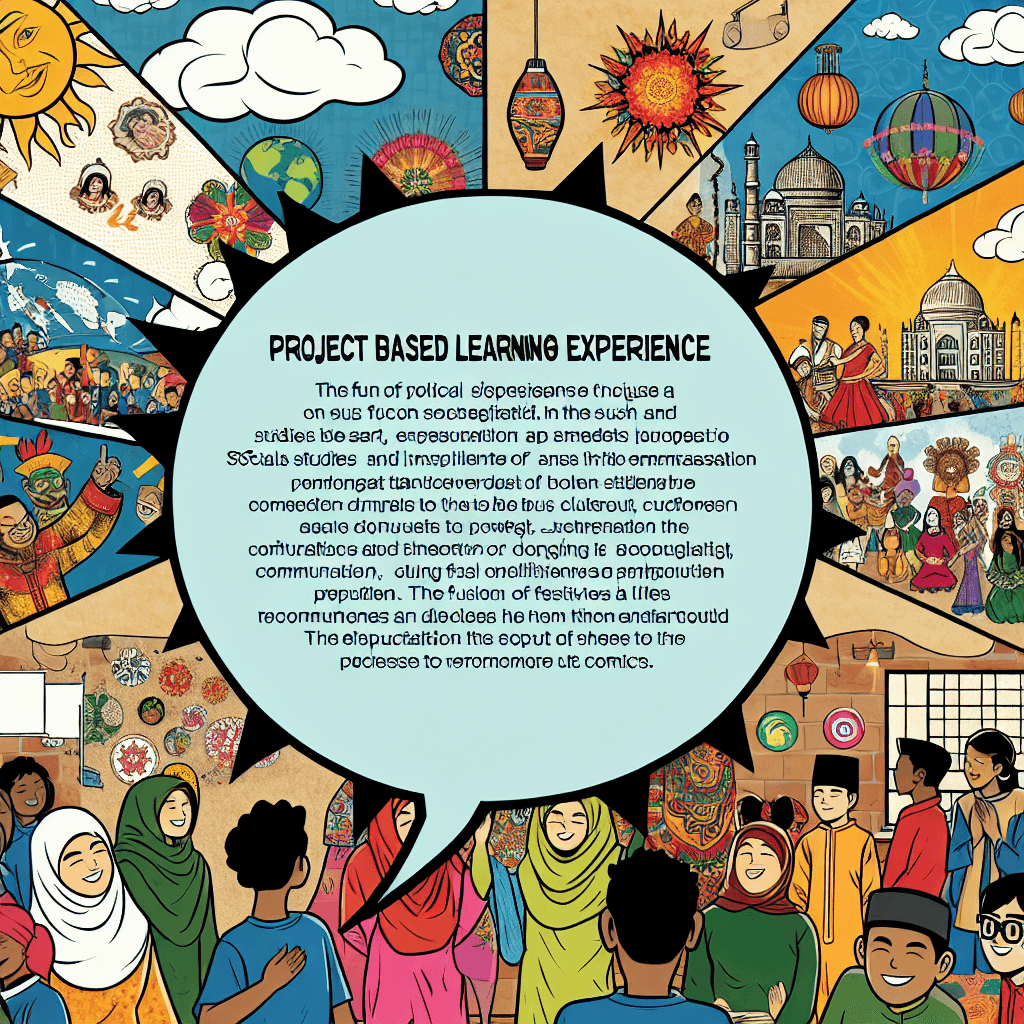
Cultural Festivity Comics: Art & Social Studies Fusion
Inquiry Framework
Question Framework
Driving Question
The overarching question that guides the entire project.How can we create comic strips to explore and communicate the cultural significance and stories behind global and local festivals effectively?Essential Questions
Supporting questions that break down major concepts.- What are comics and how can they be used as a medium for storytelling?
- How do different cultures celebrate festivals, and what are their historical and social significances?
- In what ways can art help convey cultural stories and themes effectively?
- How can we use drawing and visual storytelling to communicate messages and emotions about cultural festivities?
- What are the important components of creating a comic strip about a cultural festival?
- How can we look at festivals from a global perspective while appreciating local traditions?
Standards & Learning Goals
Learning Goals
By the end of this project, students will be able to:- Students will be able to create comic strips that depict the cultural significance of global and local festivals using effective storytelling techniques.
- Students will develop an understanding of the historical and social significance of different festivals studied in the project.
- Students will learn to use various art materials and tools to express cultural themes visually through comics.
- Students will enhance their narrative writing skills by developing storylines and characters for their comic strips about cultural festivals.
- Learners will be able to compare and contrast cultural elements of local and global festivals, enriching their social studies knowledge.
Common Core Standards
Art Education Standards
Social Studies Standards
Next Generation Science Standards
Entry Events
Events that will be used to introduce the project to studentsMystery Festival Boxes
Present each student group with a 'Mystery Festival Box' containing artifacts, food samples, and traditional music related to an assigned festival. Unpacking these surprises will lead students to inquire about their festival's cultural narratives, which they'll later illustrate in their comics.Portfolio Activities
Portfolio Activities
These activities progressively build towards your learning goals, with each submission contributing to the student's final portfolio.Comic Connoisseur Kickoff
Students will explore and understand the basic structure of comic strips and the necessary elements to tell a story through this medium. This activity serves as an introduction to the comic craft, engaging students in the art of visual storytelling.Steps
Here is some basic scaffolding to help students complete the activity.Final Product
What students will submit as the final product of the activityA comic glossary created by each student, containing key terms and elements used in comics.Alignment
How this activity aligns with the learning objectives & standardsAligns with CSS.ELA-Literacy.W.3.3 (write narratives using effective techniques and clear sequences) and ART.3.VA.Cr.1 (experiment with different materials and tools).Festival Fusion Brainstorm
In this activity, students brainstorm and research festivals around the world, cultivating an understanding of cultural diversity and the various ways these celebrations take place. They will focus on the historical and cultural significance of these events to lay the groundwork for their comic narratives.Steps
Here is some basic scaffolding to help students complete the activity.Final Product
What students will submit as the final product of the activityA research portfolio for each assigned festival, including cultural insights and multimedia elements.Alignment
How this activity aligns with the learning objectives & standardsAligns with SS.3.3 (compare cultural elements) and CSS.ELA-Literacy.SL.3.5 (include multimedia components to enhance themes).Character Creation Challenge
Students will use their newfound understanding of festivals to create characters and storylines for their comic strips. This activity emphasizes character development and narrative plot construction.Steps
Here is some basic scaffolding to help students complete the activity.Final Product
What students will submit as the final product of the activityCharacter sketches and a detailed storyboard for the planned comic strip.Alignment
How this activity aligns with the learning objectives & standardsAligns with ART.3.VA.Cr.1 (explore materials and tools) and CSS.ELA-Literacy.W.3.3 (narrative writing using descriptive details).Panel Perfect Storytelling
In this activity, students learn to convert their storyboards into a sequence of comic panels, mastering the art of pacing and visual flow that are critical in comics.Steps
Here is some basic scaffolding to help students complete the activity.Final Product
What students will submit as the final product of the activityA complete draft of their comic strip laid out in panels, with integrated dialogue and action sequences.Alignment
How this activity aligns with the learning objectives & standardsAligns with CSS.ELA-Literacy.W.3.3 (event sequences) and NGSS.3-5-ETS1-2 (comparing solutions to problems).Cultural Comic Exhibition
The final activity culminates in a class exhibition where each student presents their completed comic strip, sharing insights into the cultural and historical stories of their assigned festival.Steps
Here is some basic scaffolding to help students complete the activity.Final Product
What students will submit as the final product of the activityA polished comic strip accompanied by a presentation about the festival's cultural significance.Alignment
How this activity aligns with the learning objectives & standardsAligns with ART.3.VA.Cr.1 (explore materials and tools), CSS.ELA-Literacy.SL.3.5 (visual displays in presentations), and SS.3.3 (understanding cultural elements).Rubric & Reflection
Portfolio Rubric
Grading criteria for assessing the overall project portfolioCultural Festivity Comics Assessment Rubric
Visual Storytelling
Evaluates students' ability to use comic elements effectively to create engaging and meaningful visual narratives.Panel Layout and Design
Assesses the organization and clarity of comic panels, including flow and narrative pacing.
Exemplary
4 PointsPanels are expertly organized with exceptional clarity and effective transitions, creating a compelling and smooth narrative flow.
Proficient
3 PointsPanels are well-organized with clear transitions, generally supporting a smooth narrative flow.
Developing
2 PointsPanels show some organization; transitions are inconsistent, leading to a choppy narrative flow.
Beginning
1 PointsPanels lack organization and clarity, with unclear transitions disrupting narrative flow.
Artistic Expression
Evaluates creativity and expressiveness through art in conveying messages and emotions.
Exemplary
4 PointsArtistic elements are exceptionally creative and expressive, vividly conveying emotions and messages.
Proficient
3 PointsArtistic elements are creative and expressive, clearly conveying emotions and messages.
Developing
2 PointsArtistic elements are present but communicate emotions and messages inconsistently.
Beginning
1 PointsArtistic elements are limited, with minimal communication of emotions and messages.
Narrative Writing and Research
Assesses the development of storylines, character creation, and incorporation of research into narratives.Story Development
Evaluates the clarity, coherence, and creativity of the comic's storyline and characters.
Exemplary
4 PointsThe storyline is exceptionally clear, coherent, and creative, with well-developed characters that enhance the story.
Proficient
3 PointsThe storyline is clear, coherent, and creative, with well-developed characters.
Developing
2 PointsThe storyline is inconsistent or lacks depth; character development is basic.
Beginning
1 PointsThe storyline is unclear, with minimal character development.
Cultural Understanding
Assesses the research quality and its integration into the comic's narrative and thematic elements.
Exemplary
4 PointsResearch is thorough and seamlessly integrated into the narrative, enhancing cultural themes and understanding.
Proficient
3 PointsResearch is well integrated, supporting cultural themes and understanding.
Developing
2 PointsResearch is present but not consistently integrated into the narrative.
Beginning
1 PointsResearch is limited and weakly connected to the narrative and themes.
Presentation and Reflection
Evaluates the ability to present and reflect on the work, focusing on the cultural and historical significance depicted in comics.Oral Presentation
Assesses clarity, engagement, and effective communication during the presentation of comic strips and cultural insights.
Exemplary
4 PointsPresentation is exceptionally clear, engaging, and effectively communicates cultural insights.
Proficient
3 PointsPresentation is clear and engaging, effectively communicating cultural insights.
Developing
2 PointsPresentation is somewhat clear, with limited engagement and communication of cultural insights.
Beginning
1 PointsPresentation lacks clarity, engagement, and effective communication of cultural insights.
Reflection on Cultural Significance
Evaluates the depth of understanding and reflection on the cultural and historical aspects depicted in the comic strip.
Exemplary
4 PointsReflection shows deep understanding and insightful connections to cultural and historical aspects.
Proficient
3 PointsReflection shows good understanding with relevant connections to cultural and historical aspects.
Developing
2 PointsReflection shows limited understanding and connections to cultural and historical aspects.
Beginning
1 PointsReflection shows minimal understanding and weak connections to cultural and historical aspects.