
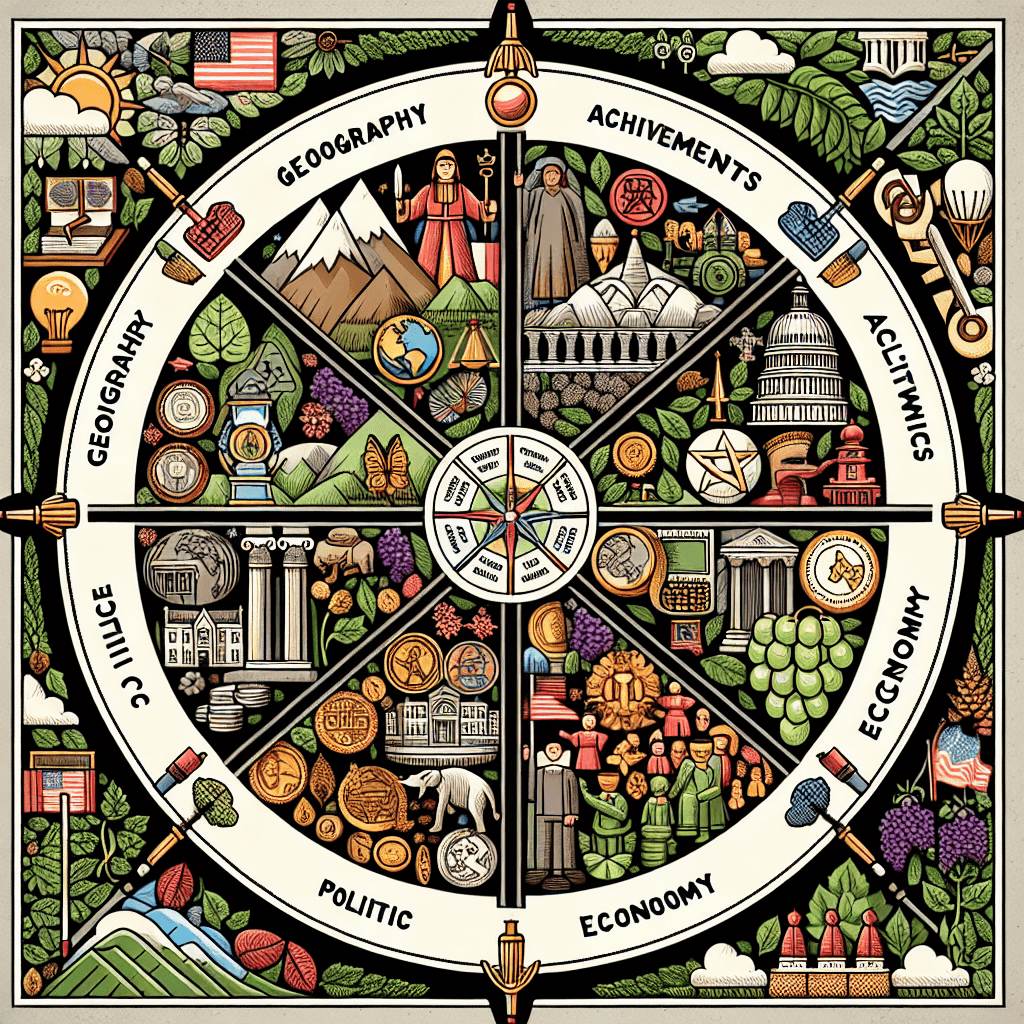
Cultural Kaleidoscope: Explore Countries via GRAPES and Traditions
Inquiry Framework
Question Framework
Driving Question
The overarching question that guides the entire project.How can we explore the diverse cultures of the world through their geography, religion, achievements, politics, economics, and social structures (GRAPES), as well as their traditions, holidays, food, and music, to gain a deeper understanding of their cultural identities and histories?Essential Questions
Supporting questions that break down major concepts.- What are the key components of a culture's geography, religion, achievements, politics, economics, and social structures (GRAPES), and how do they influence the life of its people?
- How do the traditions, holidays, food, and music of a country reflect its cultural identity and history?
- In what ways do different cultures compare and contrast in their GRAPES elements and customs?
- How can understanding diverse cultures through their GRAPES and customs foster greater global awareness and empathy?
Standards & Learning Goals
Learning Goals
By the end of this project, students will be able to:- Understand and analyze the six components of GRAPES (Geography, Religion, Achievements, Politics, Economics, Social Structures) for various countries and how they shape cultural identity.
- Explore and compare traditions, holidays, food, and music of different countries to appreciate cultural diversity.
- Develop research skills by sourcing information from multiple channels to answer specific cultural questions.
- Enhance presentation skills by logically organizing findings and clearly communicating them to an audience.
- Foster global awareness and empathy through understanding diverse cultures and their histories.
Common Core Standards
C3 Framework for Social Studies State Standards
Entry Events
Events that will be used to introduce the project to studentsCultural Exchange Fair
Create a mock cultural fair where students receive 'passports' and explore stations representing different aspects of G.R.A.P.E.S. and customs from various countries, filling their passport with stamps. This event encourages curiosity and immediate engagement.Virtual World Tour
Host a virtual reality day where students 'visit' countries to experience their cultures through immersive technology, focusing on G.R.A.P.E.S. and traditions. This tech-driven approach appeals to student interests and broadens inquiry pathways.Global Cuisine Cook-Off
Students are divided into small groups representing different countries. Each group collaborates to research and cook a traditional dish that aligns with the G.R.A.P.E.S. model, sharing their culinary efforts and newfound knowledge in a class feast.Portfolio Activities
Portfolio Activities
These activities progressively build towards your learning goals, with each submission contributing to the student's final portfolio.Cultural Passport Exploration
Students will create a 'passport' booklet documenting their chosen country. They will explore the six G.R.A.P.E.S components for their selected nation, enhancing their research skills.Steps
Here is some basic scaffolding to help students complete the activity.Final Product
What students will submit as the final product of the activityA completed passport booklet with a comprehensive overview of the country's G.R.A.P.E.S.Alignment
How this activity aligns with the learning objectives & standardsAligns with CCSS.ELA-LITERACY.W.6.7 and CCSS.ELA-LITERACY.RH.6-8.7 as students conduct research and integrate visual information.Traditions and Celebrations Exhibit
Students will create a presentation detailing the traditions, holidays, food, and music of their chosen country, fostering appreciation for cultural diversity.Steps
Here is some basic scaffolding to help students complete the activity.Final Product
What students will submit as the final product of the activityAn exhibit board or digital presentation showcasing traditions and celebrations.Alignment
How this activity aligns with the learning objectives & standardsCovers CCSS.ELA-LITERACY.RI.6.7 and D2.Geo.2.6-8 as students integrate different information formats and use geographical tools.Global Cuisine Feast
In groups, students will research and prepare a traditional dish from their country of study, sharing their culinary experiences and insights.Steps
Here is some basic scaffolding to help students complete the activity.Final Product
What students will submit as the final product of the activityA prepared traditional dish, presented with cultural insights and documented through photos or video.Alignment
How this activity aligns with the learning objectives & standardsStudents practice CCSS.ELA-LITERACY.SL.6.4 by presenting their findings and sharing the dish, enhancing communication skills.Cultural Kaleidoscope Presentation
Students will synthesize their research and experiences into a comprehensive presentation demonstrating their understanding of their chosen country.Steps
Here is some basic scaffolding to help students complete the activity.Final Product
What students will submit as the final product of the activityA multimedia presentation synthesizing all aspects of the cultural exploration project.Alignment
How this activity aligns with the learning objectives & standardsAligns with CCSS.ELA-LITERACY.SL.6.4 by requiring effective communication and presentation of ideas and findings.Rubric & Reflection
Portfolio Rubric
Grading criteria for assessing the overall project portfolioCultural Exploration and Presentation Rubric
Research Skills
Evaluates the student's ability to conduct effective research on cultural components using various resources.Information Gathering
Measures the student's ability to gather relevant, diverse, and credible information on GRAPES and cultural customs.
Exemplary
4 PointsGathers a wide range of relevant, credible, and diverse information, surpassing requirements and drawing from various sophisticated sources.
Proficient
3 PointsGathers relevant and credible information from various sources, meeting the research requirements.
Developing
2 PointsGathers some relevant information, but lacks diversity or credibility in sources.
Beginning
1 PointsStruggles to gather relevant information, relying on few or non-credible sources.
Integration and Analysis
Assesses the student's ability to integrate and analyze cultural components, including GRAPES and customs.Synthesis of Information
Measures the ability to integrate visual, textual, and numerical data to form coherent cultural insights.
Exemplary
4 PointsExceptional integration of varied data types resulting in sophisticated cultural insights.
Proficient
3 PointsSuccessfully integrates data types with coherent cultural insights.
Developing
2 PointsPartially integrates data, leading to incomplete cultural insights.
Beginning
1 PointsLimited integration of data, resulting in superficial cultural insights.
Presentation Skills
Evaluates the effectiveness of the student's presentation in terms of communication, organization, and engagement.Quality of Presentation
Measures clarity, organization, and engagement in presenting cultural findings.
Exemplary
4 PointsPresents in a highly organized, clear, and engaging manner with outstanding use of visuals.
Proficient
3 PointsPresents clearly and with good organization, using visuals effectively.
Developing
2 PointsPresentation is somewhat organized and clear, with basic use of visuals.
Beginning
1 PointsPresentation lacks clarity, organization, and effective use of visuals.
Cultural Understanding
Assesses the depth of understanding of cultural components and empathy towards diverse cultures.Depth of Cultural Understanding
Measures the depth of analysis and empathy towards the explored culture's components.
Exemplary
4 PointsDemonstrates profound understanding and empathy towards cultural diversity, making insightful connections.
Proficient
3 PointsShows thorough understanding and appreciation of cultural diversity.
Developing
2 PointsShows basic understanding and some appreciation of cultural diversity.
Beginning
1 PointsStruggles to demonstrate understanding or empathy towards cultural diversity.