
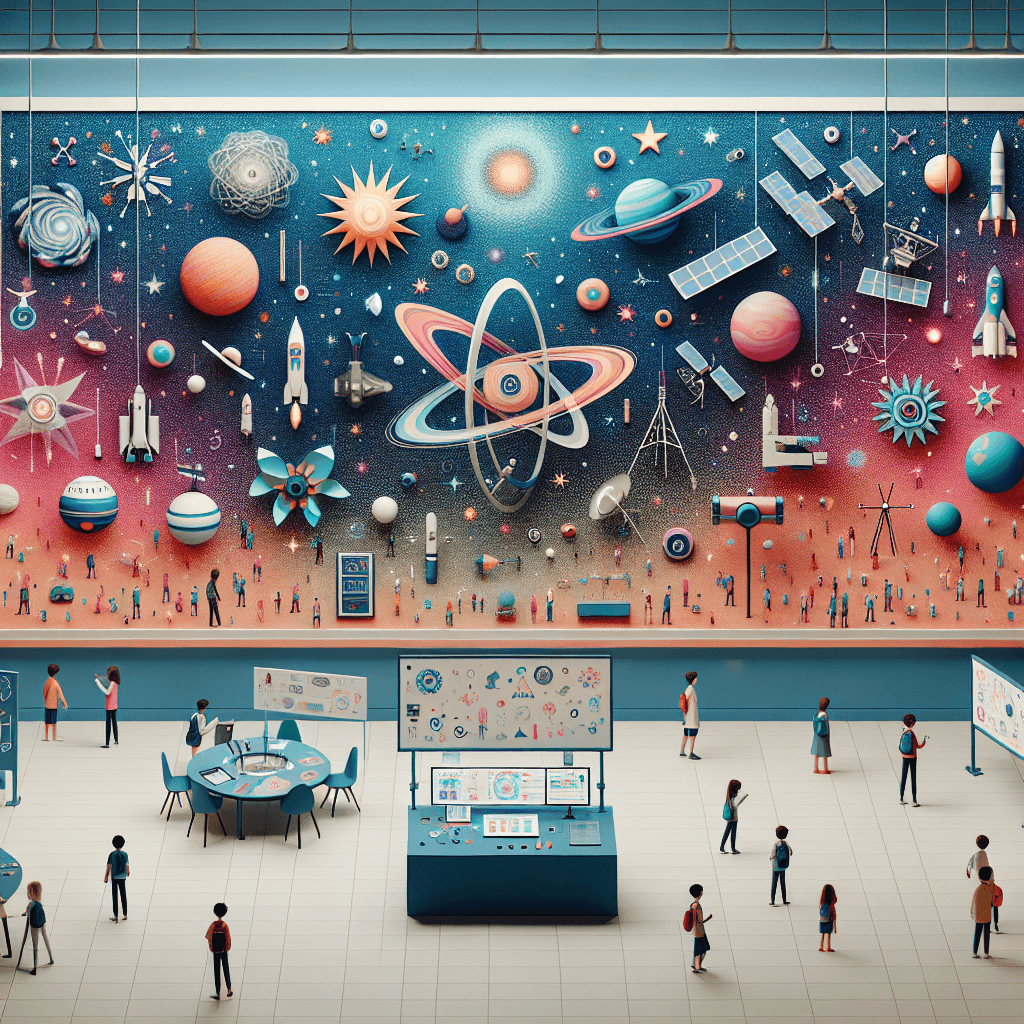
Curating the Cosmos: Space Innovation and Communication Exhibit
Inquiry Framework
Question Framework
Driving Question
The overarching question that guides the entire project.How can we, as museum curators, design an immersive exhibit that uses history, math, and science to tell the story of how innovative communication technology helps humans survive and stay connected across the extreme distances of space?Essential Questions
Supporting questions that break down major concepts.- How has the technology used to communicate in space evolved from early missions to current explorations?
- In what ways does space technology solve the problem of survival in extreme environments?
- How can we use mathematical scale and data to help museum visitors visualize the vast distances signals must travel in space?
- How can we analyze historical events, such as the Apollo missions, to understand the critical role of innovation during moments of crisis?
- What narrative techniques and visual elements are most effective at teaching a diverse audience about complex scientific concepts?
- How do the properties of light and sound waves affect the way scientists design communication tools for outer space?
Standards & Learning Goals
Learning Goals
By the end of this project, students will be able to:- Investigate and explain the physical properties of light and sound waves and how they are utilized in space communication systems.
- Analyze historical case studies, such as the Apollo missions, to determine how technological innovations addressed survival in extreme space environments.
- Apply mathematical concepts of scale, large number place value, and data visualization to accurately represent distances in the solar system within a museum exhibit.
- Curate and design an interactive museum exhibit that uses diverse media, narrative techniques, and visual elements to communicate complex scientific concepts to a specific audience.
- Conduct independent research on the evolution of space technology from early exploration to current missions and synthesize findings into a cohesive historical timeline.
Texas Essential Knowledge and Skills (TEKS) - Science
Texas Essential Knowledge and Skills (TEKS) - Social Studies
Texas Essential Knowledge and Skills (TEKS) - ELAR
Texas Essential Knowledge and Skills (TEKS) - Math
Entry Events
Events that will be used to introduce the project to studentsThe Silent Signal: A Transmission from 2075
Students receive a 'transmission from the future'—a garbled, static-filled video message from a lunar colony reporting a total communications blackout. They must decode the message and use math to calculate the distance and time-delay of the signal, realizing that without space-age innovation, the colony is lost.Portfolio Activities
Portfolio Activities
These activities progressively build towards your learning goals, with each submission contributing to the student's final portfolio.The Evolution of Echoes: A History of NASA Innovation
In this first phase, students step into their roles as historians. They will investigate how NASA has overcome the challenges of space communication from the Apollo missions to the modern day. Students will look for 'Innovation Milestones'—specific moments where technology changed to help humans survive further from Earth.Steps
Here is some basic scaffolding to help students complete the activity.Final Product
What students will submit as the final product of the activityAn 'Evolution of Echoes' Interactive Timeline. This will be a visual and textual display that highlights at least four major communication breakthroughs in NASA's history, explaining the 'Problem' and the 'Innovative Solution' for each.Alignment
How this activity aligns with the learning objectives & standardsThis activity directly addresses SS.5.5C by having students identify the accomplishments of NASA in the field of technology. It also meets ELAR.5.13C as students must synthesize information from various historical sources to create a cohesive narrative of technological change.Wave Warriors: Decoding the Physics of Space Communication
As museum curators, students must explain the science behind the 'magic' of space communication. In this activity, students conduct experiments to understand why we can't 'shout' through space. They will explore the properties of waves, focusing on why sound needs a medium (like air) and how light/radio waves can travel through the vacuum of space.Steps
Here is some basic scaffolding to help students complete the activity.Final Product
What students will submit as the final product of the activityA 'Science of the Signal' Infographic. This visual aid will use diagrams to compare sound waves and light waves, explaining to museum visitors why sound fails in a vacuum and how light carries data across the stars.Alignment
How this activity aligns with the learning objectives & standardsThis activity aligns with SCI.5.6A by requiring students to explore and differentiate between the uses and properties of light and sound energy. It specifically helps them understand why light (radio waves) is the primary form of energy for space communication.The Billion-Mile Blueprint: Scaling the Silent Signal
Museum visitors need to visualize just how far the 'Silent Signal' from 2075 had to travel. Students will use mathematical modeling to represent the vast distances of the solar system. They will convert astronomical units to kilometers and miles, then scale those numbers down to fit within the physical space of their museum exhibit.Steps
Here is some basic scaffolding to help students complete the activity.Final Product
What students will submit as the final product of the activityThe 'Billion-Mile Blueprint.' This is a scaled map of the signal's journey, featuring data cards for each planet/station that show the distance in standard numerals, expanded notation, and word form.Alignment
How this activity aligns with the learning objectives & standardsThis activity targets MATH.5.2A by requiring students to represent distances up to 1,000,000,000 in expanded notation and numerals. It also addresses MATH.5.7A as students must solve problems by calculating conversions between different units of measurement to create a scale model.The Curator’s Voice: Scripting the Story of Survival
In this final portfolio activity, students transition from researchers to designers. They will write the 'Curator’s Scripts'—the informational placards and audio-guide scripts that will accompany their artifacts. They must take the complex history (Activity 1), science (Activity 2), and math (Activity 3) they’ve learned and translate it into engaging, easy-to-understand language for their audience.Steps
Here is some basic scaffolding to help students complete the activity.Final Product
What students will submit as the final product of the activityThe Curator’s Exhibit Portfolio. This includes a collection of 'Object Labels' for each artifact and a 'Director’s Script' that provides a narrative tour of the exhibit, explaining how human innovation ensures our survival in the future.Alignment
How this activity aligns with the learning objectives & standardsThis activity fulfills ELAR.5.12B by having students compose informational texts that convey complex ideas clearly. It also serves as the final synthesis (ELAR.5.13C) of all previous research, math, and science findings into a professional museum format.Rubric & Reflection
Portfolio Rubric
Grading criteria for assessing the overall project portfolioThe Silent Signal: Space Innovation Museum Rubric
Curatorial Excellence Domains
This category assesses the multi-disciplinary skills required to design a professional and educational museum exhibit about space communication technology.Historical Synthesis: Evolution of Echoes
Ability to research and synthesize the progression of NASA's communication technology, identifying specific 'Survival Challenges' and their innovative solutions.
Exemplary
4 PointsSynthesizes information from more than three varied sources to create a sophisticated narrative. Clearly identifies four or more major NASA milestones, providing insightful analysis of how specific innovations directly addressed survival challenges during moments of crisis. Presentation is highly organized and professional.
Proficient
3 PointsSynthesizes information from at least three sources to identify four NASA milestones. Accurately identifies the 'Problem' and 'Innovative Solution' for each, showing a clear understanding of technological progression. Timeline is organized and clear.
Developing
2 PointsIdentifies 2-3 NASA milestones but synthesis is inconsistent. The connection between the 'Problem' and the 'Solution' is basic or lacks detail. Timeline is present but may have organizational gaps.
Beginning
1 PointsIdentifies 1-2 milestones with minimal research. The 'Problem' and 'Solution' are not clearly linked or are historically inaccurate. Timeline is incomplete.
Scientific Inquiry: Physics of Space Communication
Demonstration of the physical properties of light and sound waves, specifically how they behave in a vacuum and their role in data transmission.
Exemplary
4 PointsProvides a masterful comparison of light and sound waves. Infographic includes advanced details on modulation, binary/fiber optic concepts, and sophisticated diagrams of frequency and amplitude. Explanations of why light is required for space communication are exceptionally clear and nuanced.
Proficient
3 PointsEffectively compares light and sound waves using diagrams. Correctly explains that sound requires a medium (air) while light travels through a vacuum. Infographic accurately labels frequency and amplitude to show how data is carried.
Developing
2 PointsCompares light and sound but with minor scientific inaccuracies. Demonstrates a basic understanding that sound cannot travel in space, but the explanation of wave properties (frequency/amplitude) is incomplete or unclear.
Beginning
1 PointsStruggles to differentiate between light and sound properties. Diagrams are missing, mislabeled, or fail to explain how signals travel through space.
Mathematical Precision: The Billion-Mile Blueprint
Accuracy in representing large numbers (up to billions), place value notation, and the application of scale factors and measurement conversions.
Exemplary
4 PointsCalculations are flawless. Represents distances up to billions with complex expanded notation and word form. Scale factor is applied with high precision across the entire classroom model. Includes multiple, accurate conversions between metric and customary units with clear showing of work.
Proficient
3 PointsRepresents distances up to 1,000,000,000 accurately in standard, expanded, and word form. Correctly calculates a scale factor to determine physical placement in the exhibit. Successfully performs basic conversions between metric and customary units.
Developing
2 PointsNumbers in the millions or billions contain errors in place value or notation. Scale factor is applied but results in inconsistent proportions. Measurement conversions are attempted but contain mathematical errors.
Beginning
1 PointsMajor errors in representing whole numbers or place value. Scale modeling is absent or inaccurate. Measurement conversions are missing or incorrect.
Curatorial Communication & Exhibit Design
Effectiveness of informational writing, use of 'Museum Voice,' and the ability to translate complex data into engaging content for a diverse audience.
Exemplary
4 PointsExhibits a professional and captivating 'Curator’s Voice.' Technical terms are explained through brilliant metaphors or analogies. The narrative flow is seamless, leading visitors through a compelling story of human connection and survival. The portfolio is polished and error-free.
Proficient
3 PointsUses a clear informational 'Museum Voice' to write placards and scripts. Effectively explains technical terms (vacuum, expanded notation) for a general audience. The exhibit layout follows a logical narrative from history to the 2075 scenario. Writing is clear and mostly error-free.
Developing
2 PointsWriting is descriptive but occasionally too technical or too simple for the intended audience. The narrative flow between exhibit pieces is disjointed. Some placards may be missing or lack a clear central idea.
Beginning
1 PointsInformational text is incomplete or lacks a professional tone. Fails to explain complex concepts to the visitor. Little evidence of a cohesive narrative or exhibit layout.
Innovation & Collaborative Growth
Evidence of critical thinking, peer collaboration, and the ability to solve the 'Silent Signal' challenge through innovative thinking.
Exemplary
4 PointsDemonstrates exceptional critical thinking by proposing innovative hypothetical solutions for the 2075 blackout. Takes a leadership role in peer reviews, providing high-quality, growth-oriented feedback. Shows a profound understanding of how innovation ensures survival.
Proficient
3 PointsShows effective critical thinking in solving the 'Survival Challenges.' Actively participates in peer-review sessions and incorporates feedback into final drafts. Demonstrates a clear understanding of the project’s driving question.
Developing
2 PointsDemonstrates basic critical thinking but relies heavily on provided examples. Participates in collaboration but may struggle to give or receive constructive feedback. Connection to the 'Survival' theme is superficial.
Beginning
1 PointsShows minimal critical thinking or problem-solving. Requires significant support to engage in collaborative tasks. Fails to connect the exhibit artifacts to the central theme of innovation and survival.