
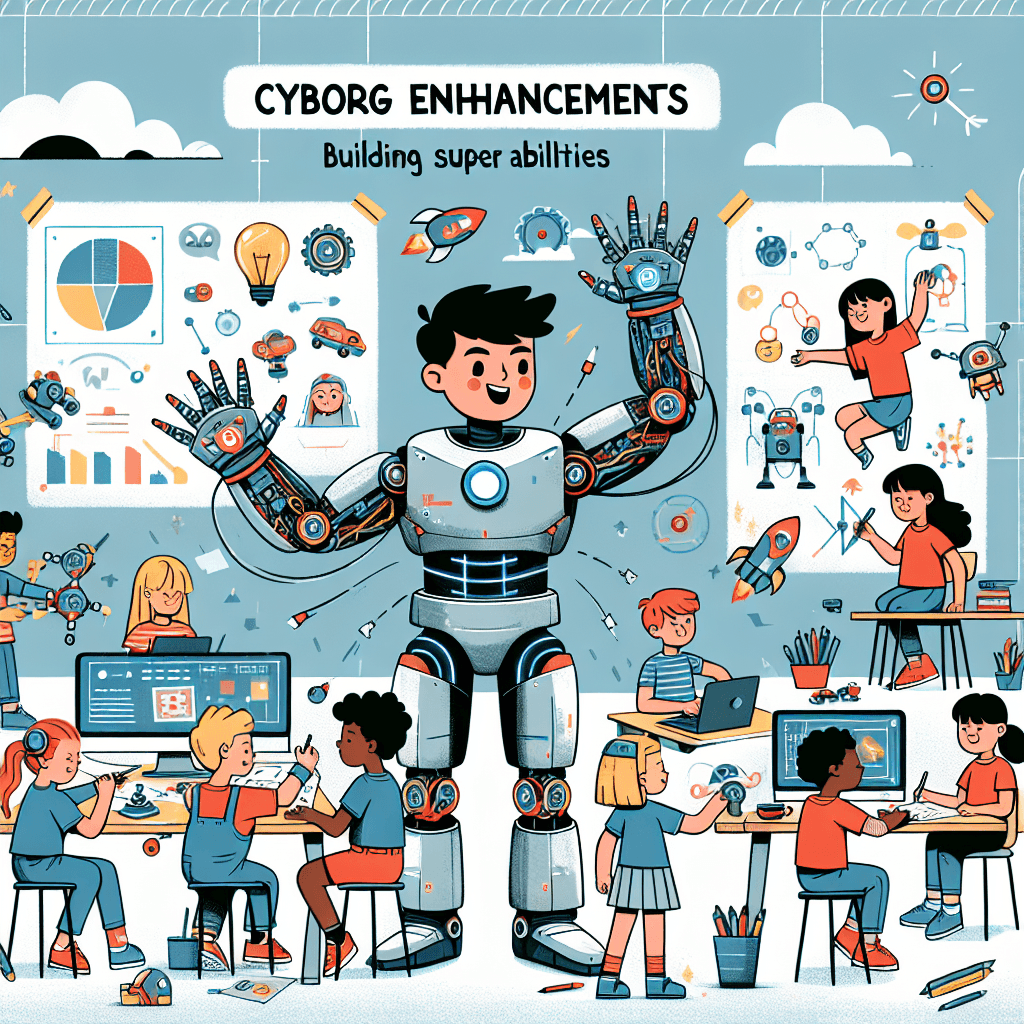
Inquiry Framework
Question Framework
Driving Question
The overarching question that guides the entire project.How can we design a prototype of a cyborg enhancement that improves daily life for individuals with disabilities or enhances normal abilities into super abilities, while considering ethical implications?Essential Questions
Supporting questions that break down major concepts.- What are cyborg enhancements and how can they change the way we live?
- How can technology help people with disabilities to function in daily life?
- In what ways can normal functions be enhanced to become super abilities?
- What ethical considerations should we think about when creating cyborg enhancements?
- How does the design process work in creating a prototype for a cyborg enhancement?
Standards & Learning Goals
Learning Goals
By the end of this project, students will be able to:- Students will define the criteria and constraints for their cyborg enhancement prototype.
- Students will evaluate different designs for their prototypes based on established criteria.
- Students will create a prototype of a cyborg enhancement that addresses a specific need.
- Students will assess the ethical implications of their prototypes.
- Students will present their prototype and rationale to the class.
Next Generation Science Standards (NGSS)
Common Core Standards
Entry Events
Events that will be used to introduce the project to studentsSuperhero Enhancement Day
Students discover that they have been selected as science consultants for a new superhero movie. They must design cyborg enhancements for the heroes, based on real-world technologies and challenges faced by people with disabilities.Portfolio Activities
Portfolio Activities
These activities progressively build towards your learning goals, with each submission contributing to the student's final portfolio.Cyborg Inspiration Gallery
In this activity, students explore different types of technological enhancements and disabilities to draw inspiration for their own cyborg prototypes. They will research various enhancements available in modern technology or in fiction and discuss both the pros and cons of such improvements.Steps
Here is some basic scaffolding to help students complete the activity.Final Product
What students will submit as the final product of the activityA visual poster or digital slideshow that highlights at least two cyborg enhancements, their functions, and a brief opinion piece discussing their benefits and challenges.Alignment
How this activity aligns with the learning objectives & standardsThis activity aligns with understanding technological advancements (NGSS 4-ETS1-1) and discussing how they impact society.Cyborg Concept Creator
Building on the previous activity, students will conceptualize their own cyborg enhancements. They will choose a disability or normal function that they want to enhance and design an original cyborg prototype that addresses it.Steps
Here is some basic scaffolding to help students complete the activity.Final Product
What students will submit as the final product of the activityA detailed sketch of the cyborg enhancement along with a written description of its function and purpose.Alignment
How this activity aligns with the learning objectives & standardsThis activity aligns with STEM design and engineering practices (NGSS 4-ETS1-2) by encouraging students to design solutions to real-world problems.Cyborg Prototype Builder
In this hands-on activity, students will create a physical prototype of their cyborg enhancement using various art supplies. This encourages them to make their designs tangible and consider the challenge of engineering limitations.Steps
Here is some basic scaffolding to help students complete the activity.Final Product
What students will submit as the final product of the activityA 3D prototype of the designed cyborg enhancement, ready to be presented to peers for feedback.Alignment
How this activity aligns with the learning objectives & standardsThis activity supports the engineering design process (NGSS 4-ETS1-3) and allows students to physically create their ideas.Cyborg Advocacy Campaign
Students will learn to advocate for their cyborg enhancement by creating a persuasive campaign that includes a written piece and visual components to effectively communicate their enhancement's benefits.Steps
Here is some basic scaffolding to help students complete the activity.Final Product
What students will submit as the final product of the activityA persuasive letter and accompanying visual component (flyer/infographic) that advocates for the cyborg enhancement, presented to the audience.Alignment
How this activity aligns with the learning objectives & standardsThis activity aligns with writing informational texts and supporting ideas with reasons and evidence (CCSS.ELA-Literacy.W.4.1).Cyborg Reflection Journal
In this final reflective activity, students will assess their learning throughout the project and contemplate the implications of cyborg technology on society and individuals.Steps
Here is some basic scaffolding to help students complete the activity.Final Product
What students will submit as the final product of the activityA reflective journal entry that captures the learning journey and thoughts on the implications of cyborg technology.Alignment
How this activity aligns with the learning objectives & standardsThis activity prompts critical thinking and self-assessment, linking to deeper understanding of ethical issues and societal impacts (NGSS Crosscutting Concepts).Rubric & Reflection
Portfolio Rubric
Grading criteria for assessing the overall project portfolioCyborg Enhancement Project Rubric
Research and Understanding
Assesses the depth of research, understanding of cyborg enhancements, and ability to relate them to real-world applications.Comprehensive Research
Evaluation of the thoroughness and relevance of research conducted on cyborg enhancements from various sources.
Exemplary
4 PointsConducts thorough research with diverse sources, demonstrating an in-depth understanding of cyborg enhancements and effectively relates findings to real-world applications.
Proficient
3 PointsConducts comprehensive research with multiple sources, demonstrating a clear understanding of cyborg enhancements and referencing some real-world applications.
Developing
2 PointsConducts basic research with few sources, demonstrating a partial understanding of cyborg enhancements with limited reference to real-world applications.
Beginning
1 PointsConducts minimal research with one or two sources, showing little understanding of cyborg enhancements and minimal connection to real-world applications.
Ethical Considerations
Assessment of the student's ability to identify and discuss the ethical implications of cyborg enhancements.
Exemplary
4 PointsInsightfully identifies and discusses multiple ethical considerations with well-supported arguments and implications for society.
Proficient
3 PointsIdentifies and discusses key ethical considerations with clear explanations and implications.
Developing
2 PointsIdentifies some ethical considerations with basic explanations and limited implications.
Beginning
1 PointsIdentifies ethical considerations superficially with little explanation.
Design and Prototyping
Evaluates the creativity, functionality, and accuracy of the cyborg enhancement design and prototype.Design Creativity
Assessment of the originality, feasibility, and innovative aspects of the cyborg enhancement design.
Exemplary
4 PointsCreates an original and innovative design that is highly feasible, showcasing exceptional creativity and purpose.
Proficient
3 PointsCreates an original design that is feasible and shows clear creativity and purpose.
Developing
2 PointsCreates a design with some original aspects but limited creativity and feasibility.
Beginning
1 PointsCreates a basic design with minimal originality and creativity.
Prototype Functionality
Evaluation of the practical execution and functionality of the cyborg prototype.
Exemplary
4 PointsBuilds a prototype that demonstrates excellent functionality and closely aligns with the design intentions.
Proficient
3 PointsBuilds a prototype that demonstrates good functionality and aligns well with the design intentions.
Developing
2 PointsBuilds a prototype with basic functionality that somewhat aligns with the design intentions.
Beginning
1 PointsBuilds a prototype with minimal functionality and alignment with the design intentions.
Collaboration and Presentation
Assesses teamwork, communication, and the effectiveness of presentations.Team Collaboration
Evaluation of the student's contribution and effectiveness in collaborating with team members.
Exemplary
4 PointsExhibits leadership and initiative, significantly contributing to the team with excellent collaboration skills.
Proficient
3 PointsEffectively collaborates with team members, contributing meaningfully and participating constructively.
Developing
2 PointsParticipates in team activities with some contribution and collaboration.
Beginning
1 PointsParticipates minimally in team activities with limited contribution.
Presentation Skills
Assessment of the clarity, engagement, and persuasiveness of the presentation delivery.
Exemplary
4 PointsDelivers a highly engaging and clear presentation that is exceptionally well-organized and persuasive.
Proficient
3 PointsDelivers a clear and engaging presentation that is well-organized and persuasive.
Developing
2 PointsDelivers a presentation with some clarity and engagement, with basic organization and persuasiveness.
Beginning
1 PointsDelivers a presentation with minimal clarity and engagement, lacking organization and persuasiveness.
Reflective and Critical Thinking
Evaluates the student's reflections on their learning journey and critical analysis of their work.Reflective Insight
Assessment of the depth and insightfulness of personal reflections on the project experience.
Exemplary
4 PointsProvides deep and insightful reflections, critically analyzing learning experiences and outcomes.
Proficient
3 PointsProvides clear and thoughtful reflections, analyzing learning experiences.
Developing
2 PointsProvides basic reflections with limited analysis of learning experiences.
Beginning
1 PointsProvides superficial reflections with minimal analysis of learning experiences.