
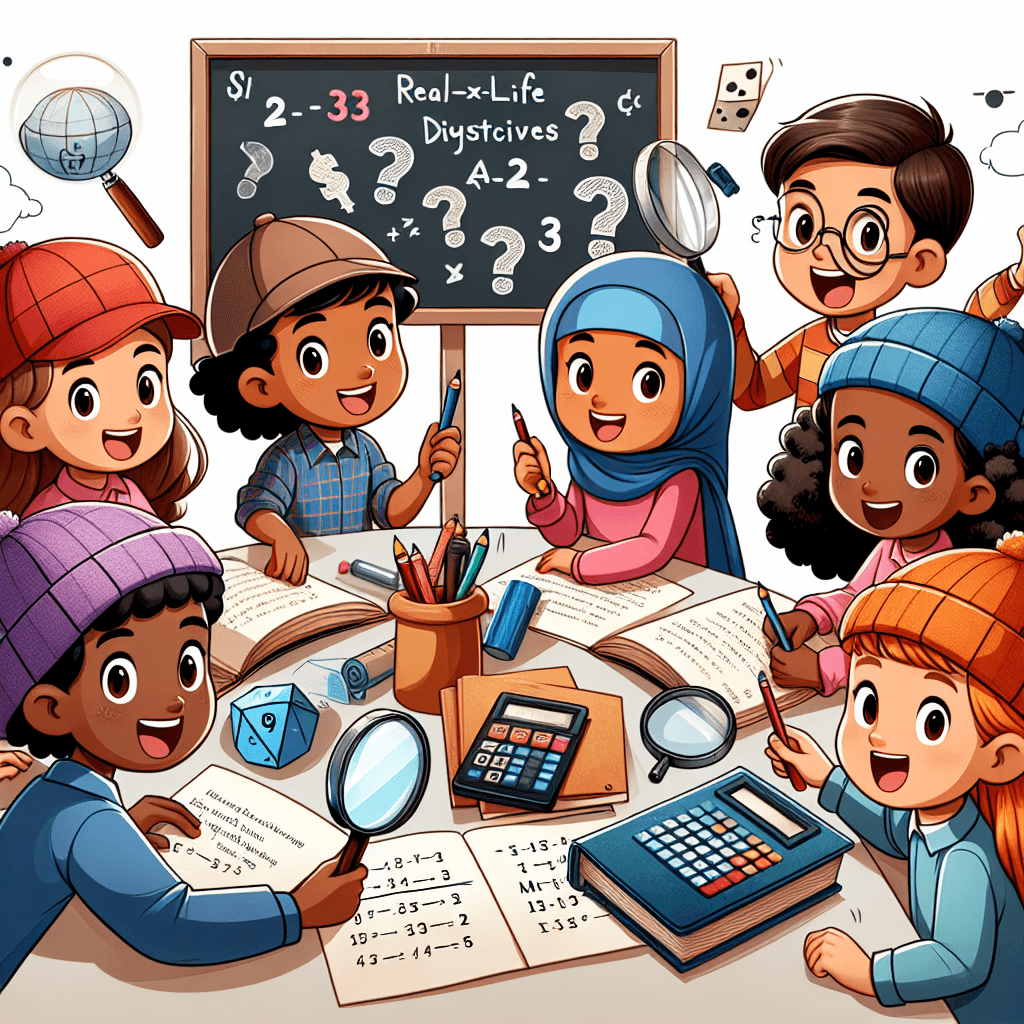
Decimal Detectives: Real-Life Math Mysteries
Inquiry Framework
Question Framework
Driving Question
The overarching question that guides the entire project.How can we, as Decimal Detectives, solve real-life puzzles by exploring the effects of division by 10 and 100 on two-digit numbers, understanding the relationship between fractions and decimals, and using these concepts to solve decimal-based word problems?Essential Questions
Supporting questions that break down major concepts.- How does dividing by 10 affect the value of a number, and how does it differ when using a two-digit number?
- What are hundredths and how can they be expressed as fractions?
- How do tenths compare to hundredths, and why is this distinction important when working with decimals?
- What happens to the digits in a number when you divide by 100, and how can a place value chart help us understand this movement?
- How can the understanding of fractions, decimals, and division be applied to solve real-life word problems involving decimals?
Standards & Learning Goals
Learning Goals
By the end of this project, students will be able to:- Students will be able to divide two-digit numbers by 10 and explain the result using place value concepts.
- Students will understand and express hundredths as fractions and compare them to tenths in various scenarios.
- Learners will master the concept of dividing one- or two-digit numbers by 100, using place value charts for clarification.
- Students will apply their understanding of decimals, fractions, and division to solve real-life word problems relevant to the detective theme.
Teacher-Specified Standards
Entry Events
Events that will be used to introduce the project to studentsDecimal Escape Room Challenge
Transform the classroom into a digital escape room where each clue involves a puzzle solving decimals, fractions, and distribution by 10 and 100. Students will eagerly dive into problem-solving as they collaborate to 'escape,' relating math to game-like challenges.Exploring Treasure Maps
Students are tasked with reading decimal coordinates on treasure maps to find the hidden treasures in the classroom. Each map leads to a new challenge involving division and decimal understanding, making math a thrilling adventure.Portfolio Activities
Portfolio Activities
These activities progressively build towards your learning goals, with each submission contributing to the student's final portfolio.Divide and Conquer: Uncovering Decimals
In this activity, students will practice dividing two-digit numbers by 10 in a series of fun detective-themed puzzles. The objective is to understand the impact of division by 10 on the numerical value and avoid common misconceptions.Steps
Here is some basic scaffolding to help students complete the activity.Final Product
What students will submit as the final product of the activityA completed set of detective-themed puzzles demonstrating the accurate division of two-digit numbers by 10.Alignment
How this activity aligns with the learning objectives & standardsCovers L1 - dividing a two-digit number by 10, understanding place value.Fraction Detective: The Case of the Missing Hundredths
Students investigate the mysterious case of hundredths in fractions. Through a series of guided exercises, they will uncover the value of hundredths and how they compare to tenths, enhancing their understanding of fractions.Steps
Here is some basic scaffolding to help students complete the activity.Final Product
What students will submit as the final product of the activityA collection of comparison charts and solved mysteries demonstrating the understanding of hundredths as fractions.Alignment
How this activity aligns with the learning objectives & standardsCovers L2 - understanding hundredths as fractions and comparing them to tenths.The Hundred Divide: Moving Places
In this activity, students will understand how dividing one- or two-digit numbers by 100 affects place value. With the help of place value charts, they will reinforce their understanding and solve related problems.Steps
Here is some basic scaffolding to help students complete the activity.Final Product
What students will submit as the final product of the activityA completed challenge book where students illustrate their comprehension of dividing numbers by 100 using place value charts.Alignment
How this activity aligns with the learning objectives & standardsCovers L3 - dividing one- or two-digit numbers by 100 and understanding place value.Decimal Sleuth: Solving Real-Life Mysteries
Students apply all their acquired knowledge of decimals, fractions, and division to solve real-life word problems, enhancing their problem-solving skills through engaging scenarios.Steps
Here is some basic scaffolding to help students complete the activity.Final Product
What students will submit as the final product of the activityA portfolio of solved word problems connecting decimals, fractions, and division to real-world scenarios.Alignment
How this activity aligns with the learning objectives & standardsCovers L4 - applying understanding of decimals and fractions to solve word problems using problem-solving skills.Rubric & Reflection
Portfolio Rubric
Grading criteria for assessing the overall project portfolioDecimal Detectives Portfolio Rubric
Understanding of Division by 10 and Place Value
Assesses student's ability to divide two-digit numbers by 10, recognizing the changes in place value and avoiding common misconceptions.Accurate Division Results
Measures accuracy in dividing two-digit numbers by 10, ensuring correct place value representation.
Exemplary
4 PointsAccurately divides all numbers and correctly explains the place value change without misconceptions.
Proficient
3 PointsAccurately divides most numbers and mostly explains place value changes correctly.
Developing
2 PointsDivides some numbers accurately but has significant mistakes in place value explanations.
Beginning
1 PointsStruggles with accurate division and shows limited understanding of place value changes.
Avoidance of Common Misconceptions
Evaluates student's ability to avoid typical mistakes such as writing results like 5.0 instead of 50.
Exemplary
4 PointsConsistently avoids misconceptions, showing clear understanding in all instances.
Proficient
3 PointsMostly avoids misconceptions with only occasional errors.
Developing
2 PointsSometimes avoids misconceptions, but has frequent errors.
Beginning
1 PointsStruggles to identify and avoid misconceptions.
Understanding of Hundredths and Fraction Equivalence
Evaluates student's ability to express hundredths as fractions and compare them to tenths.Fraction and Decimal Correlation
Assesses the understanding of the relationship between fractions and decimals, focusing on hundredths and tenths.
Exemplary
4 PointsAccurately demonstrates the relationship through clear explanations and correct conversion charts.
Proficient
3 PointsCorrectly demonstrates the relationship with minor errors.
Developing
2 PointsShows partial understanding with several errors.
Beginning
1 PointsHas difficulty explaining fractions and decimals correlation.
Application of Division by 100 and Place Value
Assesses student's ability to divide numbers by 100, using place value charts to visualize digit movement.Use of Place Value Charts
Measures student's proficiency in using charts to accurately represent digit movement in division by 100.
Exemplary
4 PointsExpertly utilizes place value charts to show precise digit changes in all instances.
Proficient
3 PointsEffectively uses place value charts with minor errors.
Developing
2 PointsUses charts with frequent errors, showing partial understanding.
Beginning
1 PointsStruggles to use charts effectively and consistently makes errors.
Problem-solving with Decimals in Real-life Scenarios
Evaluates student's ability to apply understanding of decimals and fractions to solve word problems.Effective Problem-solving Strategies
Assesses the ability to apply learned strategies to solve real-life word problems involving decimals.
Exemplary
4 PointsEffectively solves all problems, demonstrating advanced application of strategies and concepts.
Proficient
3 PointsSolves most problems correctly, showing solid strategy application.
Developing
2 PointsSolves some problems with basic application of strategies; frequent errors present.
Beginning
1 PointsStruggles to solve problems using learned strategies, regular errors occur.