
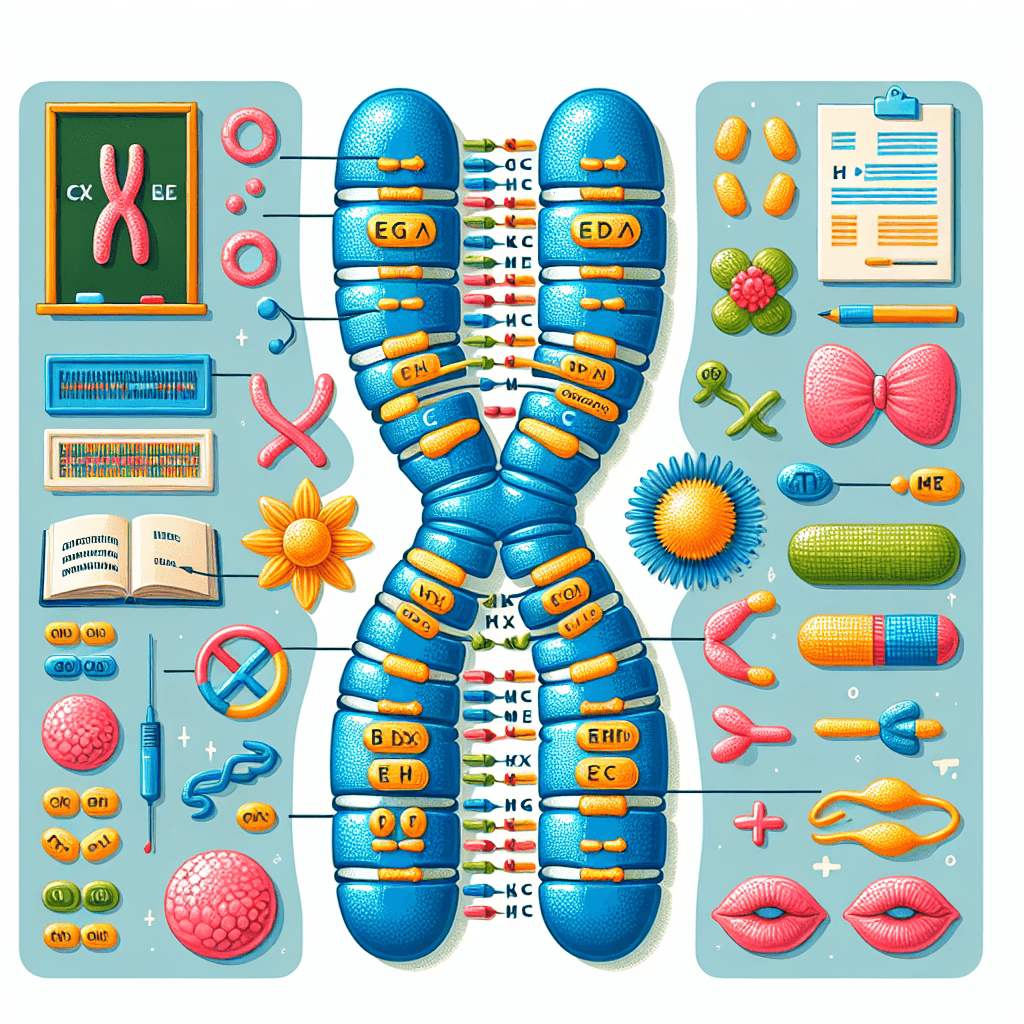
Decoding the Blueprint: Human Chromosomes and Genetic Mutations
Inquiry Framework
Question Framework
Driving Question
The overarching question that guides the entire project.How can we, as genetic counselors, help families navigate the biological causes and ethical complexities of genetic conditions by translating the "instruction manual" of human chromosomes?Essential Questions
Supporting questions that break down major concepts.- How do chromosomes act as the instruction manual for the human body?
- What is the relationship between a DNA sequence, a protein, and an observable trait?
- In what ways can a small error in the genetic code lead to a significant change in an organism?
- How do errors during the process of meiosis result in chromosomal abnormalities like Trisomy 21 or Turner Syndrome?
- Are mutations always "bad," or can they be beneficial or neutral for a population?
- How can we use tools like karyotypes and pedigrees to diagnose and predict genetic disorders?
- What are the ethical implications of genetic testing and our ability to "read" a person’s future health?
Standards & Learning Goals
Learning Goals
By the end of this project, students will be able to:- Analyze how the structure of DNA and chromosomes serves as a blueprint for protein synthesis and the expression of physical traits.
- Model the process of meiosis to explain how non-disjunction leads to chromosomal abnormalities such as Down Syndrome or Turner Syndrome.
- Evaluate the impact of different types of mutations (substitution, insertion, deletion) on protein function and organism health.
- Construct and interpret karyotypes and pedigrees to diagnose genetic conditions and predict the probability of inheritance in a family.
- Formulate an ethical argument regarding the use of genetic testing and counseling, balancing scientific data with patient autonomy and social implications.
Next Generation Science Standards (NGSS)
Common Core State Standards (ELA-Literacy)
Entry Events
Events that will be used to introduce the project to studentsThe Genetic Privacy Breach
Students arrive to find a simulated 'Data Breach' alert from a prominent genetic testing company, informing them that their anonymous genetic profiles have been 'de-anonymized' and sold to insurance providers. They must investigate how specific chromosomal markers and mutations define their health risks and whether their 'biological code' should be private property or public knowledge.Portfolio Activities
Portfolio Activities
These activities progressively build towards your learning goals, with each submission contributing to the student's final portfolio.Blueprint to Being: Mapping the Instruction Manual
In this foundational activity, students take on the role of 'Molecular Biologists' working for the counseling firm. They will select a specific human trait or condition (e.g., sickle cell, cystic fibrosis, or even eye color) and trace the 'biological flow' from a specific gene sequence to the resulting protein and final observable phenotype. This helps students understand that chromosomes aren't just shapes—they are packed with specific instructions that build the body.Steps
Here is some basic scaffolding to help students complete the activity.Final Product
What students will submit as the final product of the activityAn 'Instructional Flowchart' or digital infographic that illustrates a specific DNA sequence, the corresponding mRNA, the protein produced, and the physical trait it creates.Alignment
How this activity aligns with the learning objectives & standardsThis activity aligns with HS-LS1-1, as students construct an explanation for how the structure of DNA determines the structure of proteins and traits. It also supports HS-LS3-1 by clarifying the role of DNA as the instruction manual for characteristic traits.The Karyotype Codebreaker: Meiotic Mismatches
Now that students understand how genes work, they will investigate how large-scale chromosomal errors occur. Students will simulate the process of meiosis using 'chromosome noodles' or digital modeling tools to demonstrate non-disjunction. They will then act as 'Cytogeneticists' to analyze a 'breached' patient's genetic data and construct a digital karyotype to identify chromosomal abnormalities like Trisomy 21, Klinefelter syndrome, or Turner syndrome.Steps
Here is some basic scaffolding to help students complete the activity.Final Product
What students will submit as the final product of the activityA 'Diagnostic Karyotype Report' featuring a completed chromosomal map and a written explanation of the meiotic error (non-disjunction) that led to the condition.Alignment
How this activity aligns with the learning objectives & standardsThis activity directly addresses HS-LS3-2, requiring students to defend a claim about how inheritable genetic variations result from errors in meiosis. It also hits CCSS.ELA-LITERACY.RST.9-10.7 by requiring the translation of technical chromosomal data into a visual karyotype.Family Tree Detectives: Tracking the Mutation Path
Moving from the individual to the family, students will become 'Genetic Genealogists.' They are given a 'Case File' containing a narrative history of a family affected by the data breach. Students must translate this story into a professional pedigree chart, identifying patterns of inheritance (Autosomal Dominant, Recessive, or X-linked). They will use this visual tool to predict the likelihood of future generations inheriting specific mutations.Steps
Here is some basic scaffolding to help students complete the activity.Final Product
What students will submit as the final product of the activityA 'Family Legacy Map' (Pedigree) with a written 'Risk Assessment' that uses Punnett squares to provide statistical probabilities for the next generation.Alignment
How this activity aligns with the learning objectives & standardsThis activity aligns with RST.9-10.7 as students translate a narrative family history into a visual pedigree chart and use that chart to calculate the probability of inheritance (HS-LS3-1).The Ethics of the Code: The Counselor’s Final Brief
In the final culminating activity, students synthesize their biological findings with the ethical dilemma of the 'Genetic Privacy Breach.' They must write a formal 'Counselor’s Brief' to the affected family. This brief doesn't just explain the science; it must address the ethical implications of the data breach. Should this information be private? How should the family use this knowledge? Students must balance scientific facts with empathy and ethical reasoning.Steps
Here is some basic scaffolding to help students complete the activity.Final Product
What students will submit as the final product of the activityA 'Counselor’s Case File' consisting of a formal letter to the family and an 'Ethics Statement' regarding the privacy of the human genome.Alignment
How this activity aligns with the learning objectives & standardsThis activity aligns with HS-ETS1-3 by requiring students to evaluate the merits and limitations of genetic testing technologies. It also synthesizes HS-LS3-2 by having students defend a claim about genetic variation and its impact on human lives.Rubric & Reflection
Portfolio Rubric
Grading criteria for assessing the overall project portfolioGenetics & Human Chromosomes: Counselor's Portfolio Rubric
Molecular Genetics: The Instruction Manual
Evaluation of the student's understanding of the 'instruction manual'—how DNA codes for proteins and how specific mutations alter those instructions.Molecular Flow & Mutation Impact (HS-LS1-1, HS-LS3-1)
Examines the student's ability to model the central dogma (DNA to mRNA to Protein) and explain how genetic sequences determine specific physical traits or conditions.
Exemplary
4 PointsModels the DNA-to-trait pathway with exceptional precision; explains the specific biochemical impact of a mutation on protein folding and resulting phenotype with sophisticated detail.
Proficient
3 PointsAccurately models the DNA-to-trait pathway; explains how a mutation alters the 'instruction manual' and changes the resulting protein and trait.
Developing
2 PointsModels the DNA-to-trait pathway with minor errors; identifies that a mutation changes a trait but provides a limited explanation of the protein's role.
Beginning
1 PointsProvides an incomplete or inaccurate model of the DNA-to-trait pathway; struggles to link genetic changes to physical outcomes.
Cytogenetics: Meiotic Errors & Visualization
Focuses on the mechanical errors during cell division that lead to large-scale chromosomal variations and the tools used to visualize them.Chromosomal Dynamics & Karyotyping (HS-LS3-2)
Assesses the ability to simulate meiotic processes and accurately identify chromosomal abnormalities through the construction and analysis of a karyotype.
Exemplary
4 PointsDemonstrates a sophisticated understanding of non-disjunction by pinpointing exactly where the error occurred in meiosis; karyotype is professionally organized and diagnosis is flawlessly supported by evidence.
Proficient
3 PointsCorrectly simulates non-disjunction and organizes a karyotype to identify an abnormality; provides a clear explanation of the meiotic error.
Developing
2 PointsSimulates meiosis with some inaccuracies; identifies an abnormality in the karyotype but provides a vague or partially incorrect explanation of non-disjunction.
Beginning
1 PointsStruggles to model meiosis or identify abnormalities in the karyotype; explanation of chromosomal errors is missing or significantly flawed.
Heredity: Tracking the Genetic Legacy
Focuses on the ability to track the movement of genetic information through generations and predict future outcomes.Pedigree Analysis & Risk Assessment (RST.9-10.7, HS-LS3-1)
Evaluates the student's ability to translate narrative family data into a standard pedigree and use Punnett squares to calculate the probability of genetic inheritance.
Exemplary
4 PointsConstructs a complex, multi-generational pedigree with 100% accuracy in symbols/shading; risk assessments include sophisticated statistical reasoning and precise Punnett square applications.
Proficient
3 PointsAccurately constructs a three-generation pedigree and identifies the inheritance pattern; calculates inheritance risk correctly using Punnett squares.
Developing
2 PointsConstructs a pedigree with minor errors in symbols or connections; Punnett squares are present but may contain calculation errors or incorrect parent genotypes.
Beginning
1 PointsPedigree is disorganized or uses incorrect symbols; risk assessments are missing or lack evidence from genetic crosses.
Bioethics & Counseling Communication
Evaluation of the student's role as a counselor, balancing scientific accuracy with empathy and ethical decision-making.Ethical Synthesis & Communication (HS-ETS1-3)
Assesses the ability to translate complex biological data into empathetic, accessible language and evaluate the ethical implications of genetic privacy and testing technologies.
Exemplary
4 PointsCrafts a masterful synthesis of biological facts and ethical reasoning; provides a compelling argument for genetic privacy citing legal protections like GINA while maintaining high empathy.
Proficient
3 PointsEffectively translates technical data for a lay audience and provides a clear ethical argument regarding genetic testing and privacy based on the case file.
Developing
2 PointsSummarizes biological findings but uses excessive jargon or lacks empathy; ethical argument is present but lacks depth or specific references to the case or laws.
Beginning
1 PointsThe brief is incomplete or fails to address ethical concerns; biological explanations are unclear or inaccurate for a general audience.