
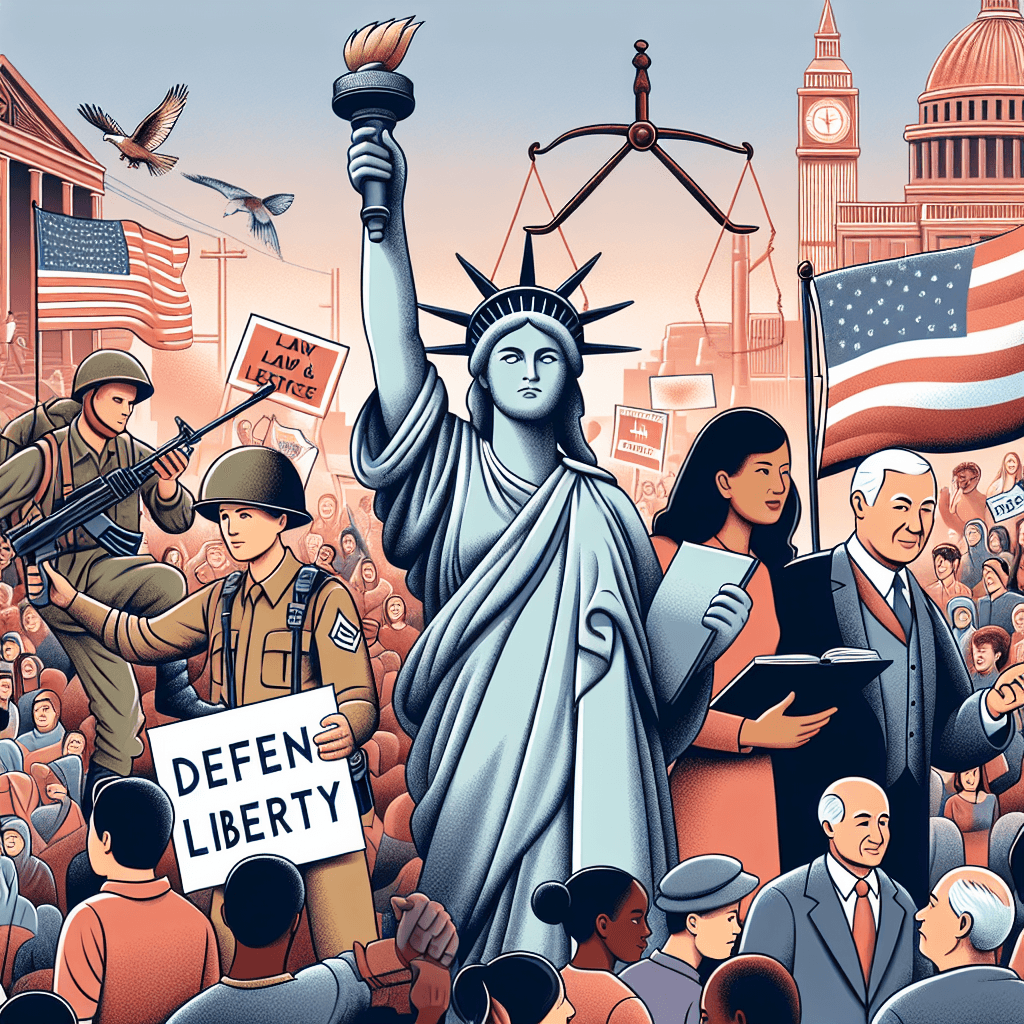
Defending Liberty: Post-WWI Attacks and the Fight for Rights
Inquiry Framework
Question Framework
Driving Question
The overarching question that guides the entire project.How can we use the lessons from the 1920s to create a "Civil Liberties Guide" that teaches our community how to protect the rights of everyone, especially when people feel afraid?Essential Questions
Supporting questions that break down major concepts.- How does fear of "outsiders" change the way a government treats its own people?
- In what ways did groups like the KKK and immigration laws make the United States feel unsafe for certain communities in the 1920s?
- How did leaders like Marcus Garvey and organizations like the NAACP and ADL fight back against unfair treatment?
- Why is it necessary to have organizations (like the ACLU) that focus specifically on protecting the rights of everyone, even during times of national fear?
- How can we use the lessons from the 1920s to help protect civil liberties in our world today?
Standards & Learning Goals
Learning Goals
By the end of this project, students will be able to:- Students will identify and describe at least three major historical events or movements from the 1920s (e.g., Palmer Raids, KKK, immigration quotas) that impacted civil liberties.
- Students will analyze and explain the strategies used by organizations like the NAACP, ACLU, and ADL to respond to attacks on civil liberties during the 1920s.
- Students will compare the historical "fear of outsiders" in the 1920s to a contemporary example of civil liberties challenges in modern society.
- Students will synthesize their historical research to create a "Civil Liberties Guide" that provides actionable advice on protecting constitutional rights for their community.
California History-Social Science Content Standards
Common Core State Standards (History/Social Studies)
Entry Events
Events that will be used to introduce the project to studentsThe Evidence Room: Unlocking 1920s Secrets
Students enter a classroom transformed into a 1920s 'Evidence Room' filled with sealed envelopes containing artifacts like a mock steamship ticket to Africa, a 'Red Scare' propaganda poster, and a coded KKK letter. Their task is to act as 'Civil Rights Detectives' to determine which items represent threats to freedom and which groups (like the ACLU or NAACP) would have stepped in to investigate.Portfolio Activities
Portfolio Activities
These activities progressively build towards your learning goals, with each submission contributing to the student's final portfolio.The Threat Detective: Case Files of Injustice
Building on the 'Evidence Room' entry event, students will act as lead detectives to investigate the 'crimes against liberty' committed in the 1920s. This activity focuses on understanding why these attacks happened (the 'motive' of fear) and what form they took. For SPED students, this is scaffolded using visual 'Case File' organizers to help categorize information about the Palmer Raids, the KKK, and immigration quotas.Steps
Here is some basic scaffolding to help students complete the activity.Final Product
What students will submit as the final product of the activityA 'Case File Portfolio' containing three completed investigation sheets, each identifying a specific threat to civil liberties, the reason behind it (fear of outsiders, etc.), and the specific groups targeted.Alignment
How this activity aligns with the learning objectives & standardsThis activity aligns with HSS-11.5.2 by having students identify the international and domestic philosophies (like the Red Scare) that prompted attacks on civil liberties (Palmer Raids, KKK). It also addresses CCSS.ELA-LITERACY.RH.11-12.1 by requiring students to cite specific details from the 'evidence' provided.The Rights Rescuers: Mission Briefing
Now that students have identified the threats, they must research the 'Rescuers.' Students will explore how the NAACP, ACLU, and ADL fought back. This activity uses a 'Mission Briefing' format to help students simplify complex legal and social strategies into clear actions (e.g., 'The NAACP uses the law to fight for fairness' or 'The ACLU protects the right to speak').Steps
Here is some basic scaffolding to help students complete the activity.Final Product
What students will submit as the final product of the activityA 'Defenders' Mission Brief' which includes a matching chart linking specific 1920s threats to the organization that fought them, along with one 'Strategy Card' for each organization describing their main method of defense.Alignment
How this activity aligns with the learning objectives & standardsThis activity aligns with HSS-11.5.2 (analyzing responses of organizations like the ACLU, NAACP, and ADL) and CCSS.ELA-LITERACY.RH.11-12.2 (determining central ideas and providing an accurate summary of their philosophies).The History Mirror: Then and Now
In this activity, students connect the 1920s to the present day. They will look at a modern headline or scenario (provided by the teacher) and look for similarities to the Palmer Raids or immigration quotas. This helps students see that the 'philosophy of fear' is a recurring theme in history, making the lessons relevant to their own lives.Steps
Here is some basic scaffolding to help students complete the activity.Final Product
What students will submit as the final product of the activityA 'Then vs. Now' Comparison Map (Venn Diagram or T-Chart) that shows at least two similarities between a 1920s civil liberties attack and a modern-day challenge.Alignment
How this activity aligns with the learning objectives & standardsAligns with CCSS.ELA-LITERACY.RH.11-12.7 (integrating multiple sources to solve a problem) and Learning Goal 3 (comparing historical 'fear of outsiders' to contemporary examples).The Blueprint for Liberty: A Community Guide
Students will compile their research from the previous activities to create the final 'Civil Liberties Guide.' This guide is designed to be a resource for their school or community. For a SPED classroom, this can be a 'Quick-Tips' brochure or a digital slide deck that uses simple language and strong visuals to explain why rights matter and how to protect them.Steps
Here is some basic scaffolding to help students complete the activity.Final Product
What students will submit as the final product of the activityA 'Civil Liberties Guide' (brochure, poster, or digital presentation) that includes: 1. A warning about 'Signs of Fear' (lessons from 1920s), 2. A 'Who to Call' list (modern versions of NAACP/ACLU/ADL), and 3. Three 'Action Steps' for protecting community rights.Alignment
How this activity aligns with the learning objectives & standardsThis final activity synthesizes HSS-11.5.2 and all secondary standards by requiring students to communicate their historical analysis as actionable advice, meeting the project's Driving Question and Learning Goal 4.Rubric & Reflection
Portfolio Rubric
Grading criteria for assessing the overall project portfolio1920s Civil Liberties Portfolio Assessment
Civil Liberties & The Blueprint for Liberty Rubric
This rubric evaluates students' ability to analyze 1920s civil liberties violations and the corresponding organizational responses. It assesses historical investigation, comparative analysis between the past and present, and the synthesis of these lessons into a functional community advocacy tool. Designed for 11th-grade SPED, it emphasizes visual evidence, matching tasks, and structured summaries.Historical Investigation of Threats (The Case Files)
Identifying and explaining the international and domestic events and philosophies (like the Red Scare, racism, and nativism) that led to civil liberties violations in the 1920s.
Exemplary
4 PointsIndependently identifies three or more threats and provides a sophisticated analysis of the 'motive' (e.g., explaining how fear of communism specifically fueled the Palmer Raids). Case reports are detailed and cite specific evidence from the 'Evidence Room' artifacts.
Proficient
3 PointsCorrectly identifies three threats (Palmer Raids, KKK, Immigration Quotas) and identifies the 'motive' for each using the provided graphic organizers. Reports clearly describe how rights were taken away.
Developing
2 PointsIdentifies one or two threats but may struggle to clearly articulate the 'motive' or specific details of how rights were violated. Detective's Log is partially complete.
Beginning
1 PointsIdentifies at least one threat with significant teacher support. Motives are missing or incorrect, and reports are incomplete.
Advocacy and Response Strategies (The Rights Rescuers)
Analyzing the missions and methods used by the NAACP, ACLU, and ADL to defend constitutional rights against 1920s injustices.
Exemplary
4 PointsDemonstrates an advanced understanding by perfectly matching organizations to threats and creating highly detailed Strategy Cards that explain the specific impact of legal, social, or protest tactics.
Proficient
3 PointsSuccessfully matches organizations to historical cases and creates a Strategy Card that accurately explains one specific method (e.g., litigation, public education, or lobbying) used to defend rights.
Developing
2 PointsMatches some organizations correctly but Strategy Cards provide only general descriptions of defense (e.g., 'they helped people') rather than specific strategies.
Beginning
1 PointsStruggles to match organizations to cases even with simplified profile sheets. Strategy Cards are missing or do not reflect the organization's mission.
Historical Continuity (The History Mirror)
Connecting the historical 'philosophy of fear' from the 1920s to modern-day civil liberties challenges.
Exemplary
4 PointsProvides a nuanced comparison identifying three or more complex similarities between past and present. Proposes a highly relevant lesson from the 1920s that directly addresses the modern scenario provided.
Proficient
3 PointsIdentifies at least two clear similarities between a 1920s event and a modern challenge using a Comparison Map. Selects one logical lesson from the 'Defenders' to apply to today.
Developing
2 PointsIdentifies one similarity between past and present. The connection between the historical lesson and the modern problem is vague or inconsistent.
Beginning
1 PointsStruggles to find similarities between the 1920s and today. The comparison map is mostly blank or contains irrelevant information.
Synthesis and Community Advocacy (The Blueprint)
Synthesizing historical knowledge into an actionable community resource that communicates how to protect civil liberties.
Exemplary
4 PointsCreates a professional-quality guide that is exceptionally persuasive and easy to understand. Action steps are highly practical, and 'Signs of Fear' are articulated with deep historical insight.
Proficient
3 PointsProduces a complete 'Civil Liberties Guide' including all three required elements: 'Signs of Fear,' 'Who to Call' list, and three 'Action Steps.' The guide is organized and appropriate for a community audience.
Developing
2 PointsThe guide is missing one of the required elements or the 'Action Steps' are not clearly linked to the historical lessons learned. Language may be difficult for the target audience.
Beginning
1 PointsThe guide is incomplete or fails to provide actionable advice. Does not demonstrate a synthesis of the historical content from previous activities.
Use of Evidence and Literacy
The ability to find and use specific details from primary and secondary sources to support historical claims.
Exemplary
4 PointsConsistently cites specific, high-quality evidence from multiple sources (posters, letters, profiles) to support every claim in the portfolio. Uses historical vocabulary accurately and fluently.
Proficient
3 PointsCites specific textual or visual evidence from the provided artifacts to support analysis in the Detective's Log and Strategy Cards. Key terms are used correctly.
Developing
2 PointsMentions artifacts or sources generally but lacks specific citations or details. Some historical terms are used incorrectly or are missing.
Beginning
1 PointsClaims are made without evidence from the sources. Relies primarily on personal opinion or requires constant prompting to reference the materials.