
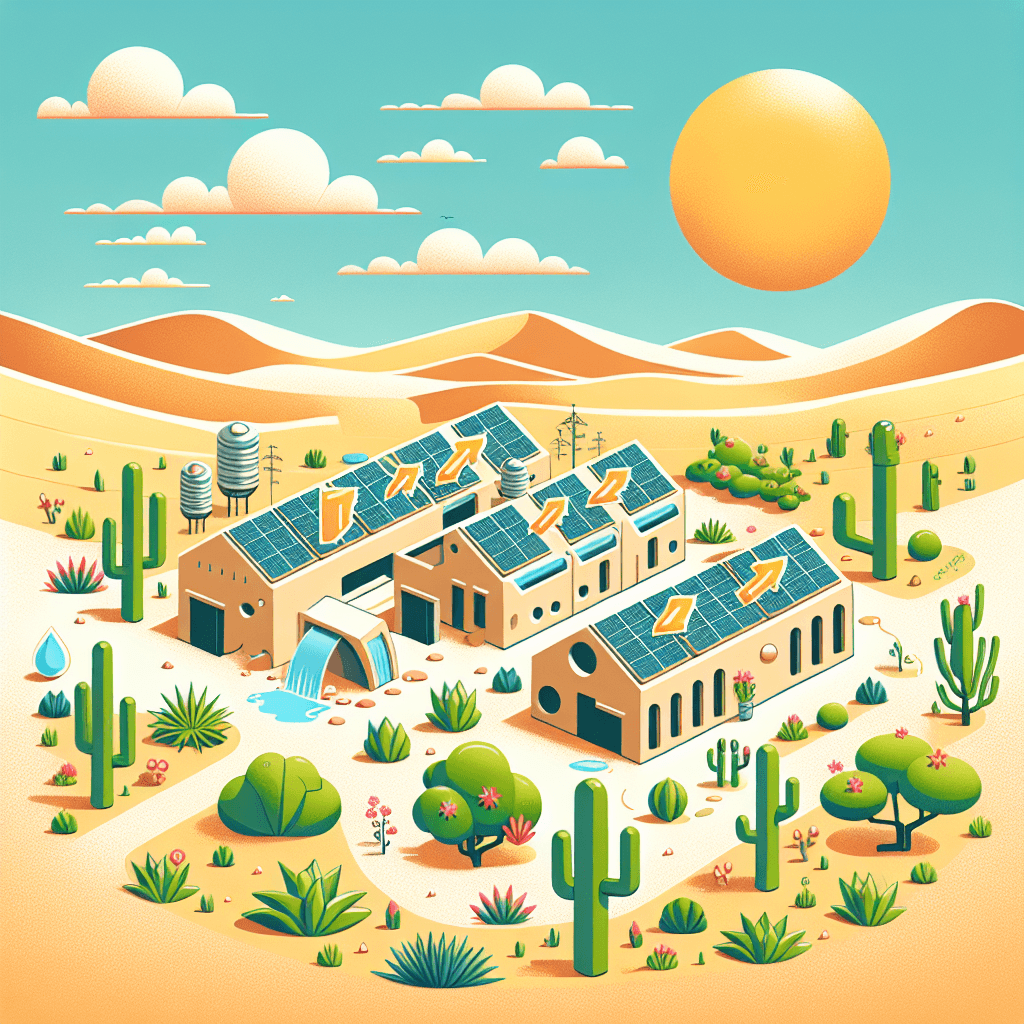
Desert Oases: Designing Sustainable Water-Harvesting Homes
Inquiry Framework
Question Framework
Driving Question
The overarching question that guides the entire project.How can we, as sustainable architects, design a residential home for the Arabian Desert that balances modern human needs with historical water-conservation techniques and the limitations of the physical environment?Essential Questions
Supporting questions that break down major concepts.- How does the climate and geography of the Arabian Desert dictate the way people live and build?
- In what ways have humans historically modified the desert environment to access and conserve water?
- How can we design a modern living space that respects the limitations of the physical environment while meeting human needs?
- What are the long-term consequences (positive and negative) of human-made water systems on the desert ecosystem?
- How do cultural values in the Arabian Peninsula influence the way people interact with their natural resources?
- What makes a water-harvesting technique 'sustainable' in one of the driest places on Earth?
Standards & Learning Goals
Learning Goals
By the end of this project, students will be able to:- Analyze the relationship between the physical geography of the Arabian Desert and the architectural adaptations required for human survival and comfort.
- Investigate and describe historical water-harvesting techniques (such as the Falaj or Qanat systems) used in the Eastern Hemisphere and explain their impact on regional development.
- Design a functional residential model that integrates traditional water conservation methods with modern sustainable technology to address water scarcity.
- Evaluate the environmental consequences of human-made water systems, distinguishing between sustainable practices and those that deplete natural resources.
- Communicate how cultural values and environmental limitations influence the decision-making process in architectural design and resource management.
Social Studies Core Standards (Grade 6)
C3 Framework for Social Studies State Standards
Next Generation Science Standards (NGSS)
Common Core State Standards for Literacy in History/Social Studies
Entry Events
Events that will be used to introduce the project to studentsThe 2050 Time Capsule: A Message from the Dunes
Students enter a classroom where every water source is taped off with 'SCARCITY ALERT' notices. They receive a 'distress signal' video from a fictional 12-year-old in the year 2050, describing how their community in the Rub' al Khali desert is thriving while others failed, prompting students to uncover the architectural secrets of that success.Portfolio Activities
Portfolio Activities
These activities progressively build towards your learning goals, with each submission contributing to the student's final portfolio.Desert Detective: The Site Analysis Portfolio
Before designing, architects must understand the terrain. In this activity, students investigate the extreme physical environment of the Rub' al Khali (Empty Quarter) or other regions of the Arabian Desert. They will research temperature fluctuations, annual rainfall, wind patterns, and sand movement to create a 'Site Analysis' that dictates their design constraints.Steps
Here is some basic scaffolding to help students complete the activity.Final Product
What students will submit as the final product of the activityA 'Desert Environmental Profile' consisting of a data sheet and a climate-response map.Alignment
How this activity aligns with the learning objectives & standardsAligns with SS.6.G.4.1 (how physical environments influence human activities) and CCSS.ELA-LITERACY.WHST.6-8.7 (conducting research to answer a question). Students investigate the specific climate barriers they must overcome.Liquid Gold: Ancient Engineering deep-dive
Students dive into the history of the Eastern Hemisphere to discover how ancient civilizations survived. They will specifically research the 'Falaj' (Oman) or 'Qanat' (Persia/Middle East) systems—gravity-driven subterranean channels that transport water. They will analyze how these systems modified the desert to allow for agriculture and permanent settlement.Steps
Here is some basic scaffolding to help students complete the activity.Final Product
What students will submit as the final product of the activityA 'Historical Hydrology' Infographic that explains the engineering and environmental impact of an ancient water-harvesting technique.Alignment
How this activity aligns with the learning objectives & standardsAligns with SS.6.G.4.1 (human activities modify the environment) and D2.Geo.9.6-8 (analyzing cultural and environmental characteristics). This focuses on historical modifications to the environment.The Architect's Site Survey: Balancing Needs
Students now define the 'Human' side of the project. They will create a 'Client Profile' for a modern family living in the desert, considering cultural values like privacy (Majlis areas) and the need for modern comforts, while balancing these against the water scarcity identified in earlier activities.Steps
Here is some basic scaffolding to help students complete the activity.Final Product
What students will submit as the final product of the activityA 'Human Needs vs. Nature' Comparison Chart and a preliminary room-list for the home.Alignment
How this activity aligns with the learning objectives & standardsAligns with D2.Geo.4.6-8 (connecting physical/human characteristics to culture) and MS-ESS3-3 (designing a method to minimize human impact). This bridges cultural needs with environmental constraints.The H2O Oasis Blueprint: Designing for Survival
Students synthesize their research into a comprehensive design. They will sketch a 2D floor plan or 3D model of their H2O Oasis home. The design must explicitly show three water-harvesting or conservation features: one inspired by history (from Activity 2), one modern technology (like atmospheric water generators), and one architectural feature (like a sloped roof for rain collection).Steps
Here is some basic scaffolding to help students complete the activity.Final Product
What students will submit as the final product of the activityA labeled Architectural Blueprint and a 'Water Path Narrative' explaining how water flows through the house.Alignment
How this activity aligns with the learning objectives & standardsAligns with SS.6.G.4.1 (Human-environment interaction) and MS-ESS3-3 (Applying scientific principles to design). This is the synthesis of all research into a tangible solution.The Guardian’s Legacy: Sustainability Impact Report
In the final portfolio piece, students evaluate their own design through the lens of long-term sustainability. They must predict the environmental consequences of their home over 50 years. Does it deplete local groundwater? Does it create a 'micro-oasis' that helps the local ecosystem? They will write a final pitch to the 'Ministry of Water' in their chosen desert region.Steps
Here is some basic scaffolding to help students complete the activity.Final Product
What students will submit as the final product of the activityA 'Sustainability Impact Report' and a Persuasive Presentation (Video or Live Pitch).Alignment
How this activity aligns with the learning objectives & standardsAligns with MS-ESS3-3 (monitoring and minimizing human impact) and D2.Geo.4.6-8 (cultural values and resource management). This final step evaluates the long-term success of the human-environment interaction.Rubric & Reflection
Portfolio Rubric
Grading criteria for assessing the overall project portfolioH2O Oasis Architect: Sustainable Design Rubric
Sustainable Architecture & Environmental Interaction
Evaluates the student's ability to analyze human-environment interaction, research historical engineering, and design sustainable architectural solutions.Environmental Literacy & Site Analysis
Accuracy and depth of research regarding the Arabian Desert's physical environment, including climate data, geographical stressors, and their specific impacts on human habitation.
Exemplary
4 PointsResearch provides sophisticated data on temperatures, precipitation, and wind. The 'Site Map' masterfully connects environmental stressors (UV, sandstorms, evaporation) to specific architectural constraints with nuanced explanations.
Proficient
3 PointsResearch includes accurate data on temperatures and precipitation. The 'Site Map' clearly identifies geographical challenges and provides logical explanations for how they affect residential design.
Developing
2 PointsResearch includes basic climate data but may lack detail. The 'Site Map' identifies some challenges, but the connection to architectural constraints is inconsistent or superficial.
Beginning
1 PointsResearch is incomplete or contains significant inaccuracies. The 'Site Map' fails to identify relevant environmental stressors or explain their impact on a home.
Historical & Cultural Synthesis
Demonstration of understanding regarding historical water-harvesting systems (Falaj/Qanat) and the integration of cultural values (e.g., privacy, Majlis) into modern sustainable living.
Exemplary
4 PointsCross-section diagrams show a sophisticated understanding of gravity-driven hydrology. The 'Client Profile' shows an exceptional ability to balance traditional cultural values with modern technological needs seamlessly.
Proficient
3 PointsDiagrams correctly illustrate how historical systems capture and move water. The 'Client Profile' effectively identifies cultural needs and traditional features like courtyards or thick walls.
Developing
2 PointsDiagrams show a basic or partial understanding of historical systems. The 'Client Profile' mentions cultural needs but does not effectively bridge them with architectural solutions.
Beginning
1 PointsHistorical systems are incorrectly described or missing. The 'Client Profile' ignores cultural context or the relationship between human needs and environmental limitations.
Architectural Design & Water Innovation
The ability to synthesize research into a functional blueprint that incorporates historical, modern, and architectural water-conservation features.
Exemplary
4 PointsBlueprint is highly innovative, featuring a central 'Water Core' and 5+ distinct eco-features. The 'Water Path Narrative' is a compelling, flawless trace of water from capture through multiple cycles of reuse.
Proficient
3 PointsBlueprint is clear and functional, featuring a 'Water Core' and 3-5 eco-features. The 'Water Path Narrative' logically explains the flow of water from harvesting to final use/recycling.
Developing
2 PointsBlueprint includes a basic layout with few eco-features. The 'Water Path Narrative' is present but contains gaps in the logic of how water is harvested or recycled.
Beginning
1 PointsBlueprint is incomplete or lacks specific water-harvesting features. The 'Water Path Narrative' is missing or fails to demonstrate a sustainable water cycle.
Sustainability Impact & Argumentation
Evaluation of the long-term environmental consequences of the design and the ability to communicate a persuasive argument for its implementation.
Exemplary
4 PointsImpact report provides a visionary 50-year prediction of ecosystem effects. The final pitch is exceptionally persuasive, offering a profound answer to the Driving Question that balances all project components.
Proficient
3 PointsImpact report realistically analyzes positive and negative consequences on the desert ecosystem. The final pitch clearly answers the Driving Question by justifying design choices based on research.
Developing
2 PointsImpact report identifies basic consequences but lacks depth in environmental analysis. The final pitch answers the Driving Question but relies on thin evidence or limited reasoning.
Beginning
1 PointsImpact report fails to predict environmental consequences. The final pitch does not address the Driving Question or provide a clear rationale for the home's design.